Cleaning Jewelry Naturally: Mineral Surface Chemistry and Ion-Exchange Restoration
Table of Contents
Things You'll Learn From This Article:
- Different jewelry materials need different cleaning methods, so always check what a piece is made of before cleaning it.
- Ultrasonic cleaners work well for very hard stones like diamonds, sapphires, and rubies, but they can crack fragile or included stones.
- Adding soap and warm water makes ultrasonic cleaning more effective by helping loosen oils and grime.
- Silver tarnish is a surface reaction, and the aluminum foil plus baking soda method removes it without scraping away real silver.
- Scrubbing silver with polish slowly wears it down, so non-abrasive methods help it last longer.
- Diamonds lose sparkle mainly because oils stick to them, not because they’re damaged.
- Simple dish soap, warm water, and a soft toothbrush are enough to restore diamond brilliance.
- Cleaning the back of a diamond matters as much as the front because that’s where light enters the stone.
- Pearls and opals are porous and fragile, so harsh chemicals, heat, and ultrasonic cleaners can permanently damage them.
- Wiping pearls and opals gently with a damp microfiber cloth after wearing removes oils before they cause problems.
- Plant-based cleaners are gentler on metals and skin but need more soaking time to work.
- Essential oils in cleaners can leave residue, so they’re not ideal for jewelry.
- Letting jewelry air-dry can leave mineral spots that dull the finish.
- Drying and buffing with a clean microfiber cloth prevents water spots and improves shine.
- Compressed air helps remove trapped water from tight settings where cloths can’t reach.
- Tarnish is removable buildup, but worn plating is permanent damage that cleaning can’t fix.
- Plated jewelry needs very gentle care because even light friction can wear through the thin metal layer.
- Cleaning jewelry before storing it slows tarnish by removing skin oils that speed up oxidation.
- Putting on lotions and perfumes before jewelry reduces buildup and makes cleaning easier later.
- Regular microfiber buffing keeps metal shiny without chemicals and reduces the need for deep cleaning.
Your jewelry takes a beating during daily wear. Between skin oils, lotions, soap residue, and atmospheric pollutants, every piece accumulates a film that gradually dulls its sparkle. The challenge is that different materials require completely different cleaning approaches. What works perfectly on diamonds could destroy a pearl. What restores silver brilliance might strip plating from costume jewelry.
Commercial jewelry cleaners often rely on harsh chemicals that create their own problems over time.
Understanding each material’s limits is essential for effective care. This guide covers the science behind cleaning precious metals and gemstones naturally. We’ll explore ultrasonic cleaning for hard stones, the brilliant electrochemistry of the baking soda method for silver, and the gentle protocols required for porous organic gems like pearls and opals. With the right techniques, you can maintain professional-level shine without the risks of aggressive chemicals.
Ultrasonic Cleaning: Blasting Away Hidden Grime
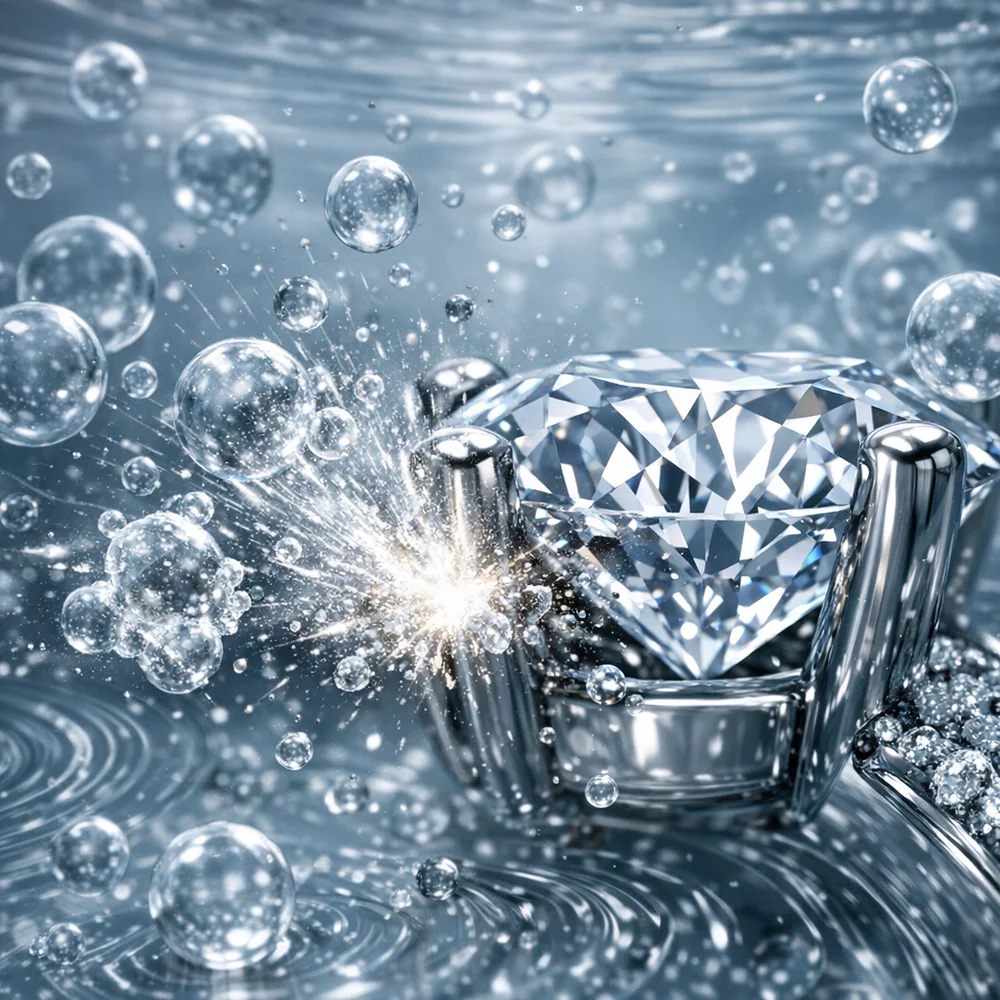
For hard gemstones like diamonds, sapphires, and rubies, ultrasonic cleaners are the gold standard. These devices use an electronic transducer to generate high-frequency sound waves in a water bath. The sound waves create alternating pressure cycles that form and collapse millions of microscopic vacuum bubbles. When these bubbles implode near a surface, they release significant localized energy.
This process, called acoustic cavitation, blasts soil, grease, and oxidized particles from every facet and hidden crevice.
The main advantage is reaching areas that manual wiping can’t touch, like the internal setting under a stone or tiny gaps in a chain. However, this same energy poses a real risk to fragile gems. Shatter-prone stones or gems with heavy inclusions can crack as the vibrations widen internal fractures. To maximize effectiveness, always add a quality detergent to the water. The soap reduces surface tension and enhances the cavitation process. Heat the water to around 50 degrees Celsius to help break down lipids faster.
Key Insight: Ultrasonic cleaners utilize acoustic cavitation, the rapid formation and collapse of microscopic vacuum bubbles, to mechanically “blast” soil from inaccessible settings. This high-energy protocol provides a superior deep-clean for hard gemstones while posing a fracture risk for soft or organic minerals.
The Aluminum Foil Trick: Silver Restoration Without Scrubbing
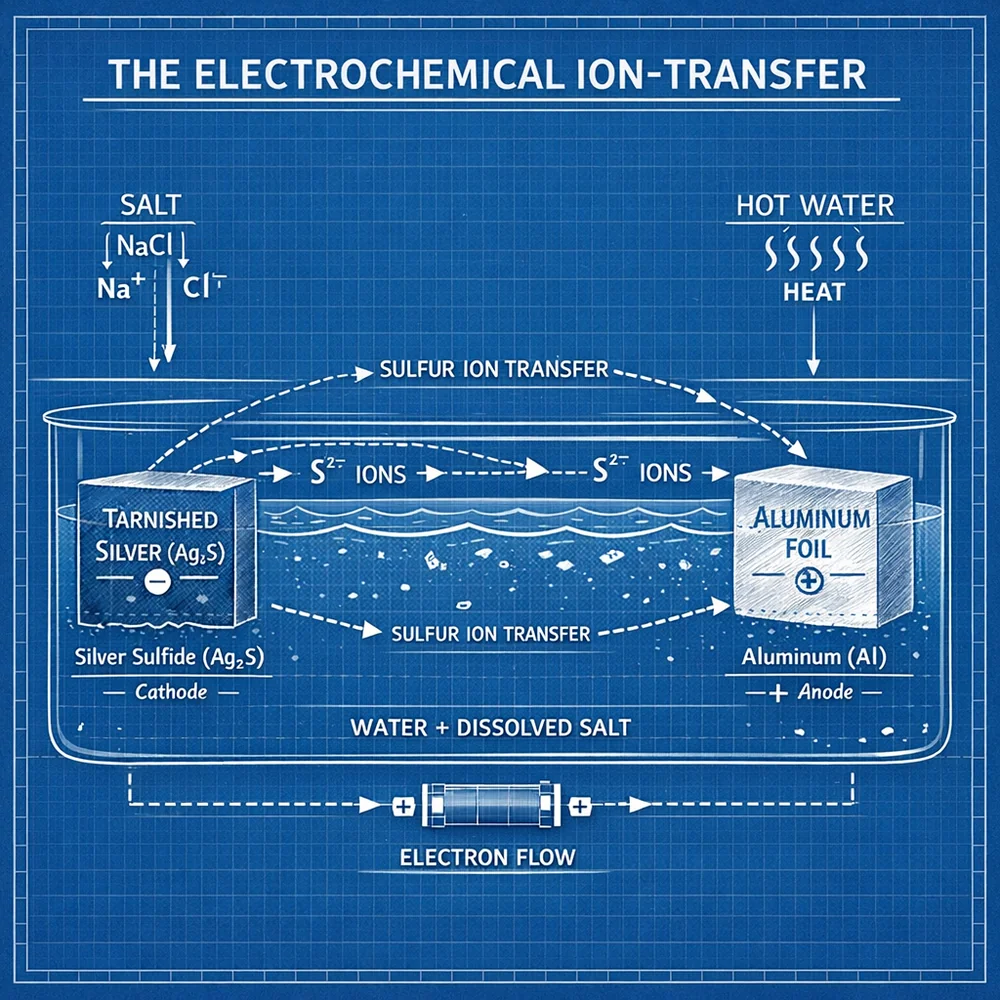
With ultrasonic cleaning covered for hard stones, let’s move to silver. That black layer on tarnished silver is silver sulfide, formed when the metal reacts with sulfur compounds in the air. Traditional silver polishes remove this layer by abrading it away with tiny particles. The problem is you’re also removing actual silver with every polish, slowly thinning the piece over time.
The ion-exchange method is a far superior approach that uses electrochemistry instead of abrasion.
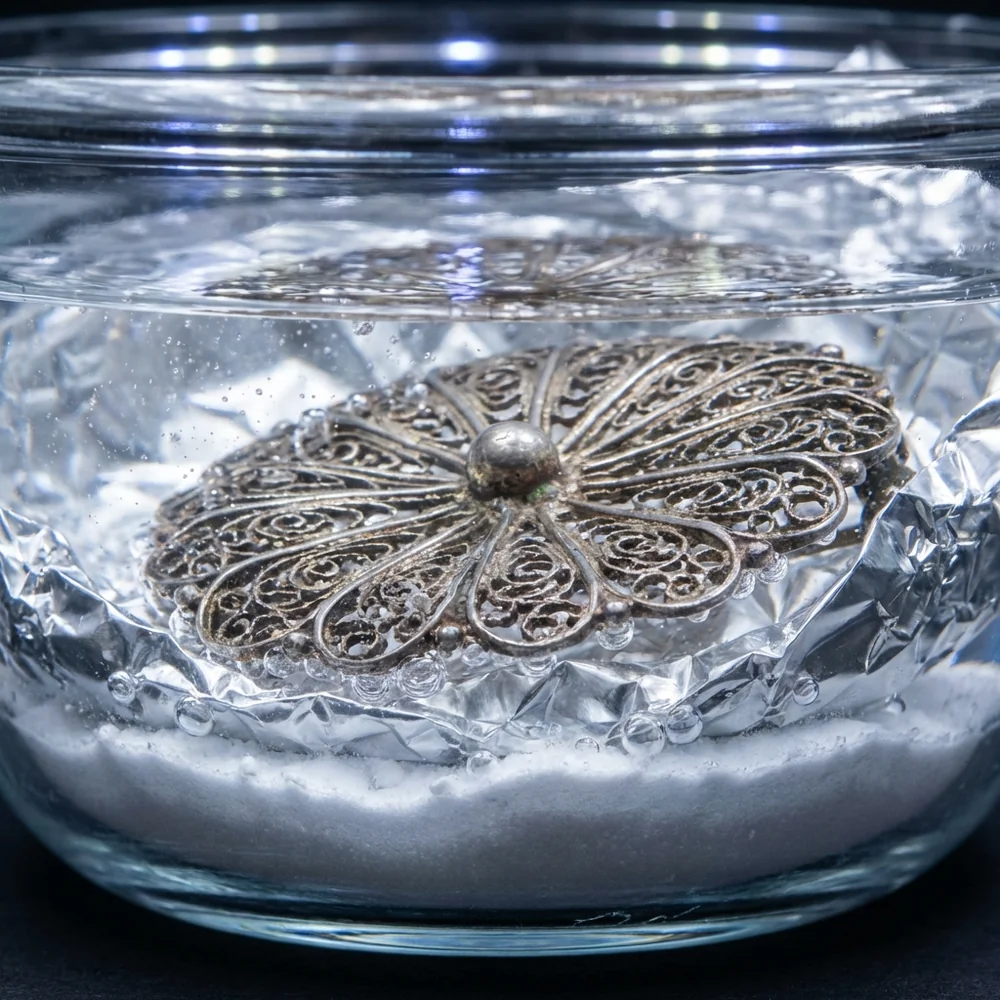
Here’s how it works: line a bowl with aluminum foil, add hot water and a tablespoon of baking soda, then place the tarnished silver in direct contact with the foil. In the presence of the sodium bicarbonate solution, aluminum has a higher affinity for sulfur than silver does. A galvanic current flows through the solution, literally pulling sulfur ions off the silver and depositing them onto the aluminum. The silver sulfide converts back to pure metal without any material loss. After treatment, rinse thoroughly with distilled water to remove any residue. This method is only safe for solid sterling silver, so avoid using it on jewelry with intentionally oxidized details or organic gemstones.
Key Insight: The baking soda and foil method utilizes a localized galvanic cell to pull sulfur ions off tarnished silver and onto a sacrificial aluminum anode. This “ion-exchange” protocol restores the metal’s luster without the mechanical loss of material caused by abrasive silver polishes.
Keeping Diamonds Brilliant: Managing Oil Buildup
From silver restoration, let’s turn to the world’s hardest gemstone. Diamonds may be indestructible, but they have a quirk that affects their appearance: they naturally attract oils. Skin oils, lotions, and soap residue bond to the facets through daily wear. This greasy film acts like a light absorber, significantly reducing the brilliance and fire that make diamonds so captivating.
The good news is that diamonds are tough enough to handle straightforward cleaning.
Soak the piece in warm water with liquid dish soap for about ten minutes. The soap molecules surround the lipid molecules and lift them off the stone. Then use a soft-bristled toothbrush to gently scrub, paying special attention to the back of the gemstone. This is where light enters the diamond to be reflected back out to your eye. If the back is dirty, the stone looks dead or cloudy no matter how clean the top is. Finish by buffing with a clean microfiber cloth to prevent water spots. This simple routine restores that eye-catching sparkle without any risk of thermal shock or chemical damage.
Key Insight: Diamonds possess a high affinity for lipids, which form a dulling film on their facets. Utilizing pH-neutral surfactants and targeted mechanical scrubbing with soft bristles restores the stone’s optical brilliance by removing this oil layer from the critical “back-facets” of the setting.
Pearls and Opals: The Fragile Exceptions
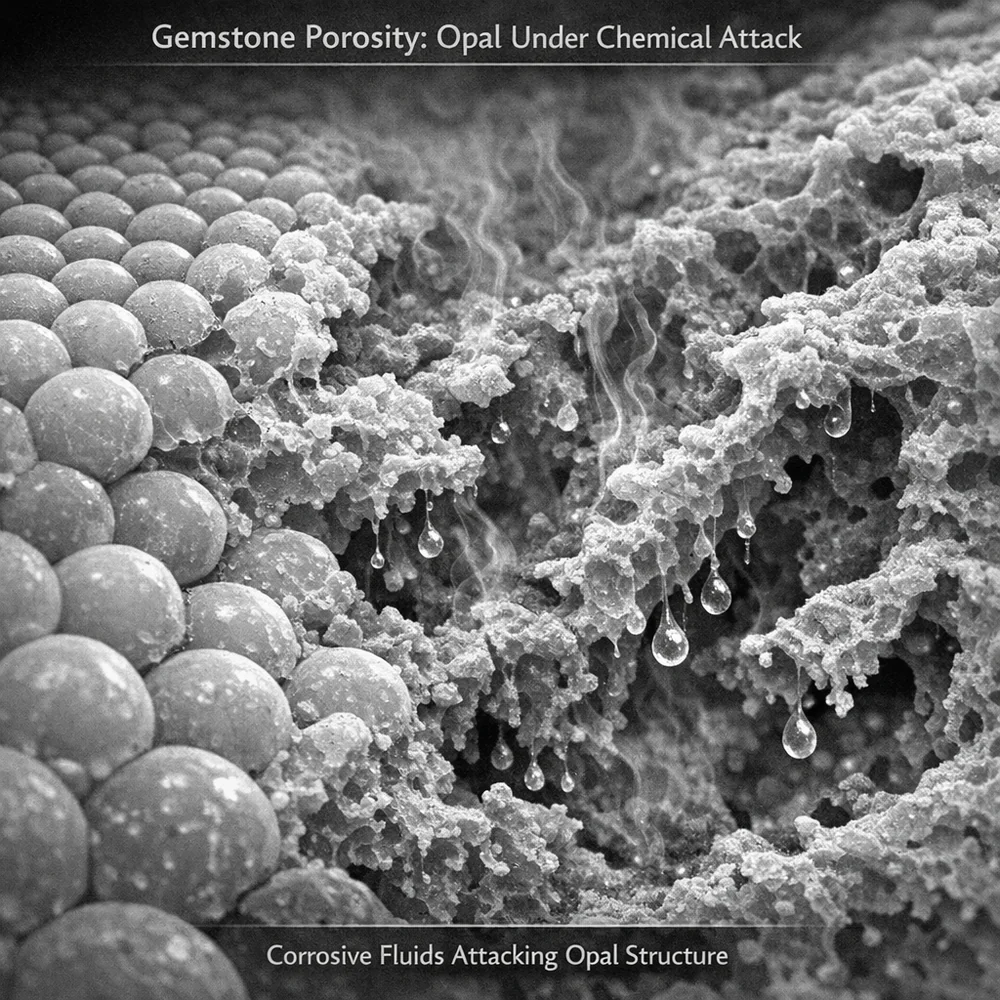
Now that we’ve covered robust gems like diamonds, we need to address the opposite end of the spectrum. Opals and pearls require completely different handling than any hard gemstone. Pearls are organic gems made from layers of calcium carbonate and protein. Opals are hydrated silica that can crack if they dry out or get too hot too fast.
Both materials are highly porous and can absorb oils or atmospheric moisture that leads to permanent discoloration or structural damage.
The primary rule for pearls: exclude any harsh chemicals, especially acidic cleaners. Acids will etch the nacre and damage the pearl’s luster permanently. For daily care, simply wipe with a clean, damp microfiber cloth after each wear to remove skin oils before storage. Opals are sensitive to thermal shock, so never clean them with hot water or steam devices. Never put opals in an ultrasonic cleaner. If an opal becomes too dry, it can lose color permanently. If submerged in water too long, some varieties can also lose color. These gems reward careful, minimal-intervention cleaning.
Key Insight: Pearls and opals are highly porous, hydrated minerals sensitive to both chemical dissolution and thermal shock. Preserving their luster requires the complete exclusion of solvents and abrasives, prioritizing dry microfiber wiping and climate-controlled storage.
Plant-Based Cleaners: Gentle and Effective
For those who want to avoid commercial cleaners entirely, plant-based jewelry cleaners offer a safer alternative. These products typically use surfactants derived from coconut or soy oils. They’re especially useful for people with sensitive skin who find traditional cleaners irritating.
The non-ionic surfactants in these formulas are less reactive toward metal surfaces and less likely to leave residue.
They work through low-energy emulsification, wrapping around soil particles and floating them away. For more on the science, see our plant-based disinfectant guide. The tradeoff is that plant-based cleaners need longer dwell time. Without the aggressive solvent power of ammonia, they require a ten-minute soak to let the natural surfactants penetrate complex settings. Always verify that your plant-based cleaner is free from essential oils, which can leave their own residue films. These gentle formulas align your jewelry care with broader zero-waste goals while still achieving excellent results.
Key Insight: Plant-based, non-ionic surfactants provide a low-energy chemical path for lipid removal without the corrosive risks of amonia or aggressive acids. These biodegradable formulas require slightly longer “dwell times” to achieve clinical-level sanitization while maintaining a neutral pH for the piece.
Drying Properly: Avoiding Water Spots
Whatever cleaning method you use, the final drying step is critical. This is where many people accidentally introduce new problems. If you let jewelry air-dry, the water evaporates but leaves behind dissolved minerals as solid deposits. These hard water spots dull the sparkle you just worked so hard to restore.
Reference our hard water laundry guide for more on the chemistry of mineral precipitation.
To achieve professional-level shine, dry manually with a clean microfiber cloth. Blot first to absorb the bulk of the water, then buff to a finish. Buffing realigns microscopic surface irregularities for maximum light reflection. For pieces with complex settings, a burst of compressed air is a professional trick for blowing water out of every nook and cranny. This ensures the back of stones is perfectly clear. Avoid paper towels, which can shed lint that gets caught in prongs. A dedicated jewelry-only microfiber cloth is a must-have tool for proper care.
Key Insight: Air-drying jewelry results in mineral spotting as dissolved tap-water solids precipitate out during evaporation. Professional “fire” in gemstones is achieved through manual microfiber buffing or compressed-air extraction of moisture from the Setting’s internal voids to ensure a zero-residual finish.
Tarnish vs. Worn Plating: Knowing the Difference
Before cleaning any piece, it’s important to diagnose what you’re actually dealing with. Tarnish is an additive layer that sits on top of the metal. It can be removed with the ion-exchange method or gentle cleaning. Worn plating is a completely different problem: it’s a structural loss of material that no amount of cleaning can fix.
Look carefully at the color and texture under good lighting. If you see a yellowish hue appearing on silver-colored jewelry, the rhodium plating has worn through. On gold-plated pieces, base metal showing through on high-friction areas signals structural failure.
These pieces need professional replating, not more cleaning.
To preserve plated jewelry, avoid ultrasonic cleaners and any aggressive chemicals. Stick to wiping with a damp, soft microfiber cloth. Because the precious metal layer is only a few microns thick, even friction can accelerate wear. Treat solid precious metal pieces as long-term assets and plated pieces as requiring a gentler, lower-impact maintenance strategy.
Key Insight: Tarnish is a reversible oxidative film, whereas plating wear is a permanent loss of the precious metal layer. Identifying the difference between “residue” and “structural failure” prevents the degradative over-cleaning of vermeil and gold-plated assets.
Clean Before Storage: Preventing Problems
How often you clean jewelry should match its exposure level. A ring worn daily while cooking accumulates far more oil than a necklace worn occasionally. For daily-wear rings, a weekly wash prevents buildup that dulls brilliance and can irritate skin. This is similar to the hand-wash protocols we use for general hygiene.
For jewelry that spends most of its life stored, the critical step is cleaning before it goes in the box.
Skin oils left on metal contain fatty acids that accelerate oxidation. Cleaning and drying pieces before storage removes these catalysts and dramatically slows tarnish formation. Reference our seasonal clothing storage guide for more on climate control principles. Another smart practice: apply lotions and perfumes before putting on your jewelry. This minimizes the oil load that transfers during wear and protects both your jewelry and your electronic screens from unnecessary residue.
Key Insight: Jewelry cleaning frequency must be proportional to the daily lipid and atmospheric load. Implementing a “clean-before-storage” protocol and utilizing anti-tarnish barriers minimizes the need for degradative deep-cleaning interventions.
Microfiber Buffing: The Chemical-Free Polish
Finally, let’s talk about the simplest maintenance tool in your kit. High-quality microfiber textiles represent a significant advancement in jewelry polishing. The split-fiber geometry creates massive surface area that achieves a high-gloss finish on gold and platinum through mechanical contact alone. No chemicals needed.
Using a high-GSM microfiber cloth traps any abrasive particles before they can scratch soft metal surfaces.
Consistent buffing realigns surface reflections for that professional look. Reference our cleaning microfiber guide for proper maintenance of these tools. The key is keeping your microfiber cloths pristine. A dirty cloth just adds more soil and defeats the purpose. Wash them regularly and reserve specific cloths for jewelry only. This no-chemical approach protects the complex settings where liquid cleaners can leave hidden residue.
Key Insight: High-GSM microfiber facilitates non-abrasive mechanical polishing by trapping soil within its split-fiber matrix through molecular-level contact. This protocol restores the metal’s reflective uniformity without relying on chemical polishing agents that can leave residues in complex settings.
Conclusion
Cleaning jewelry naturally requires matching your method to the material. Ultrasonic cleaners work brilliantly for hard stones like diamonds and sapphires but will crack fragile gems. The baking soda and aluminum foil method removes silver tarnish through electrochemistry without any material loss. Pearls and opals need gentle microfiber wiping only, with complete exclusion of heat, chemicals, and even prolonged water exposure.
Plant-based surfactants offer a gentler chemical option that requires longer dwell times but avoids the risks of harsh commercial cleaners. Whatever method you choose, proper drying with microfiber prevents water spots that undo your work. Learn to distinguish between tarnish you can remove and worn plating that requires professional repair.
Clean daily-wear pieces weekly and always clean before storage to prevent oils from accelerating tarnish. A high-quality microfiber cloth is your best tool for maintenance between deep cleans. With these techniques, your jewelry will maintain its brilliance for years without the cumulative damage that aggressive cleaning causes.
References
- Hustvedt, G., et al. (2012).
“Materials Science of Precious Metals: Tarnish Mechanisms and Ion-Exchange Restoration.” Journal of Metallurgy and Mining. 2. International Fabric Institute.
(2014). “Mineral Integrity and Cleaning Chemistry: The Science of Porous Gemstones.” IFI Technical Bulletin. 922.
1-12. 3. Smith, J.
A., et al. (2010). “Acoustic Cavitation in Jewelry Restoration: Efficacy and Risk Analysis.” Journal of Applied Physics.
- World Health Organization (WHO). (2019).
“Chemical Safety in the Home: Managing High-Concentration Solvents in Jewelry Care.” WHO Technical Guidance. 5. U.S. Environmental Protection Agency (EPA).
(2020). “Evaluating the Environmental Impact of Jewelry Cleaning Solutions: Post-Consumer Waste Analysis.” EPA Technical Bulletin.