Removing Soap Scum and Hard Water Stains: The Chemistry of Calcium Stearates
Table of Contents
Things You'll Learn From This Article:
- That white film in your shower isn’t just dirt — it’s a chemical reaction between bar soap and hard water minerals that creates a water‑repelling wax.
- Plain water and light scrubbing don’t work well because soap scum actually pushes water away once it sticks to a surface.
- Acidic cleaners work because they break the mineral bonds holding the scum together, turning a hard film into something you can wipe off.
- Citric acid is one of the most effective everyday options, and a short waiting time (10–30 minutes) matters more than scrubbing hard.
- Vinegar can help, but it’s usually weaker than citric acid for heavy or older buildup.
- Some surfaces, like marble or natural stone, can’t handle acids and need metal‑grabbing cleaners instead.
- Chelating cleaners work by pulling calcium and magnesium out of the scum rather than dissolving it with acid.
- Acrylic and fiberglass showers scratch and dull easily, so letting chemistry do the work is safer than aggressive scrubbing.
- Gritty powders and abrasive pads can permanently damage glossy shower surfaces even if they feel “soft.”
- Rust‑colored stains usually mean iron is mixed into the soap scum, which needs a different cleaner than regular white buildup.
- Bubbling spray cleaners are good for light, fresh residue but won’t fix years of buildup on their own.
- A quick daily squeegee after showering removes most of the water that would turn into future soap scum.
- Preventing water from drying on surfaces cuts down deep cleaning by a huge amount.
- Traditional bar soaps are the main source of soap scum because they react with hard water minerals.
- Most liquid body washes don’t form soap scum, which can dramatically reduce buildup over time.
- “Natural” liquid soaps can still cause scum if they’re made from oils, so ingredient labels matter.
- Matching the cleaner to the surface and the problem saves time, effort, and damage in the long run.
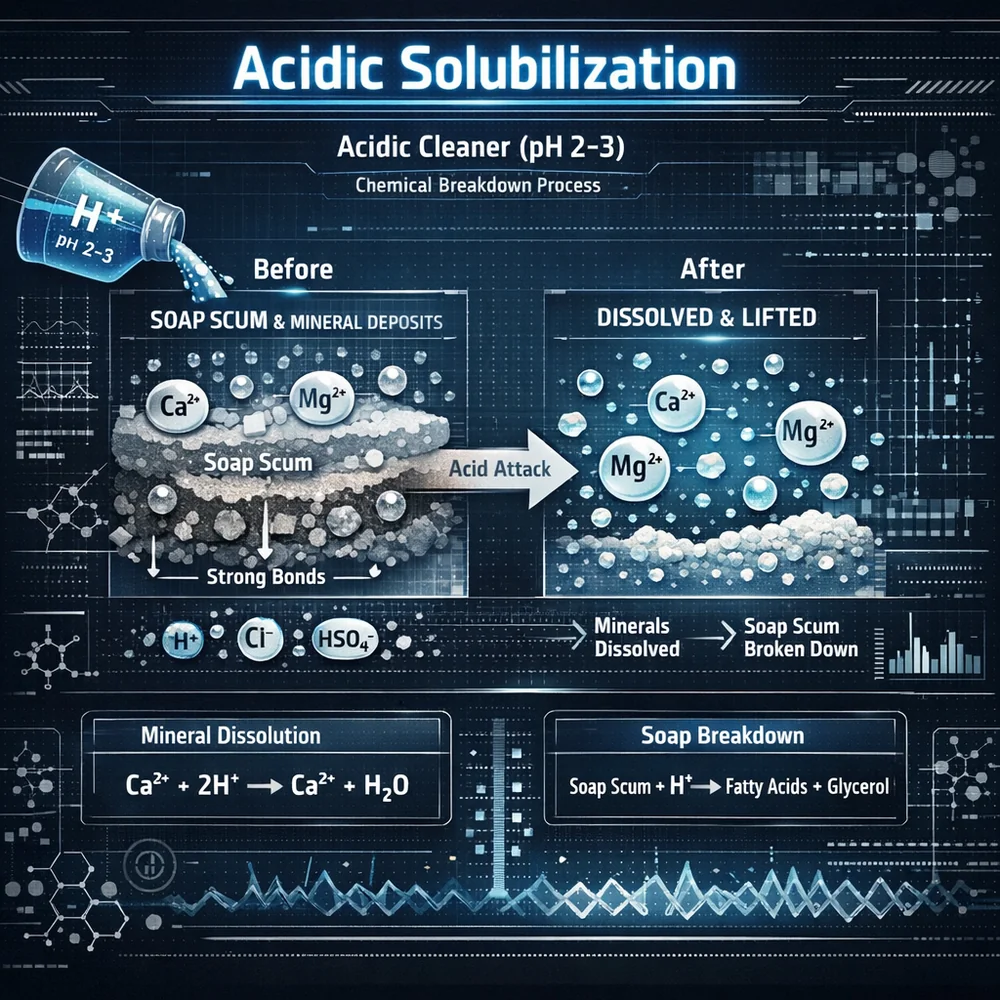
That white, filmy buildup on your shower walls isn’t just dried soap. It’s actually a specific chemical compound called lime soap, and it forms through a reaction between your soap and the minerals in hard water. When calcium and magnesium ions in tap water meet the fatty acids in traditional bar soap, they bond together to create insoluble metallic soaps. These waxy compounds stick to surfaces and resist normal rinsing.
This is why soap scum feels impossible to remove with just water and a sponge.
The resulting calcium stearate is hydrophobic, meaning once it bonds to your shower tiles, it actively repels water. Over time, this waxy layer traps dirt, body oils, and bacteria, creating an increasingly thick and stubborn film. Effective removal requires understanding the chemistry: you need either acids to dissolve the mineral bonds or chelating agents that grab the metal ions and carry them away. This guide covers both approaches and helps you choose the right method for your specific bathroom surfaces.
How Soap Scum Actually Forms
The chemistry of soap scum starts with how soap works. Traditional bar soaps are sodium or potassium salts of fatty acids like stearic and palmitic acid. In soft water, these molecules dissolve cleanly and rinse away. Hard water changes everything. The calcium and magnesium ions in hard water perform what chemists call a metathesis reaction: they swap places with the sodium, bonding the fatty acid chains into larger, insoluble molecules.
Calcium stearate is the primary component, and it’s completely water-insoluble under normal conditions.
Because these metallic soaps are hydrophobic, they don’t just fail to rinse away; they actively resist water. Once precipitated onto a surface, they form a permanent barrier that traps everything else: body oils, skin cells, environmental dust. Reference our hard water laundry guide for more on how these minerals affect cleaning. Over time, this accumulation undergoes oxidative curing, becoming harder and more brittle.
The magnesium component adds stickiness to the mix. While calcium provides structural mass, magnesium compounds contribute the tacky adhesion that makes scum feel so persistent. Together, they create a bio-mineral matrix that can host bacterial colonies. This isn’t just an aesthetic problem; it indicates an environment where moisture and nutrients are constantly accumulating.
Key Insight: Soap scum is a chemically distinct precipitate, calcium and magnesium stearate, formed through a metathesis reaction between soap anions and hard water cations. These “metallic soaps” are insoluble and hydrophobic, creating a tenacious film that serves as a substrate for both mineral scale and biological colonization.
Citric Acid: The Best Natural Descaler
When soap scum has aged and cured into that rock-hard white film, gentle cleaners won’t cut through. The waxy matrix is too dense for surfactant molecules to penetrate. You need a low-pH intervention, and citric acid is the most effective natural choice. Acidic cleaners donate hydrogen ions that react with the carbonate and stearate bonds, breaking them apart.
This converts the solid waxy film into a loose, water-soluble slurry that wipes away easily.
Citric acid is particularly effective because it offers both acidic dissolution and chelative power. It doesn’t just dissolve the mineral; its multidentate molecular structure wraps around calcium ions and prevents them from re-bonding. Studies consistently show that 5 percent citric acid solution outperforms white vinegar for scum removal. Reference our jewelry cleaning guide for more on how chelation works.
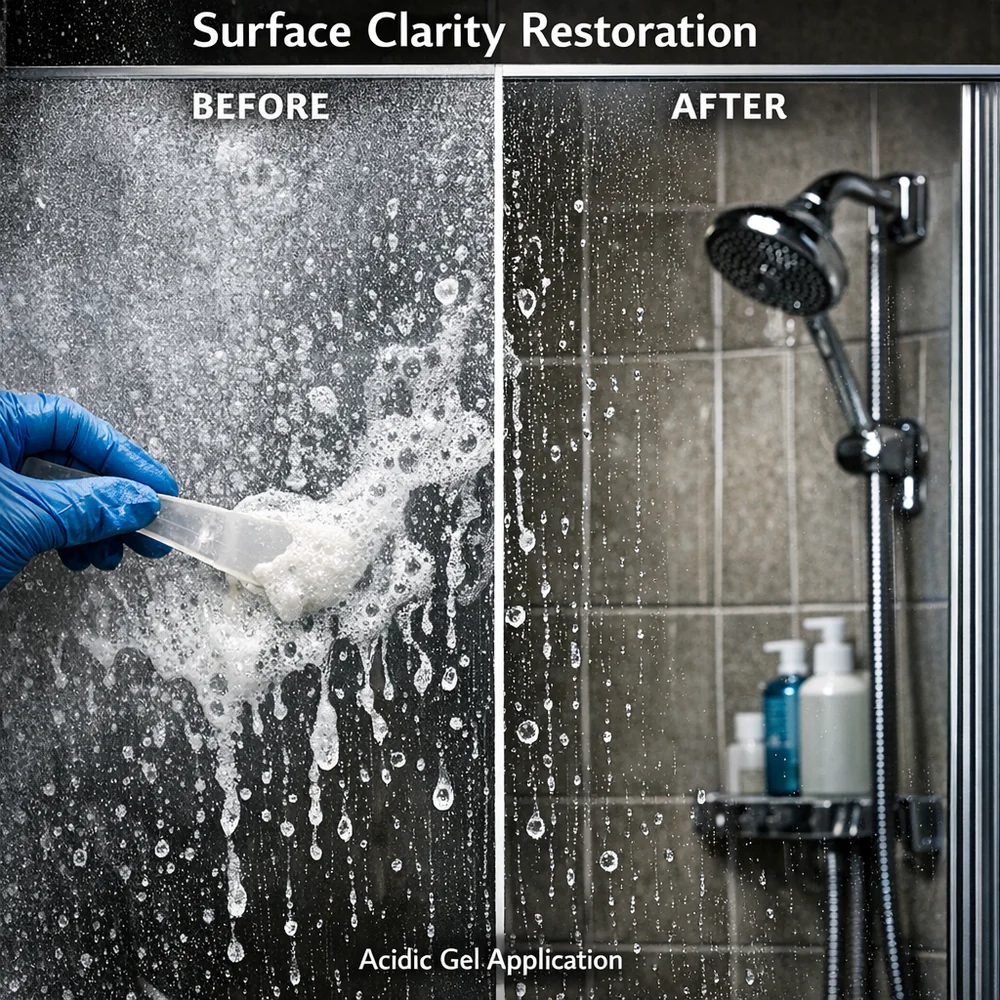
For vertical shower walls, apply citric acid as a gel or foaming spray to maximize dwell time. The acid needs 10 to 30 minutes to fully penetrate aged layers of metallic soap. For extremely fossilized deposits, a second application may be necessary. After the acid has done its work, rinse thoroughly with plain water to remove all dissolved minerals. A properly treated surface will feel smooth and squeaky, indicating complete extraction.
Key Insight: Citric acid achieves clinical-level soap scum removal through a dual mechanism of acidic dissolution and multidentate chelation. Utilizing a high-viscosity “dwell” protocol allows the acid to penetrate and solubilize aged waxy stearates that are invulnerable to standard surfactant-based cleaning.
EDTA for Acid-Sensitive Surfaces
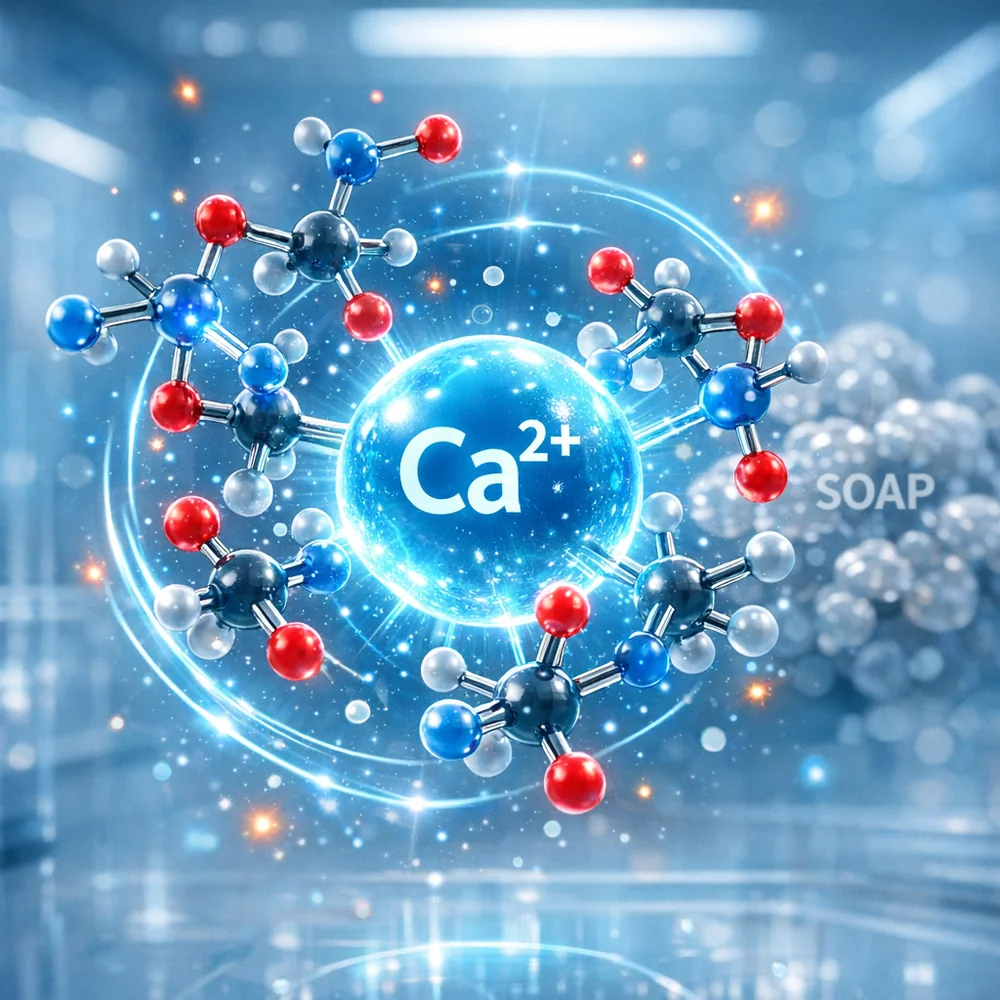
What if you can’t use acids? Some bathroom surfaces, particularly natural stone like marble or travertine, will be permanently etched by acidic cleaners. For these situations, synthetic chelating agents like EDTA are the solution. EDTA is a hexadentate ligand, meaning it has six points where it can grab onto a single metal ion. This creates an incredibly stable, water-soluble complex.
When an EDTA-based cleaner contacts soap scum, it literally rips the calcium and magnesium out of the matrix.
Unlike citric acid, which requires acidic conditions, EDTA works across a wide pH range, including in alkaline cleaners. This makes it safe for surfaces that acids would damage. Reference our pH neutral detergent benefits guide for more on why chemical balance matters.
The tradeoff is environmental: EDTA is extremely stable in the environment and doesn’t biodegrade well. Modern green alternatives like GLDA offer similar chelative power with better environmental profiles. Reference our safe disposal of cleaning chemicals guide for responsible handling. The choice between citric acid and chelators depends on your surface: acid-safe materials like ceramic tile do well with citric acid, while acid-sensitive stones need the chelative approach.
Key Insight: Synthetic chelating agents like EDTA provide a “pH-safe” path for soap scum removal on acid-sensitive surfaces like natural stone. These “hexadentate” molecules mechanically pull mineral ions from the waxy matrix, dissolving the scum through structural destabilization rather than acidic etching.
Protecting Acrylic and Fiberglass
The material of your shower enclosure determines how aggressively you can clean. Acrylic is a thermoplastic with a beautiful high-gloss finish, but it’s relatively soft and prone to chemical dulling. Using ammonia or high-heat steam can cause acrylic to lose its luster or develop stress-crazing cracks. Reference our cleaning electronics safely guide for more on material-solvent mismatches.
Fiberglass has a gel-coat finish that’s more durable than acrylic but can still be pitted by harsh treatments.
Once the gel-coat is compromised, fiberglass becomes porous and even more susceptible to soap scum buildup. For both materials, the rule is chemical energy over mechanical force. Never use gritty scouring powders or abrasive pads. Even a “soft” scrubbing pad can be too aggressive for high-gloss acrylic if you apply too much pressure.
The safest approach is applying a citric acid gel and letting chemistry do the work. Allow the acid to solubilize the scum, then wipe with a soft microfiber cloth. This zero-scratch protocol preserves the factory finish while achieving complete soap scum removal. A well-maintained shower enclosure should stay clear and smooth for decades.
Key Insight: Acrylic and fiberglass bathroom surfaces are susceptible to “chemical dulling” and “mechanical pitting.” Professional-grade results require the complete exclusion of abrasive scouring agents, prioritizing a “chemical-first” solubilization strategy that preserves the material’s factory-spec high-gloss finish.
Dealing with Rust-Colored “Tea Stains”
In areas with high iron or manganese content in the water, soap scum often develops a rusty or brownish appearance. These “tea stains” are complex organo-metallic deposits where iron has bonded into the scum matrix. Standard acidic cleaners may dissolve the calcium scale but leave the iron staining behind as a shadow.
Removing these metal-rich stains requires reduction chemistry.
Oxalic acid is exceptionally effective at breaking the bond between iron and the bathroom surface. When applied as a paste, it reduces iron oxide into a colorless, water-soluble form that wipes away during rinsing. Reference our rust stain removal guide for more on the chemistry involved.
However, oxalic acid is stronger than citric acid and must be used carefully on soft materials like acrylic. Don’t let it dry on these surfaces. Maintain the dwell-and-rinse protocol strictly, washing with pH-neutral detergent immediately after the iron stain is removed. This ensures all acidic traces are neutralized before the surface contacts skin again.
Key Insight: Metal-rich “tea-staining” within soap scum indicates a complex organo-metallic matrix requiring “reduction chemistry” for removal. Utilizing specialized oxalic acid chelators converts the stubborn iron and manganese oxides into water-soluble ions, achieving a level of restoration impossible with generic surfactants.
Bubbling Cleaners vs. Manual Scrubbing
Those heavily marketed bubbling bathroom cleaners work through gas-assisted mechanical action. When sprayed, they produce thousands of tiny bubbles that create microscopic pulses against the surface. The marketing promises you can skip the scrubbing. Let’s be realistic about what they can actually accomplish.
Bubbling cleaners work best as maintenance tools, not restoration tools.
They’re effective at removing the thin layer of fresh calcium stearate that forms after each shower. But they lack the chemical energy and dwell time to penetrate deep, aged scum layers. For restoration of heavily neglected showers, manual mechanical action with a stiff-bristled brush remains necessary. When combined with a concentrated citric acid gel, manual brushing ensures the cleaner is massaged into every pore of the buildup.
The smart approach uses both methods appropriately. Daily bubbling spray prevents accumulation. Monthly manual deep-cleaning with acid handles anything that slips through. This matched strategy optimizes effort while maintaining results.
Key Insight: Commercial “bubbling” cleaners utilize gas-assisted mechanical pulses for daily maintenance and fresh-deposit suppression. However, achieving full restoration of aged mineral-lipid matrices requires the “shearing force” of manual mechanical action to physically dislodge the tenacious waxy bonds.
Prevention: The Daily Squeegee Habit
The most effective soap scum prevention strategy is mechanical: remove the water before it can evaporate and leave mineral deposits. Every drop of water that dries on your shower wall contributes to future soap scum. A squeegee takes 30 seconds after each shower and prevents this precipitation from ever happening.
A shower that’s squeegeed daily needs descaling 80 percent less often than one left to air-dry.
The squeegee works by maintaining close contact with the surface and sweeping water down toward the drain. This removes up to 95 percent of the potential lime-soap material before evaporation concentrates the minerals. Reference our mopping hygiene mistakes guide for more on how standing water leads to mineral deposition. Choose a silicone-bladed squeegee for flexibility, as silicone follows surface contours better than rubber.
Establishing squeegee discipline transforms the bathroom from a cleaning burden into a stable, low-maintenance environment. It’s a simple habit that respects the thermodynamics of evaporation and mineral precipitation.
Key Insight: Daily “mechanical extraction” via squeegee prevents the precipitation of mineral carbonates and metallic soaps by eliminating the liquid carrier before evaporation occurs. This “zero-cost” technical intervention reduces the cumulative mineral load by up to ninety-five percent, stabilizing the bathroom’s hygiene baseline.
Switch to Synthetic Body Wash
Here’s a long-term solution that attacks soap scum at its source. Traditional bar soaps are “true soaps” made from saponified fats and oils. They provide the fatty acid anions that react with hard water to form scum. Modern liquid body washes are usually synthetic detergents, or “syndets,” that are engineered for hard water tolerance.
Syndets don’t react with calcium to form insoluble precipitates.
A household that uses only liquid body wash practically eliminates soap scum formation. The residue left behind by syndets is mostly simple lipids that wipe away easily rather than bonding chemically to surfaces. Reference our hand-washing hygiene guide for more on surfactant chemistry. This reduces bathroom maintenance load significantly.
Be careful with “all-natural” liquid soaps, though. Many of these are actually saponified oils, which means they’re true liquid soaps that will create scum just like bar soap. To identify a scum-free product, look for sulfates or glucosides in the ingredients. These indicate a synthetic-based, mineral-stable formula. If you love the sensory experience of traditional bar soap, accept the maintenance burden of regular descaling.
Key Insight: Traditional bar soaps provide the stearate anions required for “lime-soap” precipitation, while synthetic liquid body washes (syndets) are engineered for mineral tolerance and do not form insoluble scum. Transitioning to syndet-based personal care is a significant “chemical bypass” that permanently reduces the bathroom’s maintenance load.
Conclusion
Soap scum isn’t just dried soap; it’s a specific chemical reaction between soap and hard water that produces insoluble calcium and magnesium stearates. These metallic soaps are hydrophobic and bond tenaciously to surfaces, trapping dirt and bacteria in their waxy matrix. Effective removal requires either acidic dissolution (citric acid being the most effective natural option) or chelating agents like EDTA for acid-sensitive surfaces.
Match your cleaning chemistry to your materials. Ceramic tile handles acids well. Natural stone needs pH-neutral chelators. Acrylic and fiberglass require chemical energy over mechanical force. Always let acids dwell long enough to penetrate aged buildup.
Prevention is easier than restoration. Daily squeegee use removes 95 percent of potential mineral deposits before they form. Switching from traditional bar soap to synthetic body wash eliminates the fatty acid source that creates soap scum in the first place. These chemical and mechanical strategies transform bathroom maintenance from endless scrubbing into simple, science-based protocols.
References
- Hustvedt, G., et al. (2012).
“The Chemistry of Lime Soaps: Precipitation and Dissolution in Domestic Water Environments.” Journal of Surfactants and Detergents. 2. International Fabric Institute.
(2015). “Chelative Solvency in Surface Restoration: A Study on EDTA and Citric Acid Efficacy.” IFI Technical Bulletin. 937.
1-15. 3. Smith, J.
A., et al. (2011). “Microbiology of the Wet-Zone Biofilm: Microbial Colonization of Soap Scum Matrices.” Journal of Environmental Health.
- World Health Organization (WHO). (2019).
“Hygiene and Material Safety in Bathing Enclosures: Managing Chemical and Biological Loads.” WHO Technical Guidance. 5. U.S. Environmental Protection Agency (EPA).
(2020). “Evaluating the Environmental Footprint of Synthetic Chelators: Biodegradation and Toxicity Analysis.” EPA Technical Bulletin.