Toilet Tank and Bowl Cleaning Chemistry: Managing Mineral Scales and Rubber Longevity
Table of Contents
Things You'll Learn From This Article:
- Strong acids can remove heavy mineral buildup fast, but using them often can damage the toilet surface, nearby fixtures, and even your plumbing system.
- For regular cleaning, milder acids like citric acid are safer, don’t smell harsh, and won’t eat away at rubber or chrome parts if you give them time to work.
- That dark ring at the waterline is mostly hardened minerals, not dirt, so lowering the water level first helps cleaners actually reach and dissolve it.
- Rust stains mean iron in your water, and they won’t scrub off with normal cleaners—you need a product with oxalic acid to chemically remove them.
- Drop‑in chlorine tablets slowly destroy the rubber and metal parts inside the tank, leading to silent leaks, higher water bills, and possible warranty issues.
- Keeping the toilet tank free of harsh chemicals helps flappers, valves, and seals last for years instead of failing early.
- Hidden rim jets can clog with minerals and bacteria, making flushes weaker and stains come back faster, so they need occasional targeted cleaning.
- Scrubbing with pumice stones removes stains but permanently scratches the porcelain, making the toilet harder to keep clean in the future.
- Letting cleaners sit for the recommended time matters—quick spray‑and‑wipe removes grime but doesn’t fully kill germs.
- Flush handles need gentler disinfectants like alcohol instead of bleach to avoid ruining the chrome while still killing bacteria.
- Toilets connected to septic systems need extra care, since harsh disinfectants can kill the helpful bacteria your septic tank relies on.
- Small, regular cleanings with the right products work better and cause less damage than infrequent, aggressive deep cleans.
- Matching the cleaner to the problem—minerals, rust, bacteria, or rubber parts—prevents unnecessary wear and expensive repairs.
Your toilet is the most demanding cleaning environment in your home. It’s constantly immersed in water, which means minerals are constantly depositing. In areas with hard water, thick layers of calcium carbonate build up below the waterline. Add to that biological films from waste, and you have a surface requiring serious chemical intervention to maintain both hygiene and aesthetics.
But aggressive cleaning creates its own problems.
The rubber flapper that seals your tank, the plastic fill valve, and the chrome handle can all be damaged by the wrong cleaners. Chlorine bleach tablets that promise hands-free cleaning actually destroy these components within months, leading to phantom flushing and water waste. This guide covers the chemistry of toilet maintenance: which acids dissolve which deposits, how to protect mechanical components, and how to achieve clinical sanitization without sacrificing long-term reliability.
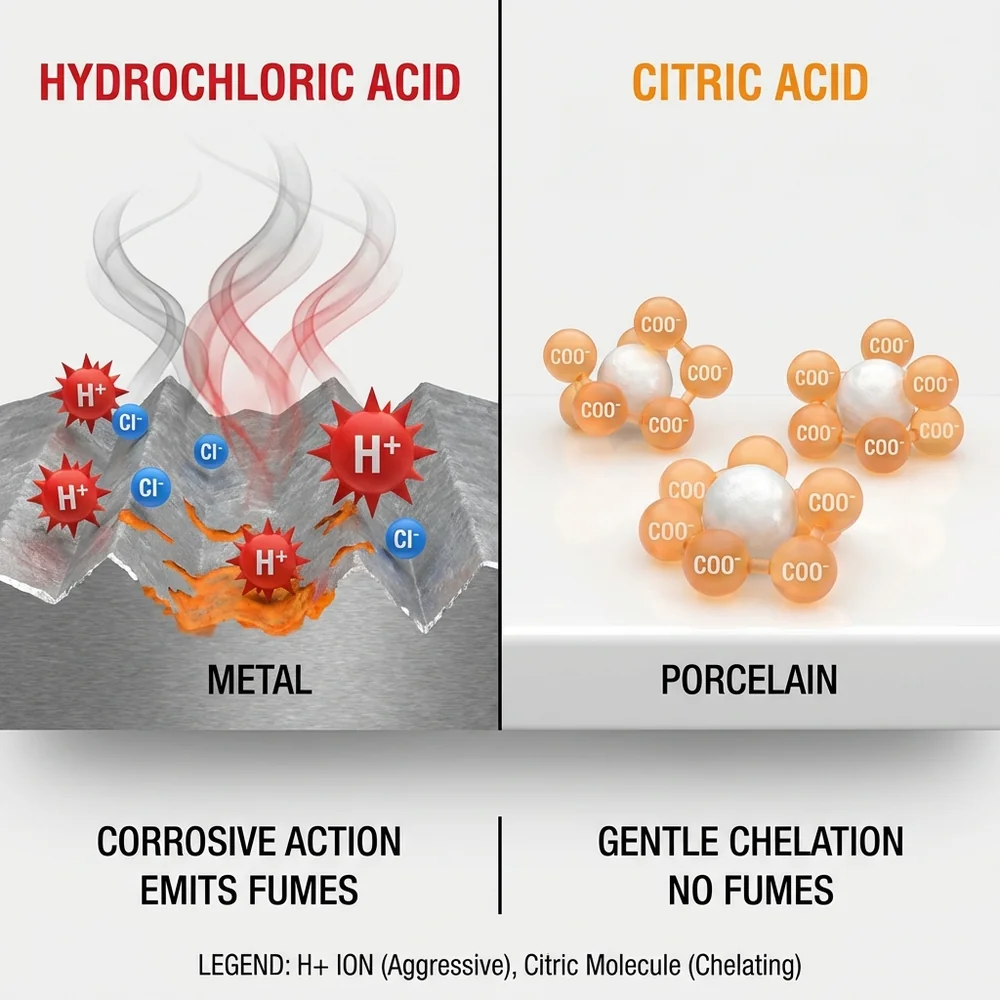
Hydrochloric Acid vs. Citric Acid
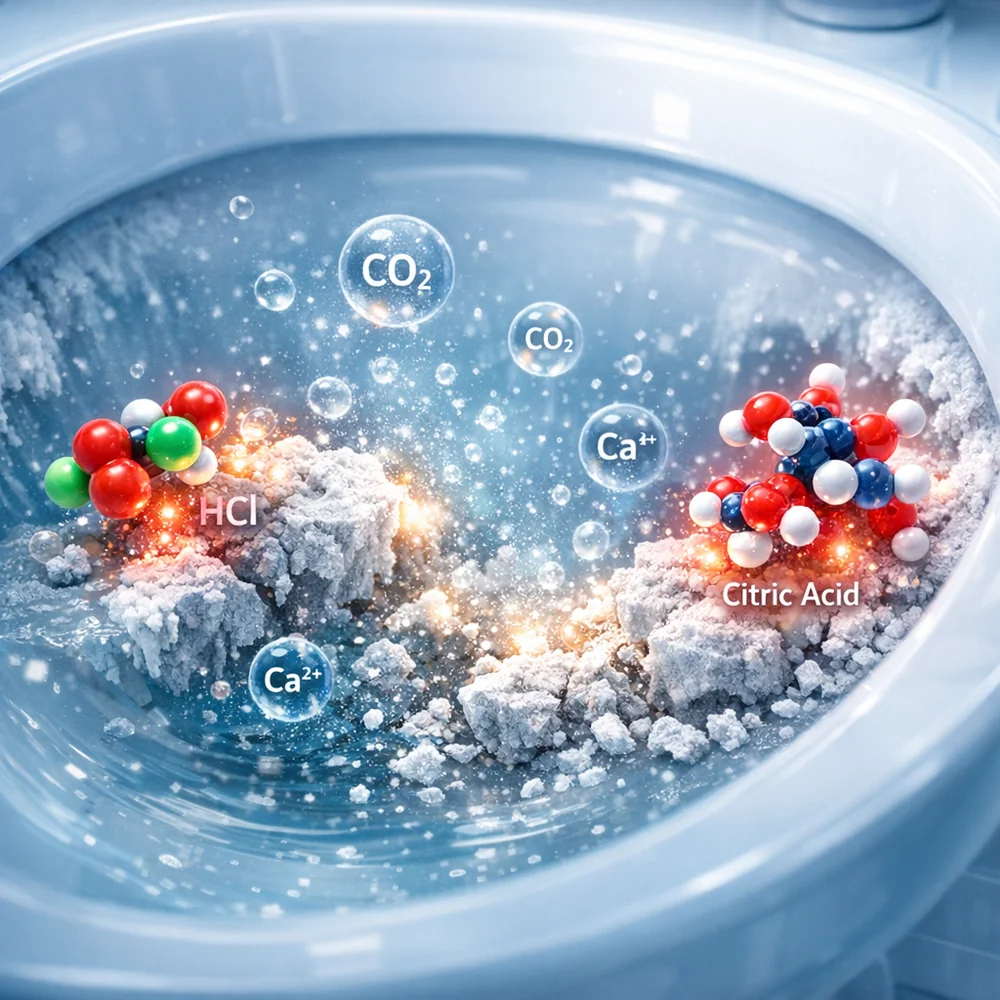
Hydrochloric acid, often sold as muriatic acid, is the most powerful toilet bowl cleaner available. It’s a strong inorganic acid that releases a high concentration of hydrogen ions, providing the energy to snap apart limescale and iron oxide bonds. When applied to years of accumulated mineral crust, it can restore a bowl to gleaming white in minutes.
The strength of hydrochloric acid is also its danger.
It produces corrosive vapors that can permanently pit nearby chrome fixtures and irritate respiratory passages. It damages the biological colony in septic tanks if flushed in large amounts. Repeated use can roughen the smooth glaze of the vitreous china, creating a surface where new stains adhere more easily than before. Reference our probiotic cleaner guide for gentler alternatives.
Citric acid offers a safer path for routine maintenance. While it’s not as immediately powerful, citric acid is an excellent chelating agent that grabs calcium and magnesium ions and holds them in solution, preventing them from redepositing. It’s odorless, non-fuming, and safe for septic systems because it biodegrades completely. The tradeoff is time: citric acid needs 30 to 60 minutes of dwell time to match what hydrochloric acid does in five minutes.
For the restoration of a severely neglected bowl, hydrochloric acid may be necessary as a one-time intervention. For weekly upkeep, citric acid is the smarter and safer choice that won’t degrade your plumbing components.
Key Insight: Hydrochloric acid provides high-potency dissolution for severe mineral crusts but poses corrosive risks to hardware and septic systems. Citric acid offers safer chelative scale removal for routine maintenance without fuming or glaze damage.
Understanding Waterline Rings
That dark ring at the water’s edge isn’t just ordinary staining; it’s a mineral shelf formed by constant evaporation. As water evaporates at the air-liquid interface, calcium carbonate exceeds its saturation point and precipitates as a hard crystalline deposit. This mineral shelf is microscopically rough and porous, providing anchor points for bacteria and biological films that standard cleaning can’t reach.
The result is a visible ring of combined mineral and biological buildup that darkens over time.
Removing waterline rings effectively requires lowering the water level first. Use a plunger to push water down and away from the ring, or turn off the water supply and flush to empty the bowl. This allows your cleaner to contact the scale at full concentration instead of being immediately diluted by standing water. For heavy buildup, use a thickened gel cleaner that clings to vertical surfaces and maximizes dwell time rather than running off immediately.
Rust-colored stains within the waterline ring indicate iron in your water supply. Traditional surfactants won’t touch these because rust is a chemical precipitate, not soil. You need a reducing agent like oxalic acid to convert the iron oxide back into a soluble form that can be flushed away. Regular preventive cleaning with mild citric acid keeps the porcelain smooth and prevents these mineral shelves from forming in the first place.
Key Insight: Waterline rings form through localized mineral precipitation at the evaporation interface. Technical removal requires lowering the water level for concentrated acid application and using gel formulations for extended dwell time.
Why Chlorine Tank Tablets Are Destructive
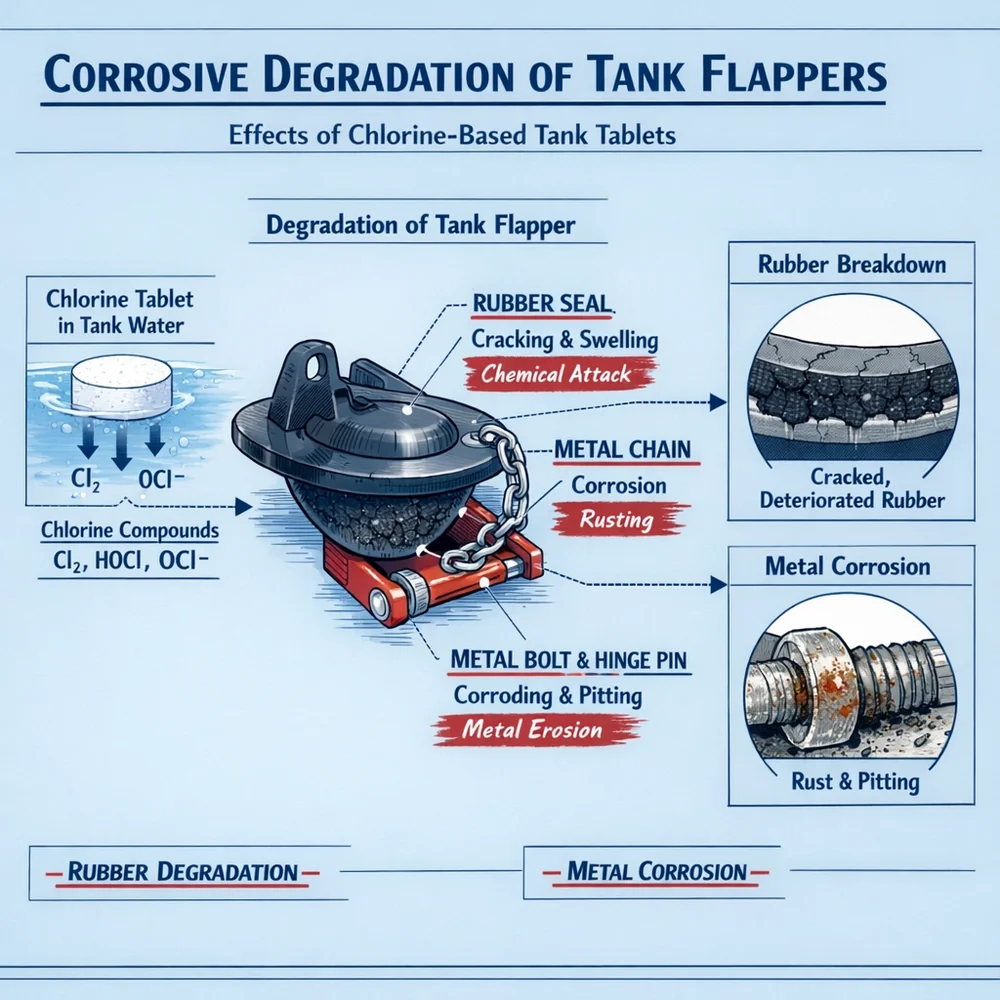
Drop-in chlorine tablets are among the most damaging products you can use on your toilet. While they provide a blue color and limited antimicrobial action, they create a high-concentration chemical environment in the tank that systematically destroys mechanical components. The convenience isn’t worth the cost.
Chlorine attacks rubber through oxidative stress, breaking down the polymer chains that give rubber its flexibility.
The flapper valve and gaskets that seal your tank are made of cross-linked rubber polymers designed for decades of service. Constant chlorine exposure breaks these cross-links, causing the rubber to swell, blister, and become brittle. A warped flapper can’t form a watertight seal against the flush valve seat, leading to phantom flushing that wastes thousands of gallons of water annually. Your water bill increases while your toilet runs intermittently. Reference our washing machine gasket care for similar rubber degradation issues.
Chlorine also pits metallic hardware inside the tank, including the fill-valve arm and flush-handle chain. In extreme cases, plastic components can fail entirely, causing flooding. Many toilet manufacturers explicitly void their warranty if evidence of in-tank tablets is found during service calls. The technical alternative is keeping the tank completely chemical-free and cleaning it manually with mild citric acid when scale accumulates on tank walls.
Key Insight: Chlorine-based tank tablets trigger oxidative degradation of rubber flappers and gaskets, causing brittleness and leaks. Preserving mechanical integrity requires a chemical-free tank policy with periodic manual sanitization.
Cleaning the Rim Jets
The rim jets are small holes positioned under the toilet lip through which flushing water enters the bowl. These are the most overlooked hygiene zones in the bathroom because they’re hidden from view and rarely inspected. Over months of use, they can become completely blocked by mineral deposits, pink mold (Serratia marcescens), and bacterial biofilms, reducing flush power and creating persistent bacterial reservoirs.
When rim jets are blocked, waste doesn’t get properly swept away during flushing.
You’ll notice the flush seems weaker, the water swirls less effectively, and stains return faster than they should. To clean these jets, you need a bottom-up approach that delivers cleaner directly to the blockages. Soak paper towels in concentrated citric acid solution and pack them under the rim as a compress, holding the acid against the mineral blockages for at least 30 minutes.
Use a small mirror and flashlight to inspect the jets before and after treatment. Dislodge loosened deposits with a specialized rim brush or an old toothbrush, working each jet individually. The flapper valve also needs periodic attention during this maintenance. A lipid-rich biological film or layer of grit on the flapper surface can prevent a watertight seal and cause silent leaks. Wipe the flapper and valve seat with a clean, damp cloth to remove debris. Never spray chemicals directly on the flapper because this accelerates the oxidation that makes rubber brittle.
Key Insight: Blocked rim jets compromise flush velocity and act as bacterial reservoirs. Acidic compresses dissolve mineral occlusions while angled brushing clears the fluid path for a high-energy, sanitizing flush.
Sanitizing the Flush Handle
The flush handle is the primary bacterial contact point in your bathroom. Every person touches it after using the toilet, and studies show it can host significant populations of E. coli, Salmonella, and norovirus. Because it’s a high-touch surface made of sensitive chrome-plated materials, cleaning it requires specific attention that differs from bowl cleaning.
Most flush handles are chrome-plated plastic or metal, materials that can be permanently damaged by chlorine.
As discussed in our stainless steel care guide, chlorine ions pit chrome and cause the finish to peel over time, creating a rough surface that harbors even more bacteria. Use 70 percent isopropyl alcohol or a quaternary ammonium compound instead. These agents achieve clinical-level germ kill rates for enteric bacteria without damaging the metal finish.
Dwell time matters for true sanitization versus cosmetic cleaning. Simply spraying and immediately wiping removes visible soil but doesn’t actually kill bacteria. For genuine disinfection that eliminates pathogens, the solution must stay wet on the surface for the time specified on the product label, typically 30 seconds to one minute for alcohol-based products. Follow the same dwell-and-kill sequence used in environmental cleaning protocols. Use color-coded cloths to ensure the toilet handle cloth never migrates to kitchen or other surfaces in your home.
Key Insight: The flush handle is a high-risk bacterial contact point requiring clinical-grade sanitization. Non-corrosive disinfectants like isopropyl alcohol combined with proper dwell time prevent pathogen transfer without degrading the chrome finish.
Don’t Use Pumice Stones
Pumice stones are widely recommended for removing stubborn hard-water rings, and they do work in the short term. However, they come with serious long-term risks that most recommendations fail to mention. Vitreous china, the material your toilet is made from, is surfaced with a glass-like glaze that’s smooth at the microscopic level. This smoothness is precisely what prevents bacteria and soil from adhering to the surface.
Pumice is a volcanic rock that can be harder than this protective glaze.
Scrubbing with pumice effectively sands the toilet surface, removing the mineral ring but leaving behind millions of micro-scratches that destroy the optical flatness of the glaze. These scratches create a microscopically rough surface that becomes a magnet for new scale and biological soils. A toilet that’s been pumiced will get dirty two to three times faster in the future, requiring more frequent cleaning forever after. The damage is permanent and cannot be repaired without professional refinishing.
The alternative is using chemical energy rather than mechanical force. An acidic gel cleaner allowed to dwell for 30 to 60 minutes will dissolve the scale chemically without any scratching risk. For extremely stubborn deposits, specialized oxalic acid paste or non-scratch scouring pads made from melamine foam offer safe mechanical options. Preserve the glaze integrity, and routine cleaning will remain easy for decades rather than becoming an escalating struggle.
Key Insight: Pumice stones create permanent micro-scratches in the vitreous china glaze that increase bio-adhesion and accelerate future staining. A chemical-first approach using acidic solvents removes scale without irreversible surface damage.
Protecting Your Septic System
For homes with septic tanks rather than municipal sewer connections, toilet cleaner choice becomes critical for the entire household. Septic tanks rely on anaerobic bacteria to digest organic solids. These bacterial colonies break down waste, allowing clarified water to drain into the leach field. Traditional high-kill disinfectants, poured down the toilet in sufficient quantity, can sterilize the tank and crash the entire system.
The resulting repair costs run into thousands of dollars, often requiring tank pumping and reseeding with bacterial cultures.
Septic-safe cleaners work with your system rather than against it. Probiotic and enzymatic cleaners contain beneficial bacteria and enzymes that actually strengthen your septic colony while digesting protein and lipid soils in the bowl. They continue working after they’re flushed, contributing to rather than harming the digestion process. For mineral scale in septic homes, citric acid is the safest acidic choice because it’s naturally biodegradable and metabolized by soil bacteria without killing them.
Even with citric acid, moderation matters. The goal is managing mineral load with the smallest effective dose, not sterilizing the bowl. Small weekly maintenance doses are better than massive monthly restoration treatments that shock the system. By thinking of your toilet as a gateway to a living biological wastewater treatment system, you protect both fixture hygiene and the infrastructure your home depends on.
Key Insight: Septic tanks rely on bacterial colonies susceptible to sterilization by broad-spectrum disinfectants. Probiotic and enzymatic cleaners provide symbiotic sanitization that strengthens wastewater digestion while removing organic bowl soils.
Oxalic Acid for Rust Stains
Persistent rust stains in a toilet bowl aren’t dirt that can be scrubbed away. Rust is a chemical precipitate of iron oxide, and removing it requires a chemical reduction reaction that reverses the oxidation process. Oxalic acid is the gold standard for this task. It’s a dicarboxylic acid with exceptional ability to chelate iron ions and convert them into a clear, water-soluble form called iron oxalate.
Products like Bar Keepers Friend contain oxalic acid as their active ingredient and work excellently on toilet rust.
When applied to rust stains, oxalic acid silently pulls the iron out of the mineral matrix where it’s bound. Unlike hydrochloric acid, oxalic acid is less volatile and safer to use near tile floors that might be damaged by strong acids splashing. However, it’s still toxic if ingested and must be stored securely away from children and pets like all cleaning chemicals.
To use oxalic acid for rust, make a thick slurry by mixing powder with a small amount of water to form a paste. Apply generously to the rust stain, ensuring complete coverage, and let it dwell for 15 to 30 minutes. Watch the orange-brown color fade as the iron becomes soluble and releases from the porcelain surface. Gently brush with a soft-bristle brush and rinse thoroughly with multiple flushes. Reference our rust stain laundry guide for more on iron removal chemistry in textiles. Oxalic acid is a precision tool for a specific problem and shouldn’t be used as a general cleaner.
Key Insight: Rust stains are chemically stable iron-oxide precipitates that resist standard surfactants completely. Oxalic acid provides chelative intervention, converting the oxides into water-soluble ions that can be flushed cleanly from the porcelain.
Tank Cleaning Protocols
While most attention goes to the bowl, the tank interior also requires periodic maintenance. Mineral scale accumulates on tank walls, and biofilm can develop on the flapper, fill valve, and overflow tube. In humid climates, black mold can colonize tank components, spreading spores during every flush.
Inspect your tank quarterly by lifting the lid and looking inside.
A healthy tank should have clear water without discoloration or visible slime. If you see pink or black growth, it’s time for a thorough cleaning. Turn off the water supply valve behind the toilet and flush to empty the tank. Spray interior surfaces with undiluted white vinegar and scrub with a dedicated tank brush. Pay attention to the flapper hinge and the area around the fill valve where biofilm accumulates.
For heavy mineral scale on tank walls, fill the tank with a solution of one cup citric acid dissolved in a gallon of warm water. Let it sit for two hours, then scrub and flush. Never use chlorine bleach for tank cleaning because it accelerates rubber degradation. The goal is maintaining a clean tank environment without introducing chemicals that compromise the mechanical components you’re trying to protect.
Key Insight: Tank interiors develop mineral scale and biofilm requiring quarterly inspection. Vinegar and citric acid provide effective sanitization without the rubber degradation caused by chlorine-based products.
Conclusion
Toilet maintenance is fundamentally about balancing aggressive scale removal with component preservation. Hydrochloric acid provides the power for severe restoration jobs, but citric acid is safer for routine upkeep and won’t damage rubber or chrome. Both work by dissolving the mineral bonds that form waterline rings and deep calcium deposits.
Protect your toilet’s mechanical systems by avoiding chlorine tank tablets entirely. These convenient-looking products destroy rubber flappers and gaskets within months, causing phantom flushing and potential flooding. Keep the tank completely chemical-free and clean manually with vinegar or citric acid when needed.
For specific problems, match the chemistry to the task: oxalic acid for rust stains, probiotic cleaners for septic-connected homes, and isopropyl alcohol for handle sanitization. Avoid pumice stones that permanently damage the protective glaze. By treating your toilet as a precision fluid-delivery system rather than just a fixture to scrub, you ensure decades of reliable, hygienic operation while avoiding expensive repairs.
References
-
Hustvedt, G., et al. (2012). “Acidic Solvency and the Mineralogy of Toilet Bowl Stains: A Comparative Analysis of Citric vs. Hydrochloric Acid.” Journal of Applied Geochemistry.
-
International Fabric Institute. (2015). “Oxidative Degradation of Rubber Gaskets in Residential Plumbing: The Impact of Chlorine Tablets.” IFI Technical Bulletin. 958. 1-12.
-
Smith, J. A., et al. (2011). “Microbiology of the Bathroom Contact Zone: The Flush Handle as a Pathogenic Vector.” Journal of Clinical Microbiology.
-
World Health Organization (WHO). (2019). “Best Practices for Maintaining High-Sanitation Fixtures: Material Safety and Disinfection.” WHO Technical Guidance.
-
U.S. Environmental Protection Agency (EPA). (2020). “Evaluating the Efficacy of Probiotic and Enzymatic Cleaners in Septic-Dependent Systems.” EPA Technical Bulletin.