Laundry Detergent Ingredients: A Scientific Overview
Table of Contents
Things You'll Learn From This Article:
- Detergent isn’t just soap; it’s a mix of many ingredients, each doing a specific job during the wash.
- Surfactants are the main cleaners, and having more than one type helps remove both greasy and non-greasy dirt.
- Hard water can block cleaning power, so builders and chelators matter a lot if your clothes look dull or stiff.
- Enzymes break stains down instead of just washing them away, which is why cold water can still clean well.
- Different stains need different enzymes, so detergents with enzyme blends handle everyday messes better.
- Some enzymes don’t clean stains at all but make fabrics look newer by smoothing worn fibers.
- Anti-redeposition agents keep dirt floating in the water so it doesn’t settle back onto your clothes.
- Without those agents, clothes slowly turn gray even if they look clean after each wash.
- High-alkaline detergents can damage washing machines, so corrosion inhibitors help protect the metal parts.
- Optical brighteners don’t clean; they make whites look whiter by changing how light reflects off fabric.
- Brighteners build up over time, which can be a problem for sensitive skin or special-use clothing.
- Oxygen-based bleaches remove organic stains like coffee and wine without stripping color from most fabrics.
- Mixing colors is safer with detergents that trap loose dyes before they stick to other clothes.
- Color protection isn’t just about dye; smoother fibers reflect light better and keep colors looking vibrant.
- Liquids rely on solvents and thickeners so the detergent stays mixed, pours correctly, and works in cold water.
- If a detergent separates, pours badly, or feels inconsistent, the “inactive” ingredients may be poorly balanced.
- Knowing these ingredient roles helps you pick detergents based on your water, stains, fabrics, and skin needs.
Have you ever wondered what is actually in that bottle or box of laundry detergent sitting in your laundry room? The ingredient list reads like a chemistry textbook, filled with words that most people have never heard of. But understanding what those ingredients do is the key to getting more out of your detergent and avoiding the laundry failures that frustrate so many people.
Modern detergents are not just soap. They are highly engineered systems containing fifteen or more different chemical classes, each performing a specific job during the wash cycle. Some molecules attack dirt directly. Others protect your washing machine from corrosion. Some keep soil that has been removed from redepositing on your clothes. And a few are there purely for show, making your whites appear whiter even though they do not actually clean anything.
The shift from traditional soap to synthetic detergents happened because old-fashioned soap fails in hard water. The calcium and magnesium in hard water react with soap to form that waxy gray scum that coats bathtubs. That same scum forms on clothes, making them stiff and dingy. Modern detergents were engineered to work in any water condition, at any temperature, on any type of stain. Understanding the hierarchy of ingredients helps you pick the right product for your situation and diagnose problems when things go wrong.
Surfactants: The Cleaning Workhorses
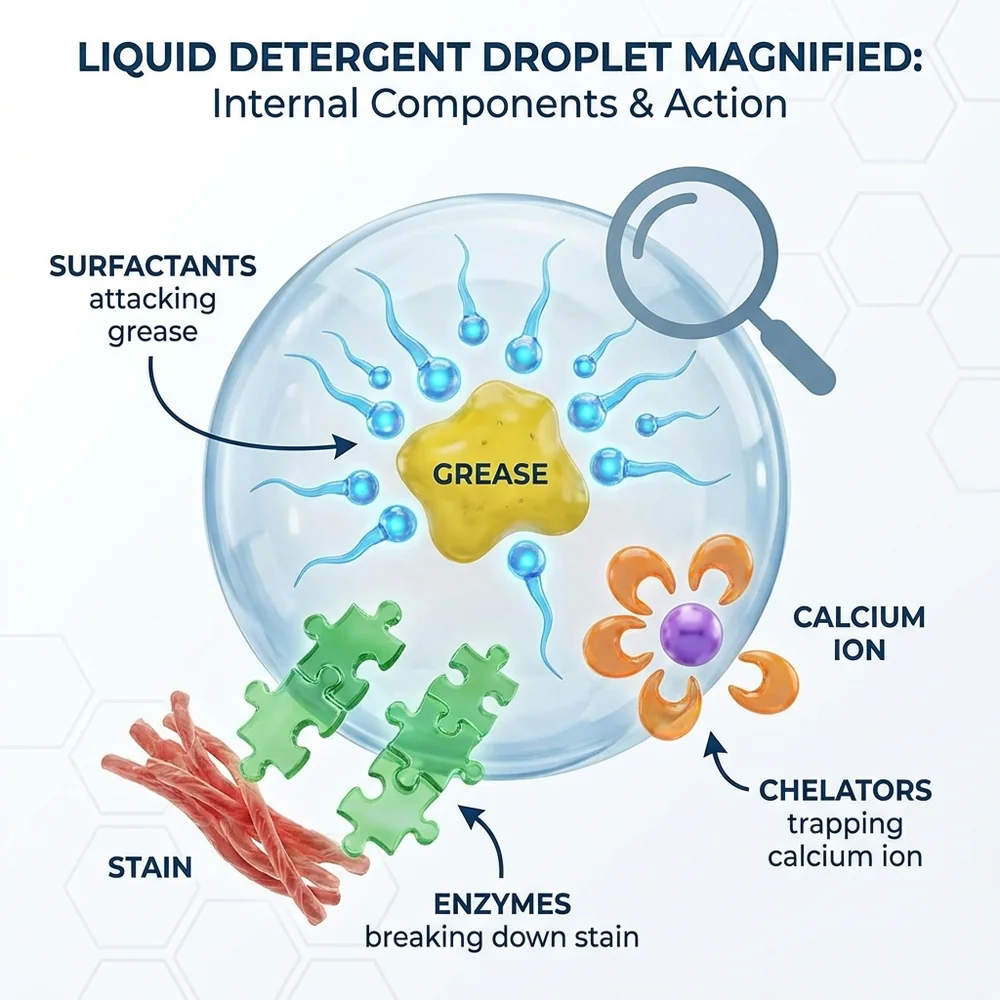
Surfactants are the core of any detergent. The name is a contraction of “surface-active agents” and that describes exactly what they do: they reduce the surface tension of water so it can penetrate fabric and lift away dirt.
Most heavy-duty detergents use a blend of two types: anionic and non-ionic surfactants. Anionic surfactants like those described in surfactants-sls-vs-sles carry a negative electrical charge. This charge allows them to interact aggressively with water while their hydrophobic (water-hating) tails anchor into oily soils. Because fabric fibers are also typically negatively charged, the surfactant-coated dirt particles are repelled away from the cloth and suspended in the wash water.
Non-ionic surfactants do not carry any charge. They are especially good at emulsifying stubborn oils and synthetic residues that anionic surfactants might miss. They also foam less, which makes them essential for high-efficiency washing machines where excess suds interfere with the tumbling action that actually cleans your clothes. Most good detergents use both types together so they can handle the full range of soils you throw at them.
The Bottom Line Surfactants are the “engine” of any detergent. Anionic types excel at general cleaning while non-ionic types specialize in grease. The best detergents combine both.
Builders and Chelators: Softening Your Water
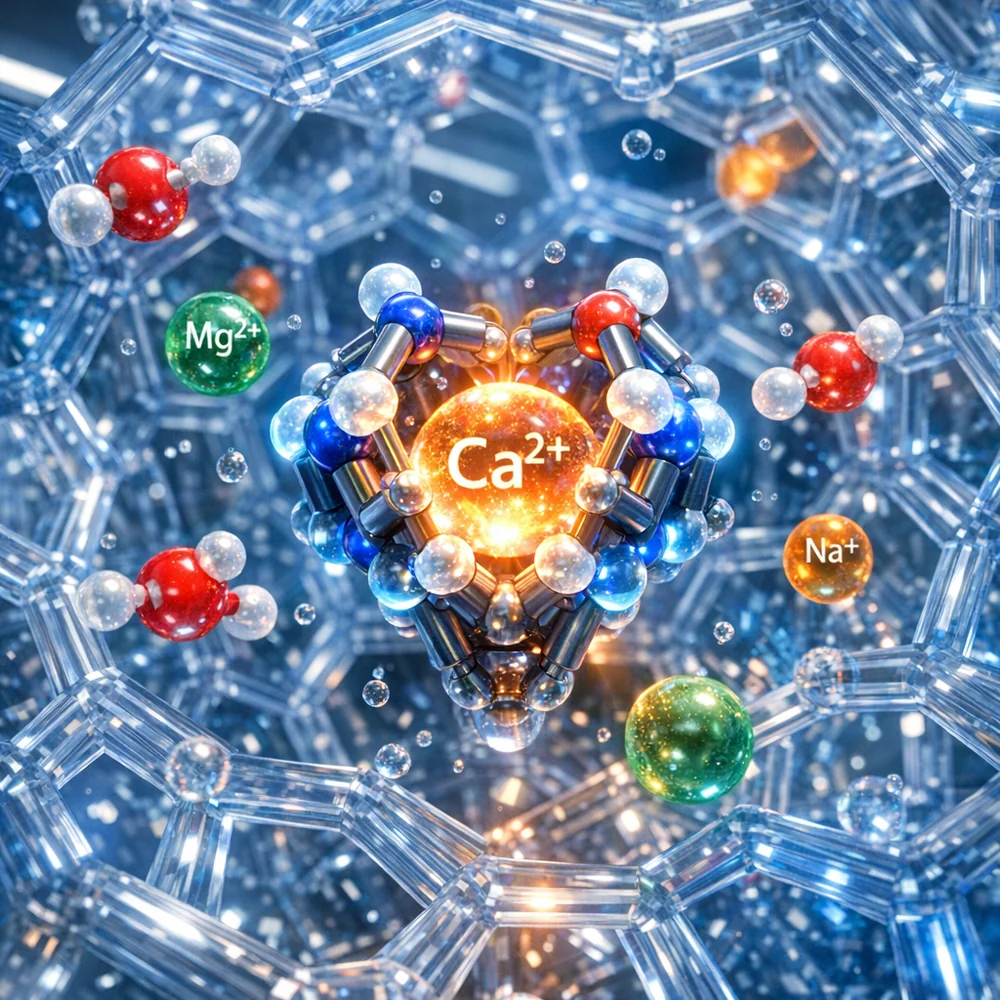
Even the best surfactants fail in hard water. Calcium and magnesium ions literally neutralize surfactant molecules before they can do their job. This is why detergents include a class of ingredients called builders.
Builders are molecules that deactivate hard water minerals before they can interfere with cleaning. Historically, this job was done by sodium tripolyphosphate (STPP), but environmental concerns have largely eliminated phosphates from consumer products. Modern phosphate-free detergents use zeolites instead. These are tiny mineral particles that work like ion exchange filters, swapping sodium ions for the problematic calcium and magnesium.
For additional protection, detergents also include chelators like sodium citrate. These molecules work like molecular claws that wrap around metal ions and lock them in a soluble complex. As covered in the hard water laundry chemistry overview, proper chelation prevents the “graying” that plagues clothes washed in hard water. Without effective builders and chelators, your expensive surfactants are fighting a losing battle.
Enzymes: The Stain Destroyers
Biological enzymes have transformed laundry cleaning from simple dirt removal to active chemical breakdown. Unlike surfactants that mechanically lift soil, enzymes are catalysts that actually digest stains at the molecular level.
A typical premium detergent contains a cocktail of enzymes from the field of laundry enzyme biology. Proteases break down protein stains like blood, grass, and food. Amylases target starch-based stains like pasta sauce and gravy. Lipases attack fats and oils. Each enzyme is engineered to target a specific type of molecule.
This enzyme targeting is what allows modern detergents to clean effectively in cold water. Hot water has always been good at loosening dirt, but it wastes energy and can damage fabrics. Enzymes do the work that heat used to do, allowing 15°C cycles to deliver results that previously required near-boiling temperatures.
There is even an enzyme called cellulase that does not target stains at all. Instead, it targets the fabric itself, specifically the damaged microfibers that create pilling and make cotton look faded. By “shaving” these loose fibrils off the surface, cellulase restores the smooth appearance and vibrant color of worn garments. This bio-polishing action is one of the most sophisticated features of modern detergent engineering.
The Bottom Line Enzymes are targeted biological catalysts that break down specific stain types. They enable cold-water cleaning and can even restore the appearance of worn fabrics.
Anti-Redeposition Agents: Keeping Dirt Suspended
One of the trickiest problems in laundry science is preventing soil from settling back onto clothes after it has been removed. The wash cycle creates a soup of suspended dirt, and without protection, that dirt would simply land on different fibers.
Anti-redeposition agents are polymers like carboxymethylcellulose (CMC) and sodium polyacrylate that solve this problem through electrostatics. These molecules coat both the fabric and the suspended soil particles with a negative charge. Since like charges repel, the dirt physically cannot settle back onto the fibers. It stays suspended in the water until it flushes away during the drain cycle.
Without these agents, particulate soil like clay dust and environmental carbon would gradually accumulate in your clothes over dozens of wash cycles. This is what causes the permanent graying and dullness that eventually makes people throw away clothes that are still structurally sound. CMC works especially well on cotton, while synthetic fabrics often require specialized polymers matched to the unique surface energy of polyester and nylon.
Corrosion Inhibitors: Protecting Your Machine
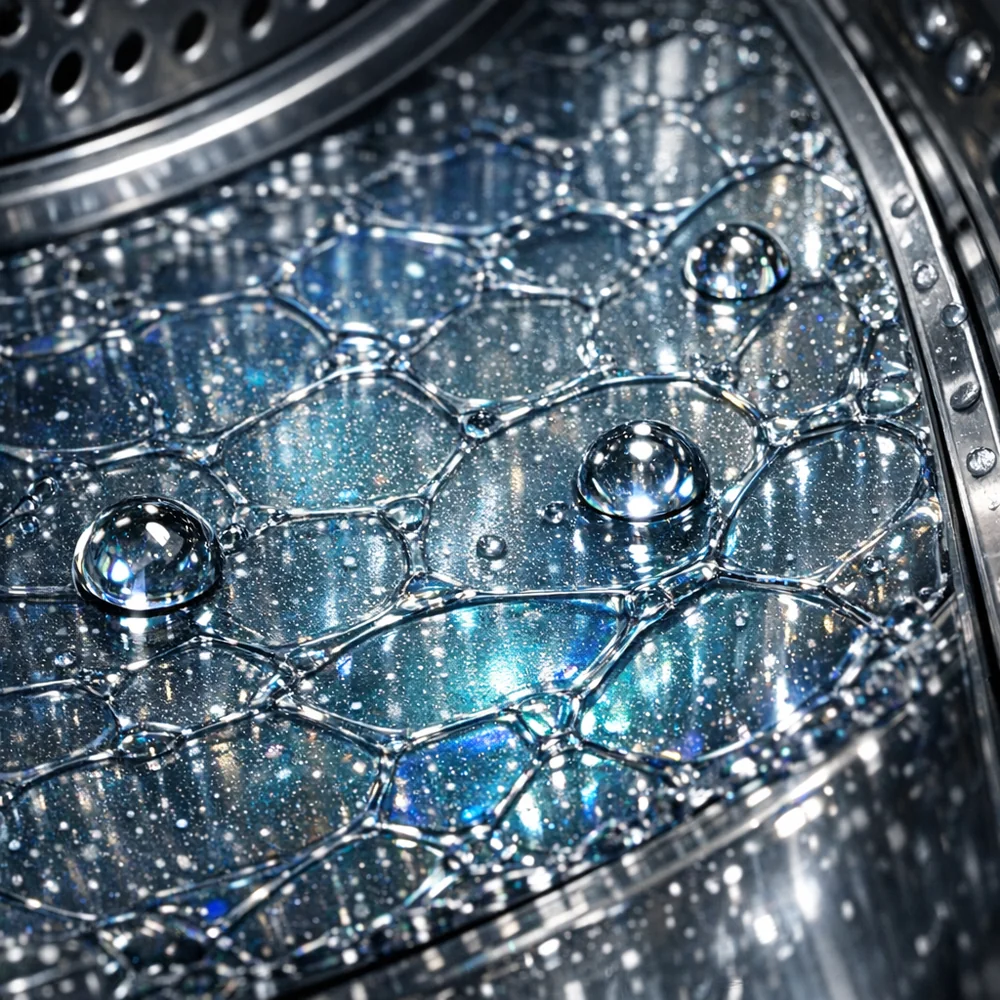
Laundry detergents are typically formulated with high alkalinity, often pH 9 to 11. This helps with cleaning but is corrosive to the metal components in your washing machine.
Corrosion inhibitors like sodium silicates protect the aluminum, stainless steel, and zinc-plated parts of the drum and pump. These molecules form a microscopic glass-like layer over metal surfaces that prevents the alkaline wash water from attacking the underlying metal. Without this protection, your machine’s internals would degrade rapidly.
Silicates also function as auxiliary builders, supporting the alkalinity of the wash and helping suspend certain inorganic soils. For users of smart washer auto-dosing systems, the presence of corrosion inhibitors in the bulk detergent prevents the concentrated liquid sitting in the machine’s reservoir from causing localized damage to the dosing system.
The Bottom Line Corrosion inhibitors form a protective barrier on metal machine parts. They are essential for appliance longevity, especially with alkaline detergent formulas.
Optical Brighteners: The White Illusion

Optical Brightening Agents (OBAs) are some of the most misunderstood ingredients in detergent. They do not actually clean your clothes. Instead, they are specialized dyes that alter how light reflects off fabric.
As explained in the optical brighteners science deep-dive, these chemicals absorb invisible ultraviolet light and re-emit it as visible blue light. This blue glow compensates for the natural yellowing that happens to white fabrics over time. Your eye perceives the result as a brighter, cleaner white, but the fabric is not actually any cleaner.
The tricky part is that OBAs are “substantive” meaning they bind permanently to fabric and accumulate with each wash. For white dress shirts, this creates a dazzling appearance. But for some users, the buildup causes problems. Military personnel find that OBAs destroy the infrared camouflage properties of uniforms. People with sensitive skin may react to the accumulated fluorescent dyes. This is why “free and clear” detergents specifically exclude brighteners in favor of chemical simplicity.
Bleaching Agents: Color-Safe Oxidizers
Many modern detergents include “color-safe” bleaches, typically oxygen-releasing compounds like sodium percarbonate. These provide a controlled oxidative attack that removes organic stains without stripping dyes.
Unlike the aggressive chemistry of chlorine bleach, oxygen bleach is selective enough to be safe for most colored fabrics. In liquid detergents where percarbonate would be unstable, manufacturers use bleach activators and stabilizers that release the oxidative power only once the product enters the wash water. These agents handle the organic stains like coffee, wine, and fruit juice that surfactants and enzymes cannot fully address.
Keeping bleaching agents stable alongside enzymes and brighteners in the same bottle is a major formulation challenge. Manufacturers use encapsulation technologies and chemical inhibitors to prevent the reactive ingredients from neutralizing each other during storage. This molecular management is what makes high-quality detergents so effective at combining sanitization, brightening, and deep cleaning in a single dose.
The Bottom Line Color-safe oxygen bleaches provide controlled stain oxidation without damage to dyes. Advanced stabilization keeps them from degrading other ingredients in the bottle.
Color Protection and Dye-Transfer Inhibition
Washing mixed loads carries the risk of dye transfer, where color escaping from one garment settles onto another. Modern detergents address this with dye-transfer inhibitors (DTIs).
The most common DTI is polyvinylpyrrolidone (PVP). This polymer acts as a dye scavenger in the wash water. When a dye molecule escapes from a fiber, the PVP wraps around it and prevents it from reattaching to any garment. This technology is what allows you to safely wash a red shirt with white socks if you are using a detergent for dark fabrics formulation with good DTI coverage.
Some detergents also include “color protectors” that work by maintaining fiber smoothness. As cotton ages and develops surface fuzz, the frayed fibers scatter light and make colors look faded. Cellulase enzymes and specialty polymers keep fibers flat and aligned, preserving the light-reflection profile that makes colors look vibrant. This intersection of optics and polymer science is a key differentiator between budget and premium products.
Solvents and Viscosity Modifiers
In liquid detergents, the distribution and stability of active ingredients depends on a complex blend of solvents and viscosity modifiers. These “inactive” ingredients are actually critical for performance.
Water is the main solvent, but many surfactants and enzymes require co-solvents like ethanol or propylene glycol to remain in a stable solution. These co-solvents prevent the product from separating into layers on the shelf and help ensure efficient performance in cold water. Propylene glycol specifically protects enzyme proteins from being destroyed by the concentrated surfactants surrounding them.
Viscosity modifiers like sodium cumene sulfonate control how the liquid pours and flows. A detergent that is too thin seems watered down. One that is too thick may not disperse properly from the machine’s dispenser. The flow properties (what scientists call rheology) are carefully engineered to deliver the right dose of active chemistry at exactly the right moment in the wash cycle.
The Bottom Line Solvents and viscosity modifiers ensure stable, consistent delivery of active ingredients. They protect enzymes during storage and guarantee proper dispensing.
Conclusion
The evolution of laundry detergents from simple soap to complex chemical systems reflects a century of scientific advancement. Each ingredient in a modern formulation has a specific purpose, from the workhorse surfactants to the specialized anti-redeposition polymers that prevent graying.
This complexity gives us the ability to achieve high levels of hygiene and fabric preservation with minimal effort and energy. Cold water cycles now clean as well as hot water did decades ago. Enzyme cocktails digest stains that would have been permanent marks on previous generations of clothing.
Understanding what goes into your detergent empowers you to make better choices. You can match the ingredient profile to your specific needs: the hardness of your water, the types of stains your household generates, and the sensitivity of your skin. The next time you stand in front of that overwhelming wall of detergent options, the right choice becomes much clearer when you know what each product actually contains.
References
- Detergent Chemistry and Physics. “Formulation Strategies for High-Efficiency and Liquid Detergents.” Wiley
- Journal of Chemical Education. “The Molecular Architecture of Laundry Detergents: A Laboratory Perspective.” ACS Publications
- Textile Research Journal. “Effect of Detergent Builders and Chelators on Mineral Redeposition in Hard Water.” Sage Journals
- Waste Management. “Biodegradability and Environmental Impact of Anionic and Non-ionic Surfactants.” ScienceDirect
- International Journal of Cosmetic Science. “Dermatological Impact of Detergent Residues and Optical Brighteners on the Skin Barrier.” Wiley