Foaming Soaps Mechanics: The Physics of Aerosolized Surfactants
Table of Contents
Things You'll Learn From This Article:
- Foam isn’t just soap with air mixed in — it’s a structure where air is trapped inside very thin liquid walls that are held together by soap molecules.
- Plain water won’t make lasting bubbles because its surface pulls itself tight, so bubbles pop right away unless soap changes that behavior.
- Soap molecules work by sitting between air and water, making it easier for bubbles to form and stick around.
- A foaming soap pump mixes air and liquid in a very controlled way using a mesh screen, so the foam comes out already formed instead of relying on your hands to make it.
- Foaming soap is much more diluted than regular liquid soap, which is why regular soap doesn’t work properly in a foaming dispenser.
- Extra ingredients are added to foaming soaps to stop bubbles from draining and collapsing too fast, even though the liquid itself is thin.
- Foam can “heal” small weak spots in its bubbles by pulling liquid back to damaged areas, which helps it last long enough to wash effectively.
- Foam spreads more evenly than liquid, so the cleaning ingredients touch more of the surface instead of pooling in one spot.
- On vertical surfaces, foam sticks in place longer than liquid, giving the soap more time to work before it runs off.
- Using foam often leads to better washing habits because you can clearly see where the soap has spread.
- Mixing different kinds of soap molecules makes bubbles stronger and gentler on skin at the same time.
- Foaming systems usually use less soap per wash, which means less product shipped, less used, and less sent down the drain.
- Foam naturally changes over time as small bubbles shrink and large ones grow, which is why fresh foam looks finer than foam that’s been sitting.
- Consistent, small bubbles make foam last longer, which is why pump design matters as much as the soap formula.
- Understanding how foam works helps you see why foaming soaps can clean well while using less product overall.
Most people think foam is just soap mixed with air. It is so much more than that. Foam is actually a carefully engineered structure where gas bubbles are trapped inside thin liquid walls, held together by the precise arrangement of surfactant molecules. Understanding how foam works explains why foaming hand soap feels different from regular liquid soap and why some foam lasts longer than others.
When you pump a foaming soap dispenser, you are not just squirting out diluted soap. You are activating a complex system where air and liquid are forced through a fine mesh screen at controlled ratios. The surfactant molecules in that liquid arrange themselves at the boundary between air and water, creating a stable film that can persist for minutes. This is real chemistry in action, and it has practical implications for cleaning effectiveness, product efficiency, and environmental impact.
The physics of foam touches on some of the most interesting concepts in surface science. We will explore how surfactants lower surface tension to make bubbles possible, how the mechanical pump creates uniform foam, why some formulas drain quickly while others stay fluffy, and how all of this affects the actual cleaning performance of the product.
Why Water Does Not Want to Make Bubbles
Pure water absolutely refuses to foam. You can shake a jar of distilled water as hard as you want, and any bubbles that form will pop almost instantly. This is because of water’s extremely high surface tension.
Water molecules are strongly attracted to each other through hydrogen bonding. They pull inward at the surface, resisting any attempt to stretch that surface into new shapes. Creating a bubble means stretching the water surface into a thin sphere, which water actively fights against. The liquid films between bubbles (called lamellae) would be so fragile that even mild vibration would rupture them.
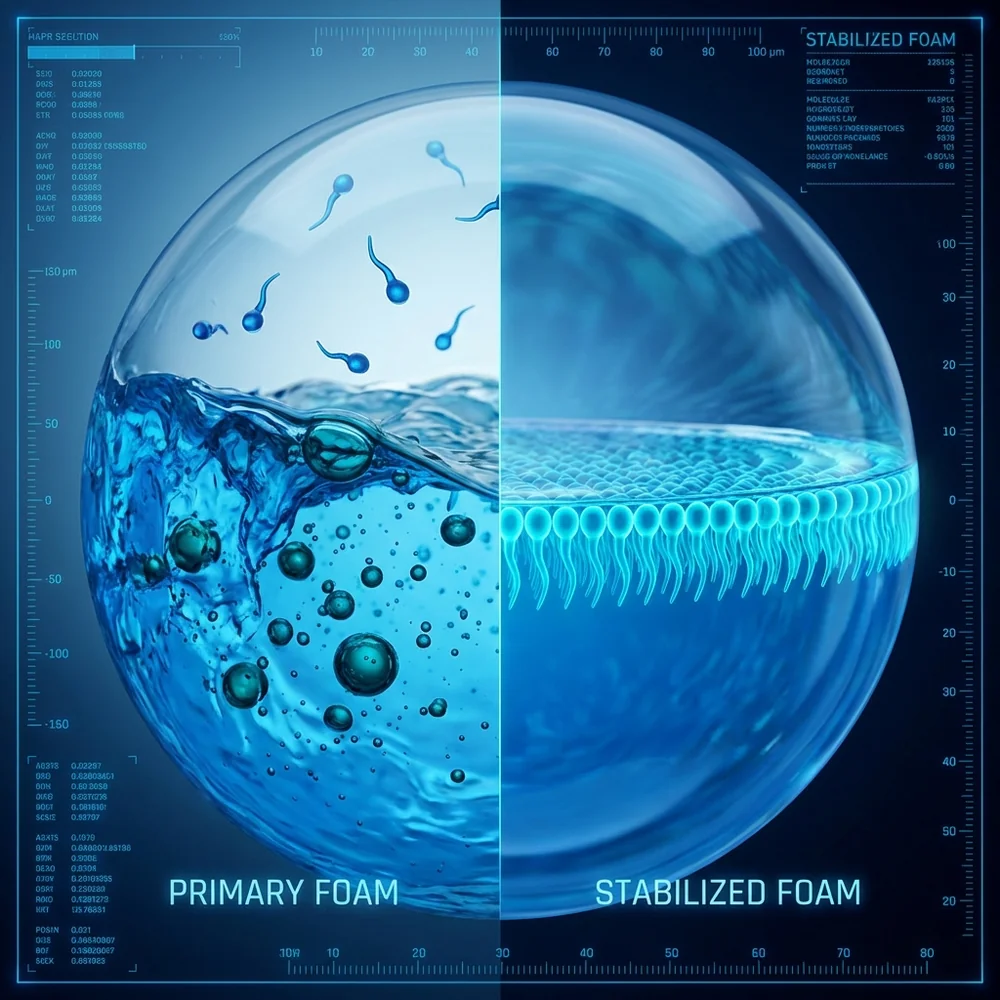
Surfactants change the game by positioning themselves at the air-water interface. The surfactant molecule has a water-loving head that stays in the liquid and a water-hating tail that sticks out into the air. This molecular orientation creates a kind of molecular carpet that covers the surface. By filling the surface with these molecules, the surfactant reduces the inward pulling force and lowers the energy required to create new surface area. Suddenly, bubbles become possible.
The stability of resulting bubbles depends on how many surfactant molecules are available to coat the interface. A higher concentration of surfactants like SLS or SLES means a denser molecular film, which means stronger bubble walls that resist rupture.
The Bottom Line Surfactants enable foam by reducing water’s surface tension. Without them, the liquid films inside foam would be too fragile to persist.
How the Foaming Pump Actually Works
A foaming soap pump is more sophisticated than a standard liquid soap dispenser. Inside are two chambers: one for air and one for the soap solution. When you press down, both chambers compress simultaneously, forcing air and liquid to mix as they pass through a fine mesh screen at the nozzle.
This mesh is the critical component. As the air-liquid mixture is pushed through the microscopic openings, the liquid gets sheared into thin films that wrap around pockets of air. The geometry of the pump ensures a consistent air-to-liquid ratio, typically around 15 to 1 or 20 to 1. This engineered ratio is much more controlled than what you get by rubbing soap between your hands.
The uniformity matters for cleaning performance. When you lather by hand, the energy input varies wildly from moment to moment. You get a mix of large, unstable bubbles and dense wet areas. The mechanical pump creates bubbles of similar size, maximizing surface area for a given amount of liquid. This pre-activated foam means the detergent ingredients start working the instant they contact skin or fabric.
Why Foaming Soap Uses Different Formulas
If you try to put regular liquid soap in a foaming dispenser, you will quickly discover it does not work. The liquid clogs the mesh or comes out as a stringy mess rather than fluffy foam. Foaming soaps require completely different formulations.
Standard liquid soaps are thickened with salts or polymers to give them that rich, viscous feel that consumers associate with quality. But that viscosity is the enemy of foaming pumps. The liquid needs to flow easily through the fine mesh, so foaming formulas have much lower viscosity, often close to water.
This creates formulation challenges. Without thickeners, the surfactants must remain stable and effective at lower concentrations. Foaming soaps typically run at 5 to 10 percent active matter compared to 15 to 30 percent in concentrated liquid soaps. Making the chemistry of pH-neutral detergents work under these constraints requires careful ingredient selection.
To produce stable foam despite the dilute formula, manufacturers add foam stabilizers and humectants. Glycerin and PEG derivatives slow the rate at which liquid drains out of the bubble walls. By increasing the viscosity within the thin films (without changing bulk solution viscosity), these additives create foam that feels stiff and luxurious instead of quickly collapsing.
The Bottom Line Foaming soaps use lower-viscosity, lower-concentration formulas than regular liquid soap. Special stabilizers make the foam feel substantial despite having less active surfactant.
The Self-Healing Bubble Wall
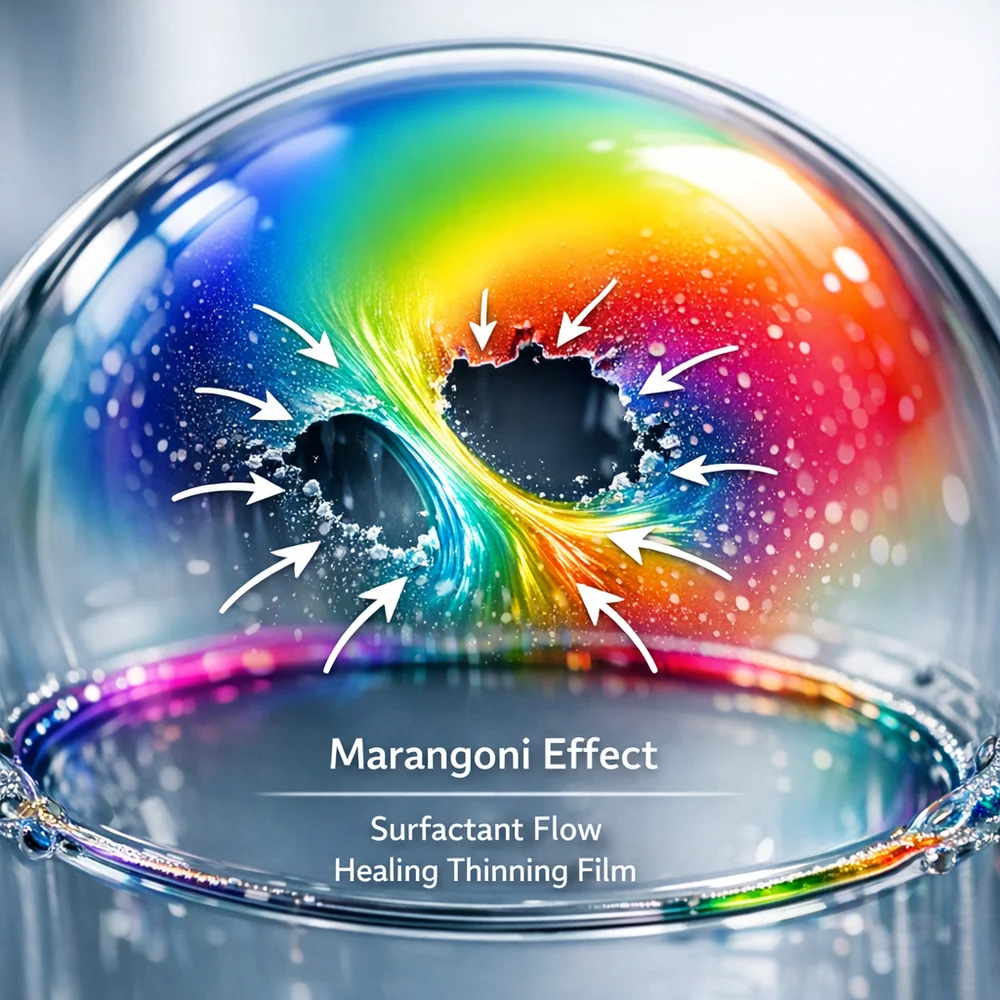
Bubbles face constant threats to their survival. Gravity pulls liquid out of the walls. Evaporation thins the films. Random vibrations create stress points. Yet well-formulated foam can persist for minutes. The secret is a phenomenon called the Marangoni effect.
When a bubble wall gets stretched or thinned, the surfactant molecules become spread farther apart in that area. This local depletion increases the surface tension at that specific spot. Higher surface tension creates an attractive force that pulls liquid from surrounding, less-stressed regions toward the weak point.
This flow carries surfactants along with it, restoring equilibrium. The bubble essentially heals itself. In a well-designed refillable foaming soap system, this self-repair mechanism keeps foam stable long enough to complete the washing task.
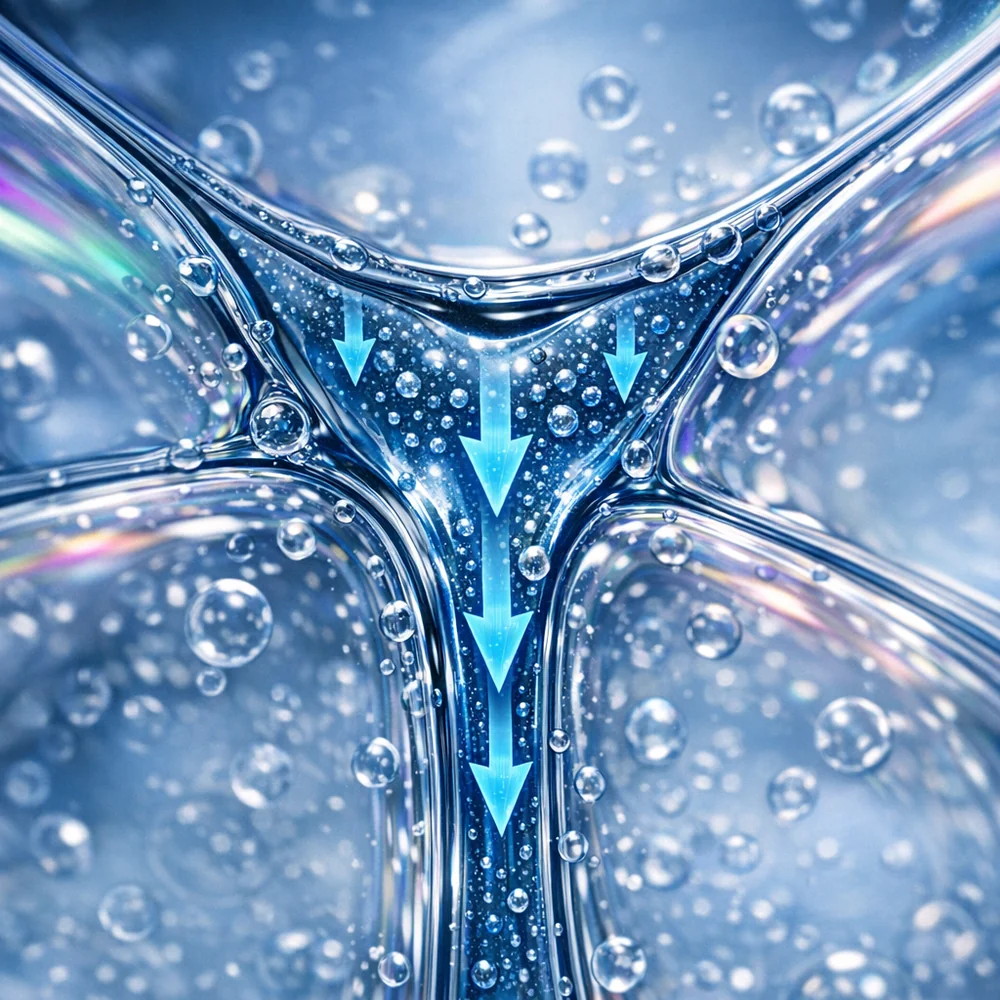
However, the Marangoni effect has limits. Gravity constantly drains liquid from the upper portions of bubbles toward the junctions between bubbles (called Plateau borders). As liquid leaves, the films become thinner. Eventually they reach a critical thickness of just 5 to 10 nanometers, basically two layers of surfactant molecules with almost no water between them. At this point, any disturbance causes rupture. This is why DIY foaming soap ratios often fail. If surfactant concentration is too low, the Marangoni effect cannot outpace drainage.
Why Foam Can Clean Better Than Liquid
A common assumption is that foaming soap is less effective because it contains more air and less liquid. The actual chemistry often shows the opposite.
Cleaning is fundamentally a surface process. Surfactant molecules must physically contact the oils and dirt to remove them. Foam presents an enormous surface area relative to the amount of liquid used. When foam is applied, it spreads easily into microscopic pores and crevices that a liquid droplet would roll right over.
This enhanced coverage ensures that scent chemistry and cleaning agents distribute evenly rather than pooling where the initial liquid lands. Users also tend to wash more thoroughly when they can see the foam covering the target surface. The visual feedback encourages proper technique.
For vertical surfaces, foam has a major advantage over liquid. A liquid sprayed onto a wall or curtain immediately begins running downward under gravity. Foam clings in place, maintaining contact time for the chemicals to work. The interlocking structure of bubbles creates a temporary scaffolding that defies gravity long enough for effective cleaning.
The Bottom Line Foam maximizes surfactant contact with surfaces through its enormous surface area. It also clings to vertical surfaces where liquid would simply run off.
Co-Surfactants Make Better Bubbles

Primary surfactants like sodium laureth sulfate are excellent at lowering surface tension but can create brittle foam that pops easily. This is where co-surfactants earn their value.
Secondary surfactants like cocamidopropyl betaine slot into the spaces between primary surfactant molecules at the interface. This intercalation makes the molecular film more tightly packed and elastic. Think of it like adding rebar to concrete. The co-surfactants provide structural reinforcement that helps bubble walls flex without breaking.
This synergy also benefits skin compatibility. High concentrations of primary anionic surfactants can irritate skin, but amphoteric co-surfactants buffer that harshness. This strategy is common in hypoallergenic detergent formulations. By building more stable foam at the molecular level, manufacturers can achieve good cleaning power with less total surfactant and less skin irritation.
The Environmental Case for Foam
The move toward foaming soap systems represents a genuine environmental opportunity. Standard liquid soaps are typically 70 to 90 percent water. Shipping all that water around the world consumes fuel and generates emissions.
Foaming dispensers enable concentrated refills that the consumer dilutes at home. This dramatically reduces the weight and volume that needs to be transported. Furthermore, foam delivers cleaning action using less total product. Studies show that foaming soap users consume up to 30 percent less product per wash than liquid soap users.
This reduction matters for wastewater systems too. Less surfactant going down the drain means reduced chemical load entering municipal treatment facilities. When combined with other eco-friendly laundry options, foam technology represents a meaningful step toward more sustainable cleaning.
Why Small Bubbles Eat Big Bubbles
Foam does not remain static. Even perfectly stable foam undergoes slow internal changes due to a phenomenon called Ostwald ripening.
The air pressure inside a curved bubble is higher than in the surrounding atmosphere. Small bubbles have higher internal pressure than large bubbles because of their tighter curvature. This pressure difference causes gas to slowly diffuse through the liquid films from small bubbles into larger ones.
Over time, the small bubbles shrink and disappear while the large bubbles grow. The foam becomes coarser and eventually collapses. This is why foam that sits for ten minutes looks completely different from freshly pumped foam.
Manufacturers minimize this effect by engineering pumps that produce uniform bubble sizes. The more consistent the initial bubble distribution, the slower the Ostwald ripening proceeds. Advanced cleaning tech in industrial applications uses pressurized systems to generate ultra-fine, uniform foam for consistent performance.
The Bottom Line Foam degrades over time as small bubbles transfer their air to large bubbles. Uniform bubble size production extends foam stability.
Conclusion
Foaming soap mechanics sit at the intersection of mechanical engineering and molecular chemistry. What looks like simple aeration is actually a precisely controlled process that maximizes cleaning efficiency while minimizing product waste.
The foam pump shears liquid through mesh screens to create uniform bubbles. Surfactant molecules arrange themselves at air-water interfaces to stabilize those bubbles. Co-surfactants reinforce the molecular film to prevent premature rupture. The Marangoni effect provides self-healing properties that extend foam life.
From a practical standpoint, foam delivers superior surface coverage and clings to vertical surfaces better than liquid. It requires less product per wash and supports more sustainable distribution through concentrated refills. Whether for hand-washing hygiene protocols or household cleaning, understanding foam mechanics helps you get more effective cleaning from less product.
The future of sustainable cleaning likely involves more sophisticated foam technologies. The ability to expand small volumes of concentrated product into high-surface-area foam at the point of use addresses both chemical efficiency and environmental impact. Foam is not just visually satisfying. It is scientifically superior.
References
- Rosen, M. J., & Kunjappu, J. T. (2012). Surfactants and Interfacial Phenomena. John Wiley & Sons.
- Cantat, I., et al. (2013). Foams: Structure and Dynamics. Oxford University Press.
- Langevin, D. (2017). Influence of Interface Rheology on Foam and Emulsion Properties. Advances in Colloid and Interface Science.
- Schramm, L. L. (2005). Emulsions, Foams, and Suspensions: Fundamentals and Applications. Wiley-VCH.
- Stevenson, P. (2012). Foam Engineering: Fundamentals and Applications. John Wiley & Sons.