Emergency Detergent Chemistry: Ad-Hoc Surfactants and Solvent Solutions
Table of Contents
Things You'll Learn From This Article:
- Laundry detergent does more than make suds; it’s built to lift dirt **and** keep it from settling back onto your clothes during the rinse.
- Dish soap can clean fabric, but too much will create massive foam that can stop your washer from working or spill suds onto the floor.
- If dish soap is the only option, a teaspoon or less is enough for a full load, and extra rinse water really matters.
- Shampoo is a workable emergency choice for lightly dirty clothes, especially delicates, but conditioners in it can slowly coat fabric.
- Clear, conditioning‑free shampoo is safer than “moisturizing” or “2‑in‑1” formulas when washing clothes.
- Baking soda and vinegar cancel each other out when mixed, so together they don’t actually clean oily dirt from fabric.
- Baking soda helps with smells, and vinegar helps remove mineral buildup or leftover soap, but neither replaces detergent on its own.
- Grated bar soap can react with hard water and create sticky buildup that coats clothes and the inside of your washer.
- Bar soap works better as a spot treatment on a single stain than as something you add to the whole wash.
- Oil‑based stains respond better to targeted spot cleaning than to dumping substitutes into the machine.
- Rubbing alcohol can break down grease or adhesive stains if you dab it on the spot and rinse by hand first.
- Solvents should never be poured into the washing machine because their fumes can be dangerous.
- Emergency substitutes often remove dirt but don’t stop it from drifting back onto clothes, which leads to dull or gray-looking laundry.
- Using the “Extra Rinse” option helps flush away loosened dirt when you’re not using real detergent.
- Plain hot water and strong agitation can clean lightly dirty clothes better than using the wrong product.
- Natural plant saponins (like soapnuts) create low foam and are much safer for machines than dish soap.
- Soapnuts and similar plants clean gently and are best for light to moderate dirt, not heavy stains.
- Front‑loading and high‑efficiency washers are far more sensitive to foam problems than top‑loaders.
- After using emergency substitutes, running an empty wash with real detergent helps clear residue from the machine.
- Emergency fixes can get you through one wash, but regular detergent is still the safest way to protect both clothes and washer.
We have all been there. You are halfway through loading the washing machine when you reach for the detergent bottle and find it completely empty. Your next thought is probably something like, “Can I just use dish soap?” or “What about that shampoo in the shower?” These are fair questions, and the answer is more complicated than a simple yes or no.
The truth is that laundry detergent is a lot more sophisticated than most people realize. It is not just soap with a nice smell. It is a carefully engineered mix of cleaning agents, builders, enzymes, and special ingredients that work together in the specific conditions inside your washing machine. When you reach for a substitute, you are grabbing something designed for a completely different job. That does not mean it will not clean your clothes at all, but it does mean you need to understand the trade-offs before you pour anything into the drum.
The core job of any detergent is to grab onto dirt and oil and pull it away from the fabric so the water can rinse it down the drain. This is done by molecules called surfactants. These clever little chemicals have two ends: one that loves water and one that hates it. The water-hating end dives into the grease, while the water-loving end stays bonded to the wash water. Together, they form tiny bubbles around the dirt particles, lift them off the fabric, and keep them suspended until the rinse cycle carries them away.
Most household products that create suds contain some form of surfactant, so in theory, they can do basic cleaning. The problems arise from the other ingredients in those products and the specific way they are designed to foam, rinse, and interact with surfaces. What works great in your sink or on your hair can cause serious mechanical problems in a washing machine or leave invisible residues that ruin your clothes over time.
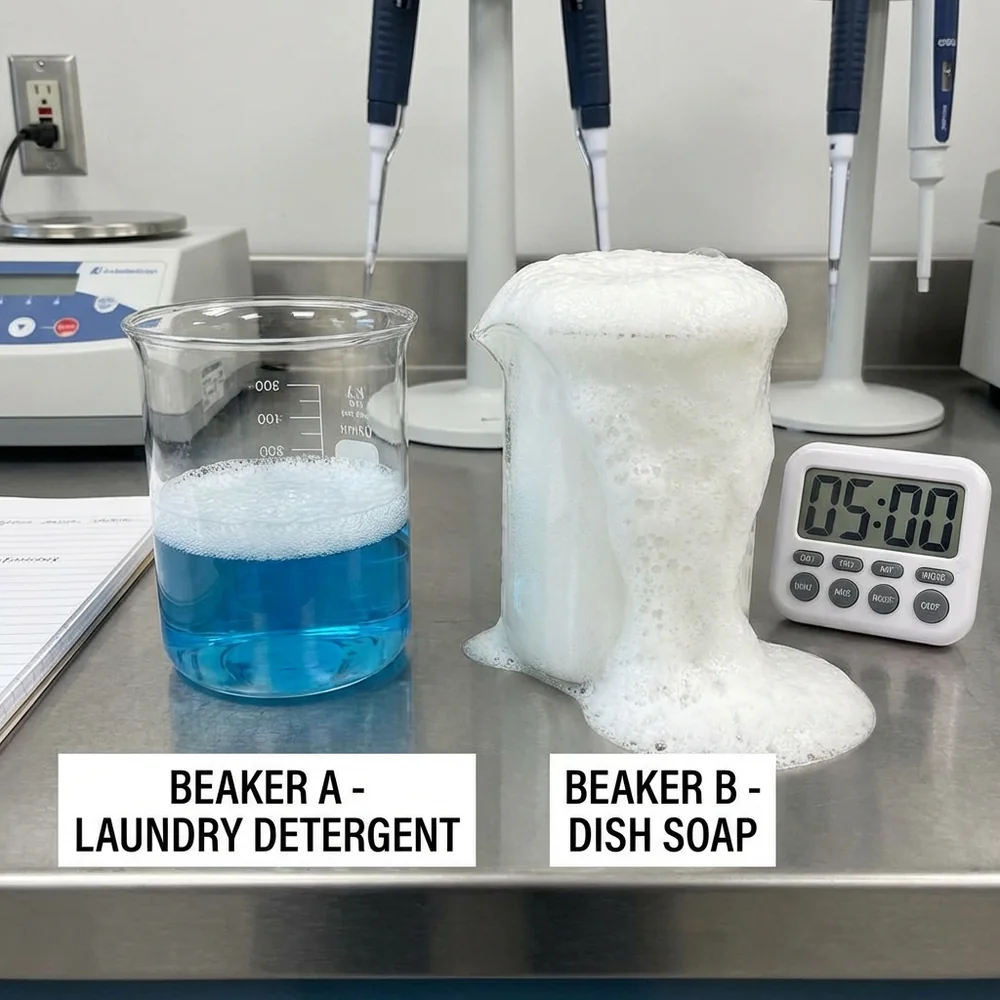
Dish Soap and the Suds Explosion Problem
The most tempting substitute in any kitchen is the bottle of liquid dish soap sitting right next to the sink. It cuts through greasy pans with ease, so it must be great for greasy laundry, right? Well, yes and no. The cleaning power is there, but the foam is a disaster waiting to happen.
Dish soaps are loaded with surfactants like Sodium Lauryl Sulfate and Cocamidopropyl Betaine. These are specifically chosen because they create that thick, stable, satisfying foam that makes hand washing dishes feel effective. When you are scrubbing a pan by hand, that foam is helpful. It gives you visual feedback that the soap is working, and it helps suspend the grease so you can wipe it away.
In a washing machine, especially a modern front-loader or any high-efficiency model, that same foam is a nightmare. The drum rotates and tumbles your clothes through the water, introducing massive amounts of air into the solution. Without special defoaming agents found in proper laundry detergent ingredients, that air creates an exponentially growing mountain of suds.
Once the foam fills the drum, it causes what technicians call a “suds lock.” The air bubbles form a cushion that stops the clothes from tumbling properly. Your garments just float in a fluffy cloud instead of being mechanically scrubbed against each other. Even worse, the foam can creep into the machine’s sensors. The pressure switch that tells your washer how much water is in the drum might read the foam as water, causing the machine to abort the cycle or refuse to drain. If you have ever seen a washing machine spew suds across your laundry room floor, you know exactly how bad this can get.
If dish soap is your only option, the key is quantity control. You need to use a tiny fraction of what you would use for laundry detergent. We are talking about a teaspoon or less for a full load. You should also stick to top-loading machines if possible, since they are less sensitive to foam problems than the sealed drum of a front-loader. Understanding these foaming soap mechanics can save you from an expensive service call.
Key Insight: Dish soap cleans effectively but creates foam designed for hand washing. In a machine, this foam can cause a “suds lock” that prevents proper cleaning and may trick sensors into aborting the wash cycle.
Shampoo as a Laundry Substitute

If you are standing in your bathroom wondering about the shampoo bottle, you are actually looking at a surprisingly reasonable emergency option, with some caveats.
Shampoos use many of the same surfactants like SLS and SLES found in laundry products. Their primary job is to strip oil and dirt from hair, which is not that different from stripping oil and dirt from fabric. Where things get tricky is in the “extra” ingredients that make shampoo good for hair but potentially problematic for clothes.
Most shampoos contain conditioning agents like silicones or quaternary ammonium compounds. These are designed to deposit a thin, slippery film on your hair to make it smooth and shiny. On fabric, these same conditioners act like a low-grade fabric softener. That might sound nice, but it comes with a cost. Over time, this residue can build up on your clothes, reducing the absorbency of towels and clogging the moisture-wicking channels in athletic wear.
Shampoo also tends to be pH-balanced on the slightly acidic side, around pH 5 to 5.5. This makes it gentle on protein fibers like silk or wool, functioning almost like a pH-neutral detergent alternative. However, that gentle acidity means it lacks the alkaline punch needed to tackle heavy grease or stubborn sweat stains. For lightly soiled delicates, a small squirt of a clear, conditioning-free shampoo can work in a pinch. Just make sure to run an extra rinse cycle to flush out any residue.
The Baking Soda and Vinegar Myth
Few home cleaning myths are as persistent as the idea that mixing baking soda and vinegar creates some kind of super-cleaner. Social media is full of videos showing the dramatic fizzing reaction and claiming it is proof of powerful cleaning action. The chemistry tells a completely different story.
Baking soda is sodium bicarbonate, a weak base. Vinegar is acetic acid, a weak acid. When you combine an acid and a base, they neutralize each other. The dramatic fizzing you see is just carbon dioxide gas being released. What you are left with after the show is over is plain water and sodium acetate salt.
Neither of these products is a surfactant. They have absolutely no ability to grab onto oil molecules and pull them away from fabric. The fizzing might provide a tiny bit of mechanical agitation if you pour the mixture directly onto a stain, but as a bulk laundry solution, you are essentially washing with slightly salty water.
Now, used separately, both baking soda and vinegar have their place in laundry. Baking soda is an excellent buffer and odor neutralizer. The baking soda and borax chemistry works by absorbing and neutralizing the acidic compounds that cause smells. Vinegar, meanwhile, is great at dissolving mineral deposits and helping to rinse away soap residue, as explained in the science of laundry vinegar.
The bottom line is that running a load with just baking soda and vinegar will leave you with clothes that might smell a bit fresher, but are still covered in skin oils, body soil, and any other grime they went in with. These products are boosters and maintenance tools, not detergent replacements.
Key Insight: Baking soda and vinegar neutralize each other when mixed, leaving behind just water and salt. Neither is a surfactant, so they cannot perform the core cleaning function of lifting grease from fibers.
Bar Soap and the Soap Scum Trap

In a real pinch, you might consider grating a bar of soap into your washing machine. This actually can work, but only under very specific conditions, and it introduces long-term risks you need to understand.
Traditional bar soaps are made through a process called saponification, where fats like tallow or coconut oil are reacted with an alkali. The result is a “true soap,” which is chemically different from the synthetic detergents used in modern laundry products. True soaps clean well in soft water, but they react badly with the minerals found in hard water.
When soap molecules encounter calcium and magnesium ions in hard water, they form an insoluble sludge called lime soap or soap scum. You have probably seen this stuff as the grayish ring around a bathtub. In a washing machine, this scum coats the drum, the heating elements, and, worst of all, your clothes. The sticky residue provides a perfect breeding ground for bacteria, leading to the formation of biofilms and that nasty “sewer smell” some machines develop.
If you absolutely must use bar soap, treat it as a pre-treatment for a specific stain rather than a bulk detergent. Rub a bit directly onto an oil and grease stain, work it in by hand, and then rinse the garment before putting it in the machine. Running a water-only cycle after that will get the clothes cleaner than bulk-soaping the whole load and creating a layer of scum inside your appliance.
Solvent-Based Spot Cleaning
When you are dealing with a specific tough stain and have no detergent, sometimes reaching for a solvent is a smarter move than trying to make the whole wash work with a substitute.
The principle behind solvent cleaning is simple: like dissolves like. Oil-based stains, including adhesives, grease, and some cosmetics, dissolve readily in other oils or in low-polarity solvents. Isopropyl alcohol, commonly known as rubbing alcohol, is one of the most accessible options. Dabbing a bit onto an oily stain can break down the chemical bonds holding the grime to the fabric. This is a core technique in adhesive and gum removal.
The critical safety rule is that solvents should never go into the washing machine drum. They are volatile and often flammable. The heat from the motor and the friction of the drum could, in theory, ignite the vapors. Always apply solvents to a specific spot, blot away the dissolved soil, and rinse the area thoroughly with cool water before the garment goes anywhere near the machine.
This targeted approach can save a garment from a permanent stain when you are traveling, out of supplies, or just cannot run a proper wash cycle right away.
The Problem Nobody Talks About: Dirt Settling Back In
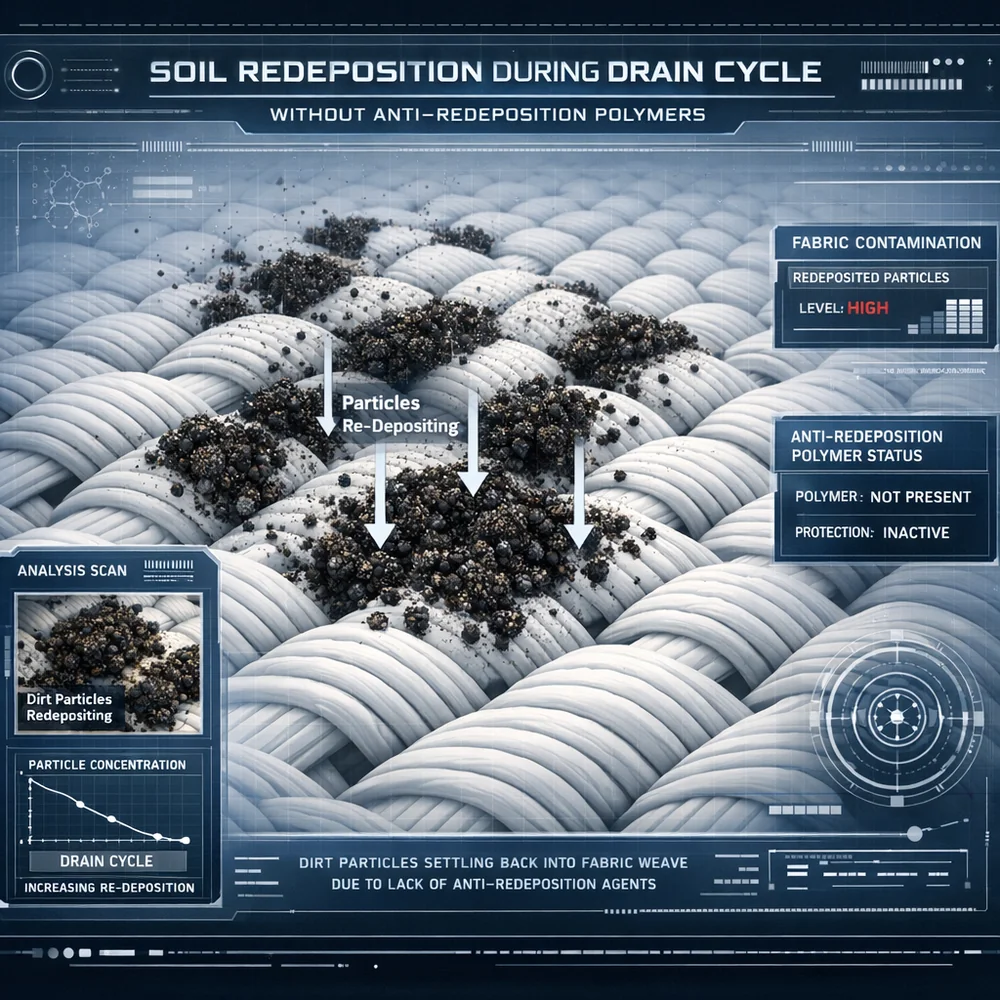
Here is something most people never think about. Getting dirt off your clothes is only half the battle. The other half is keeping it off long enough for the rinse water to carry it away. Real laundry detergents contain special ingredients called anti-redeposition agents that solve this problem.
These agents, like carboxymethyl cellulose, work by giving the dirt particles and the fabric fibers similar electrical charges. Since like charges repel, the dirt is physically pushed away from the fabric and kept floating in the water until it drains. None of your emergency substitutes contain these polymers.
When you wash with dish soap or shampoo, the surfactants may successfully pull the soil off the fabric during the wash cycle. But as soon as the water level drops or the concentration of suds decreases, the dirt has nothing stopping it from settling right back onto your clothes. This is why garments washed with makeshift detergents often come out looking dingy, dull, or slightly grayed. The dirt was lifted, moved around, and then redeposited in a thin, even layer across everything.
The best defense against this is to use the maximum amount of rinse water possible. Select the “Extra Rinse” option on your machine to flush away as much suspended dirt as you can. It is not a perfect solution, but it significantly reduces the graying effect.
Key Insight: Household substitutes lack anti-redeposition polymers. Without these, lifted dirt settles back onto the fabric during draining. Always use the maximum rinse setting to flush away as much suspended soil as possible.
Natural Plant Saponins
If you happen to have access to certain plants, you have an option that is actually safer for your machine than dish soap.
Saponins are natural compounds found in plants like soapnuts, ivy leaves, and horse chestnuts. These molecules have the same dual nature as synthetic surfactants: one end attracts water, the other repels it. When agitated in water, they produce a gentle, low-sudsing foam that can handle light to moderate soil removal. The efficacy of soap nuts has been studied for both ecological and practical laundry applications.
Natural saponins are unlikely to damage your machine’s sensors or create a suds explosion. Their cleaning power is certainly weaker than modern synthetic detergents, but they offer a genuinely safe emergency option. In a situation where you are off the grid, in a rural area, or just trying to get by until you can buy more detergent, knowing how to extract saponins from plants is a practical skill.
To use soapnuts, you typically place a few in a small cloth bag and toss them into the drum with your clothes. For ivy or horse chestnuts, you can crush the plant material and soak it in hot water to release the saponins before adding the liquid to your wash.
Putting It All Together: A Survival Hierarchy
When your detergent runs out and you need to wash something, here is a practical ranking of your options from safest to riskiest.
For lightly soiled clothes, you may actually be better off just running a plain hot water cycle on a heavy-duty setting. The heat and mechanical agitation will remove a decent amount of grime without introducing any problematic chemicals. This is the safest choice for your machine and avoids all the risks discussed above.
If you need a surfactant, a tiny amount of clear shampoo or dish soap is your next best bet. Use a teaspoon or less, and always select the extra rinse option. Prioritize a top-loader if you have access to one, since front-loaders are far more vulnerable to suds lock.
For specific stains, targeted spot treatment is often more effective than trying to substitute bulk detergent. Use rubbing alcohol, white vinegar, or even a dab of bar soap directly on the stain, work it in, rinse by hand, and then run a water-only machine cycle.
Once you have replenished your proper detergent supply, do a “reset wash.” Run an empty cycle with a good detergent and maybe a booster like borax or washing soda to flush out any residues left behind by your emergency substitutes.
Key Insight: When in doubt, plain hot water is safer than a risky substitute. Targeted spot treatment followed by a water-only cycle protects your machine while still salvaging stained garments.
The Bottom Line
Running out of laundry detergent is annoying, but it is not the end of the world. With a basic understanding of how surfactants work and what makes laundry detergent special, you can make informed decisions about temporary substitutes.
The main risks are excessive foam causing machine problems, conditioning agents reducing fabric performance, and the lack of anti-redeposition polymers leaving your clothes looking dull. By using minimal amounts, choosing the right substitute for the job, and maximizing your rinse cycles, you can get through the emergency without damaging your appliance or ruining your wardrobe.
Just remember that these are temporary fixes. Nothing replaces a properly formulated laundry detergent for consistent, effective, and safe cleaning. The next time you see that bottle getting low, pick up a replacement before it becomes an emergency.
References
- Zoller, U. (2008). Handbook of Detergents, Part E: Applications. CRC Press.
- Smulders, E., et al. (2011). Laundry Detergents. Wiley-VCH.
- Karsa, D. R. (2006). Handbook of Surfactants. Blackie Academic & Professional.
- Tadros, T. F. (2005). Applied Surfactants: Principles and Applications. Wiley-VCH.
- Myers, D. (2006). Surfactant Science and Technology. John Wiley & Sons.