Hard Water Laundry Chemistry: Minerals and Chelation
Table of Contents
Things You'll Learn From This Article:
- Hard water can make clean clothes feel stiff, look gray, and hold onto smells, even when you use a normal amount of detergent.
- Calcium and magnesium in hard water use up part of your detergent before it can clean, so the same dose works worse than it would in soft water.
- Soap scum isn’t just a bathroom problem—it can coat fabric fibers and slowly ruin how clothes look and feel.
- Towels losing softness and absorbency is often caused by mineral buildup, not age or poor-quality fabric.
- Using more detergent alone doesn’t fully fix hard water problems because minerals keep neutralizing it.
- Detergents with chelating agents help by grabbing minerals and keeping them from interfering with cleaning.
- Modern detergents rely on extra ingredients called builders to handle hard water, since surfactants can’t do the job alone.
- Zeolite-based detergents can work well in hard water, but poor rinsing may leave white residue on dark clothes.
- Minerals can settle back onto fabric during the rinse cycle, which is why clothes may look dull after drying.
- A vinegar rinse at the end of the wash can help dissolve early mineral deposits before they stick to fabric.
- High-efficiency machines need strong mineral control because they use less water, making buildup more likely.
- Magnetic or electronic water conditioners don’t remove minerals, so they don’t stop hard water from ruining laundry.
- Hard water damages washing machines by forming limescale that wastes energy and wears out parts faster.
- Regular descaling with citric acid or a descaling product helps prevent breakdowns and extends machine life.
- pH-neutral or “gentle” detergents can perform poorly in hard water because they often lack mineral-fighting ingredients.
- If you have very hard water, adding a separate softening product or using a water softener can make a big difference.
- Knowing your local water hardness helps you choose better detergents and adjust how you wash day to day.
If your clothes come out of the wash feeling stiff, looking gray, or smelling not quite clean even after a full cycle, there is a good chance your water is the problem. Hard water contains dissolved calcium and magnesium that actively interfere with cleaning. In the United States, approximately 85 percent of households deal with some degree of water hardness, yet most people have no idea how these invisible minerals sabotage their laundry.
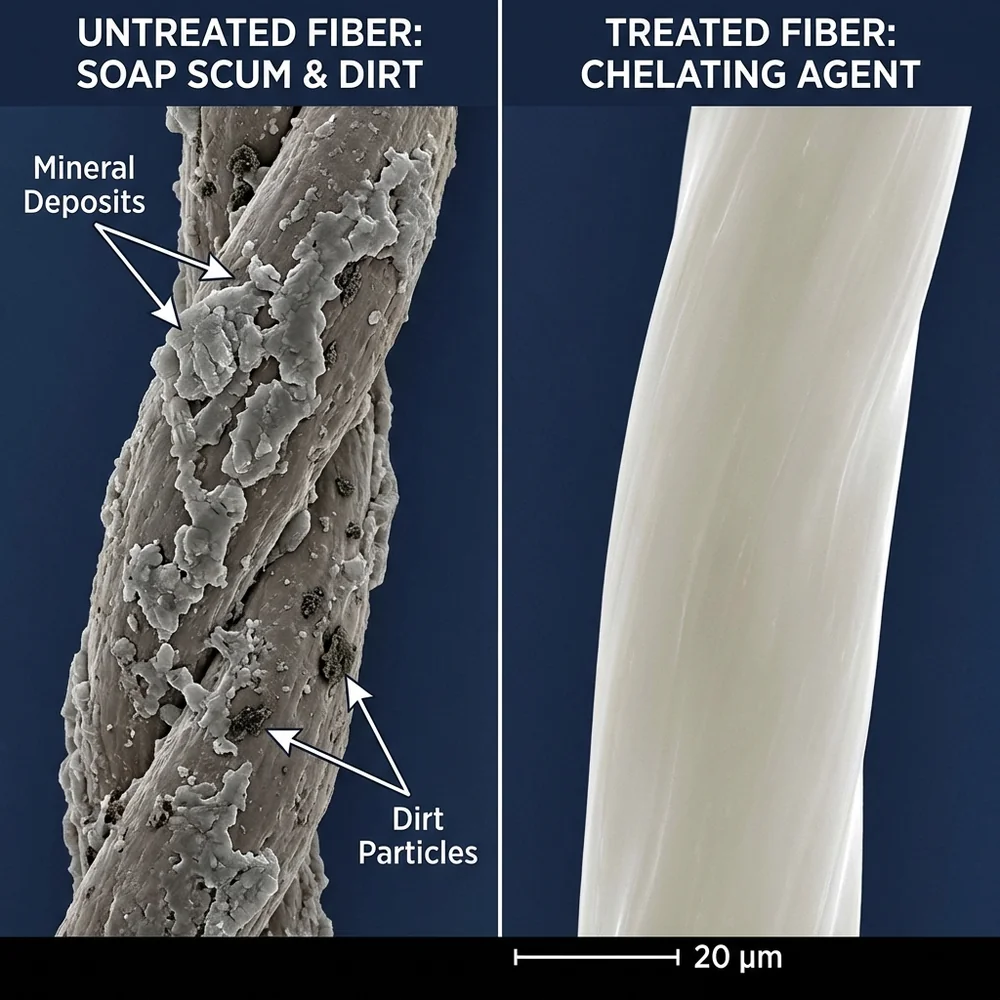
When calcium and magnesium ions hit your detergent, they trigger a chemical reaction that neutralizes the cleaning power before it ever reaches your clothes. The result is soap scum, which is not just that ring around the bathtub but also an invisible waxy film coating your fabric fibers. Over time, this buildup makes clothes dingy, stiff, and prone to holding onto odors.
Managing hard water requires understanding how minerals interact with detergent chemistry. Once you know what is happening at the molecular level, you can make smarter choices about detergent selection, dosing, and maintenance routines. The science of hard water is really the science of ion management, and getting it right makes an enormous difference in laundry results.
Why Calcium and Magnesium Cause Problems
The trouble with hard water minerals starts with their electrical charge. Calcium and magnesium carry a strong positive charge that attracts the negatively charged heads of anionic surfactants like surfactants-sls-vs-sles. When they meet, they form an ionic bond that creates an insoluble solid.
This solid is called calcium lauryl sulfate or a similar salt depending on the specific surfactant. It does not clean anything. Instead, it precipitates out of solution as a gray, waxy substance that settles onto your fabric. Your detergent dose is now partially wasted just neutralizing the minerals rather than removing soil.
This creates what chemists call a high “detergent demand.” In hard water, a significant percentage of your detergent is sacrificed to mineral neutralization before any actual cleaning happens. If you do not increase the dose to compensate, the remaining surfactant concentration may fall below what is needed for effective micelle formation. The wash cycle fails to emulsify oils and remove soil, even though you used the same amount of product that works fine in soft water.
The Bottom Line Hard water minerals bond with surfactants and neutralize them before they can clean. This forces you to use more detergent to achieve the same results.
How Soap Scum Forms and What It Does to Fabric

Traditional soap is especially vulnerable to hard water. When calcium reacts with the fatty acid salts in natural soap, it creates calcium stearate, a dense, waxy substance that repels water. In the washing machine, this soap scum interlocks with the microscopic structure of cotton and linen, creating a barrier that prevents water from penetrating the fiber core.
The consequences accumulate over multiple wash cycles. As the waxy precipitate builds up, it traps microscopic layers of skin cells, pigment, and environmental dust. The fabric takes on a permanent dingy appearance that no amount of extra detergent can fix. The physical presence of mineral wax also increases friction between fibers, making the fabric feel scratchy and stiff.
For items like linens and towels, this is the primary cause of lost absorbency. The waxy coating literally prevents water from being absorbed into the fiber. That “crunchy” towel feeling everyone hates is soap scum accumulation at work.
Chelating Agents: The Mineral Trappers
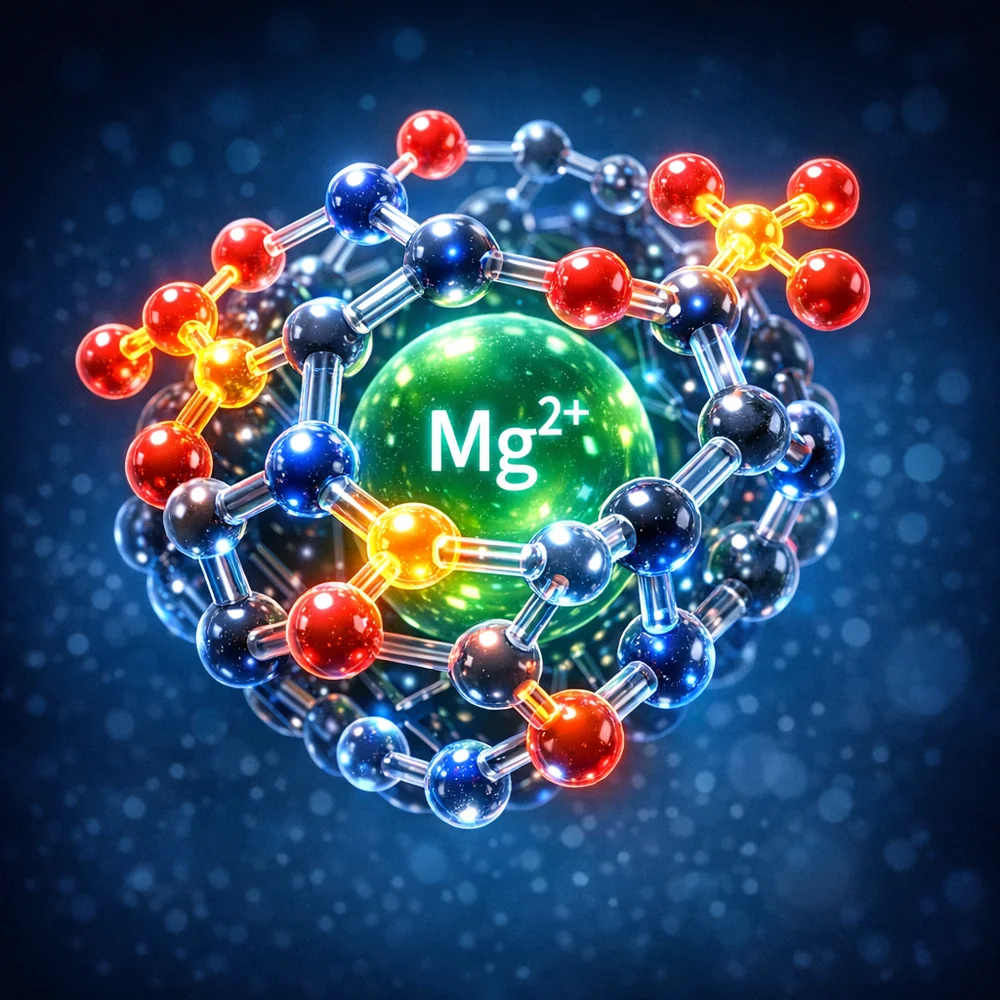
The word “chelator” comes from the Greek word for claw. These molecules live up to their name by grabbing onto metal ions and locking them away.
A chelating agent has multiple binding sites that can wrap around a single calcium or magnesium ion. Molecules like EDTA or the more biodegradable MGDA form stable, water-soluble complexes with these minerals. Once the ion is locked inside this molecular prison, it cannot react with surfactants. The water is effectively “softened” right inside the washing machine.
The strength of a chelator is measured by its stability constant. Higher values mean a tighter grip on the mineral ion, ensuring it stays locked away even under high temperature or alkaline conditions. Modern high-efficiency detergents rely heavily on chelators because the minimal water volumes in these machines leave no margin for mineral interference.
For households dealing with rust and metallic stains, specialized iron chelators are often added to the mix since iron causes its own set of problems beyond calcium and magnesium.
The Bottom Line Chelators trap mineral ions in molecular complexes, preventing them from neutralizing surfactants. This effectively softens water during the wash cycle.
Zeolites vs. Phosphates: The Builder Story
Detergent “builders” are bulk ingredients designed to handle water hardness on a large scale. For decades, sodium tripolyphosphate (STPP) was the gold standard. Phosphates were incredibly effective at both sequestering minerals and keeping soil suspended in the wash water.
The problem was environmental. Phosphate discharge into waterways caused massive algal blooms and oxygen depletion. Strict regulations followed, and the industry shifted toward zeolite technology. Zeolites are crystalline mineral structures that act like microscopic ion exchange filters.
The mechanism differs from soluble chelators. As wash water contacts the zeolite particles, calcium ions get captured inside the crystal structure while sodium ions are released in their place. Zeolites are environmentally benign and effective, but they are insoluble. If the rinse cycle is inadequate, they can leave white dusty residue on dark clothing. To address this, manufacturers pair zeolites with soluble co-builders like polycarboxylates that help disperse minerals and prevent visible deposits.
The Hidden Danger of Mineral Redeposition
Even if your detergent successfully lifts soil during the wash, hard water can cause that soil to redeposit during rinsing.
Here is the problem: builders and chelators are added during the wash phase. During the final rinse, fresh hard water enters the machine without any chemical protection. Any suspended soap fragments or soil particles in the wet fabric can react with these new minerals and precipitate back onto the textile.
This is why clothes sometimes look clean when wet but appear dingy once dried. The redeposition happens as the fabric dries and the mineral-laden water evaporates, leaving deposits behind. High spin speeds make it worse by forcing mineral-heavy water through the fabric weave.
One countermeasure is adding a final laundry vinegar rinse. The mild acidity helps dissolve incipient mineral precipitates before they can set permanently into the fibers.
The Bottom Line Rinse water introduces fresh minerals without protective builders. This can cause soil and soap residues to redeposit on fabric during the final stages of washing.
Polymeric Dispersants: Keeping Minerals Suspended
Beyond simple chelation, modern detergents use specialty polymers to keep minerals and soil suspended in the water rather than settling onto fabric.
Molecules like sodium polyacrylate carry a high density of negative charges that attract and coat any calcium carbonate crystals or soap scum particles forming in the wash. By coating these particles, the polymers create electrostatic repulsion between them, preventing aggregation into larger deposits that would be heavy enough to settle. Instead, the mineral burden stays as a fine suspension that flushes away during draining.
These dispersants are especially critical in low-water high-efficiency machines. When there is less water to hold minerals in suspension, redeposition risk increases dramatically. A few parts per million of high-performance dispersant can be more effective than doubling the dose of a traditional builder. As a bonus, these polymers can slowly break down existing limescale deposits by disrupting surface tension on the mineral crusts.
Do Magnetic Water Conditioners Actually Work?
The prevalence of hard water problems has spawned a market for physical water conditioners, particularly magnetic and electrolytic devices that claim to “soften” water without chemicals.
From a scientific perspective, these devices do not remove calcium or magnesium from the water. They attempt to change the crystal structure of minerals as they precipitate, supposedly creating “soft” aragonite crystals instead of “hard” calcite crystals that form limescale. Some industrial studies show marginal effects under very specific conditions, but residential effectiveness remains highly debatable.
The fundamental problem is that the minerals are still present. They still react with anionic surfactants. They still create detergent demand. Physical conditioners might slightly reduce limescale on heating elements, but they do nothing to solve the chemical interference that makes hard water laundry difficult. A robust chemical strategy using builders and chelators remains the only proven method for protecting fabrics.
The Bottom Line Physical water conditioners do not remove minerals and do not prevent surfactant neutralization. Chemical sequestration remains necessary for effective hard water laundry.
Hard Water Destroys Washing Machines Too
The damage from hard water extends beyond your clothes to the washing machine itself. When hard water is heated, the bicarbonate ions decompose and cause calcium carbonate to precipitate as limescale.
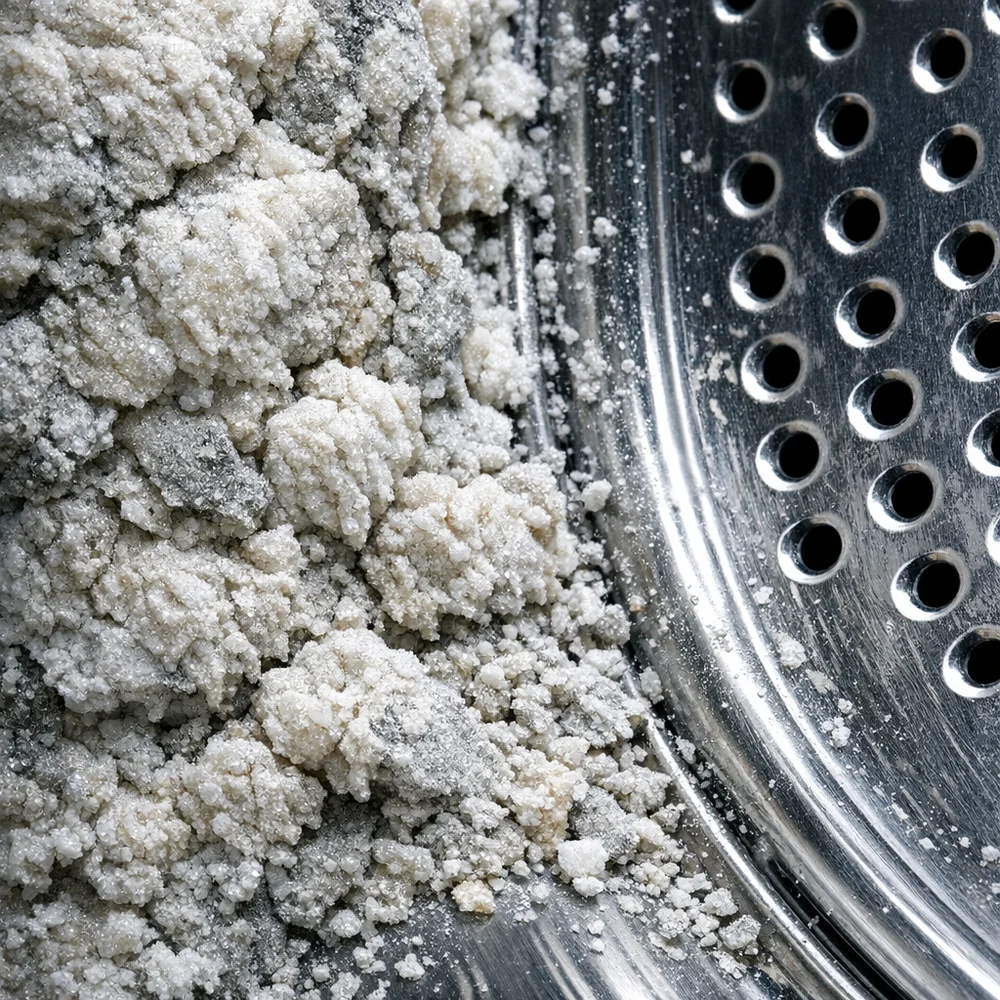
This stony crust accumulates on heating elements, acting as a thermal insulator. The element has to work harder and run hotter to heat the water, consuming more electricity and eventually burning out prematurely. Limescale also builds up in the pump housing, internal hoses, and the drum, where the jagged mineral deposits abrade rubber gaskets and cause mystery leaks.
Regular descaling with a high-concentration acid like citric acid is mandatory in hard water areas. Commercial descaling products work well, but pure citric acid often provides stronger chelating power at lower cost. A “boil wash” descaling cycle every three months prevents the accumulation that would otherwise shorten your machine’s lifespan.
Why pH-Neutral Detergents Can Make Things Worse
Interestingly, the choice of a pH-neutral detergent can actually worsen hard water problems. Neutral pH formulas often lack the alkaline builders that help manage minerals.
A moderately alkaline environment supports the kinetics of mineral sequestration and hinders the formation of the most stubborn soap scum varieties. Without this alkalinity, minerals and surfactants react more freely, and the chemistry works against you. This is one reason why “gentle” or “delicates” detergents often fail spectacularly in hard water regions.
If you have very hard water and want to use gentle formulations, consider supplementing with a separate water softening additive or installing a whole-house softening system. The chemistry cannot be bypassed just by choosing milder surfactants.
The Bottom Line pH-neutral detergents may lack the builders needed to manage hard water minerals. This can lead to increased soap scum formation despite the gentler surfactant profile.
Conclusion
Hard water management is the foundational challenge of effective laundry chemistry. The calcium and magnesium ions flowing through your pipes are invisible adversaries that neutralize your detergent and coat your fabrics with waxy residue.
Success requires understanding and deploying the right chemical tools. Chelators lock up individual ions before they can cause trouble. Builders like zeolites perform large-scale ion exchange. Polymeric dispersants keep particles suspended until they flush away. Regular descaling protects your machine from limescale damage.
Being “water-wise” means more than conservation. It means understanding the invisible chemistry that affects every load of laundry. Match your detergent choice and dosing to your specific water hardness level. Test your water if you do not know its mineral content. The payoff is clothes that actually get clean, fabrics that stay soft, and a washing machine that lasts for years instead of failing prematurely.
References
- Journal of Surfactants and Detergents. “Synergy Between Ion-Exchange Zeolites and Soluble Polycarboxylates in Phosphate-Free Washing.” Springer
- Environment International. “The Role of Builders in Detergent-Induced Eutrophication: A Historical Review.” ScienceDirect
- Textile Research Journal. “Mineral Redeposition Kinetics During Professional and Domestic Laundering Cycles.” Sage Journals
- Water Research. “Formation and Prevention of Limescale on Metallic Surfaces in Heated Water Systems.” IWA Publishing
- Appliance Science Quarterly. “The Impact of Water Hardness on the Lifespan and Energy Efficiency of Domestic Washing Machines.” IEEE Xplore