Dishwasher Detergent Wars: Gel vs Powder vs Tabs
Table of Contents
Things You'll Learn From This Article:
- Powder detergent keeps its cleaning enzymes alive longer, so it often cleans better than gels or pods.
- Measuring powder lets you use less detergent for light loads and more for greasy ones, instead of overdosing every time.
- Putting a little powder in the pre-wash cup actually helps clean during the first cycle, not just the main wash.
- Pods and tablets usually use way more detergent than most loads need, which can leave cloudy residue on glasses.
- Gels struggle with dried-on foods like egg or cheese because they usually lack enzymes or rely on bleach instead.
- Strong fragrances in detergents end up as scented steam in your kitchen, which can irritate breathing for sensitive people.
- Powder detergents tend to have fewer fragrance chemicals and are often easier on indoor air quality.
- Dishwasher pods use a dissolvable plastic film that often makes it through wastewater treatment and into rivers.
- Buying pods in huge bulk only makes sense if you’ll use them within a year, since detergents lose strength over time.
- Rinse aid isn’t optional if you want dry dishes, especially plastics, because it helps water slide off instead of bead up.
- Commercial dishwasher detergents are too harsh for home machines and can quickly damage seals and internal parts.
- DIY detergent recipes with baking soda and vinegar cancel themselves out and don’t actually clean dishes.
- Hard water can weaken any detergent, so using a built-in softener or a small amount of citric acid can make a big difference.
- Storing powder in a dry, sealed container prevents clumping and keeps it dissolving properly.
- Switching from pods to powder can save over a hundred dollars a year without sacrificing cleaning results.
Walk down the detergent aisle at any grocery store and you will encounter a bewildering array of options. Neon gels promise sparkling results. Compressed tablets boast “10-in-1” cleaning power. Multi-colored pods feature chambers within chambers, each supposedly releasing at the perfect moment. Marketing materials suggest that more colors and fancier packaging must equal better cleaning. The chemistry, however, tells a completely different story.
Choosing the right dishwasher detergent is not really about brand loyalty or eye-catching packaging. It is about matching a chemical tool to a biological problem, which is food soil, within the mechanical constraints of your specific machine. Once you understand how these different formulations actually work at a molecular level, the choice becomes surprisingly clear. And you might find that the simplest, cheapest option outperforms its more elaborate competitors.
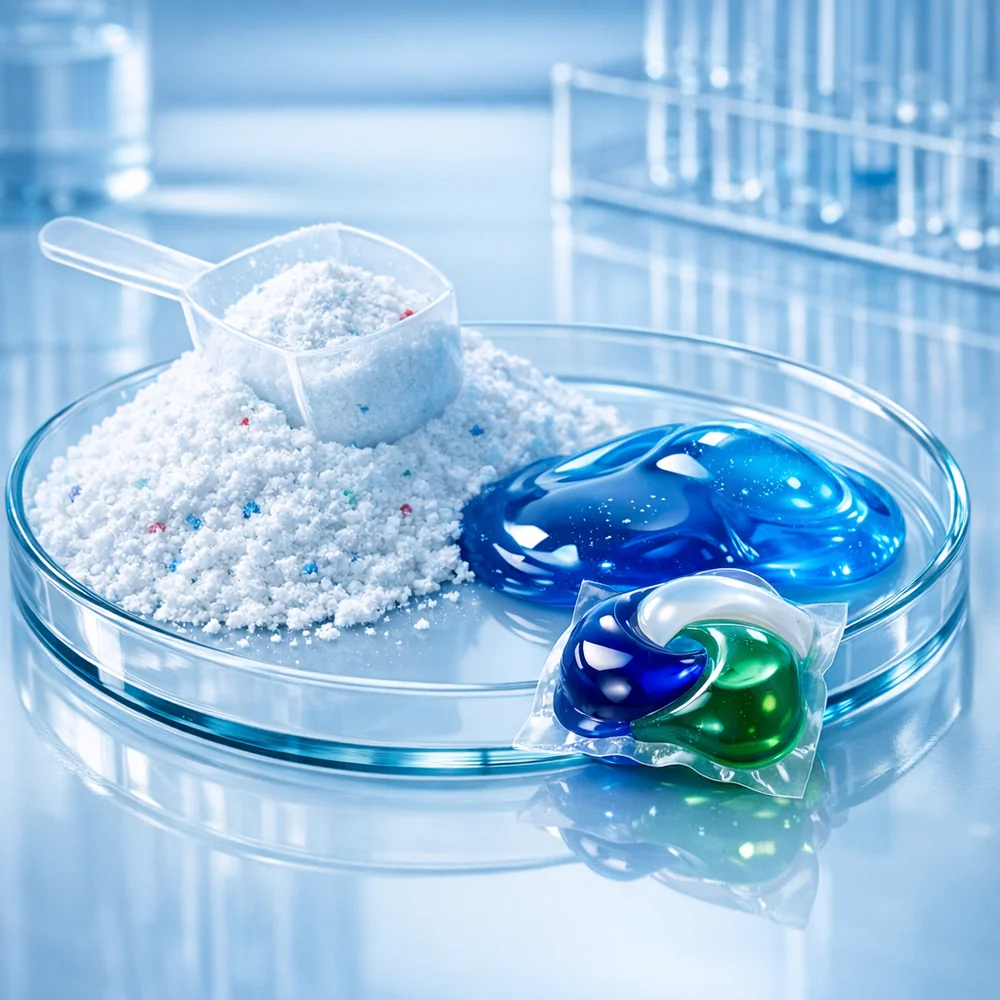
The Three States of Detergent
At a molecular level, every dishwasher detergent aims to accomplish the same goal. It needs to raise alkalinity to break down fats, provide enzymes to digest proteins and starches, and sequester calcium ions to prevent mineral scaling. These three functions are universal regardless of whether you buy powder, gel, or pods.
What differs dramatically between formats is the delivery vehicle. How those active ingredients survive storage and how they perform once released into your wash both depend heavily on whether they are suspended in liquid, compressed into tablets, or kept as dry powder. This distinction might seem trivial, but it has major implications for effectiveness, cost, and environmental impact.
The key variable is enzyme stability. Modern dishwasher detergents rely heavily on biological enzymes, specifically proteases to break down proteins and amylases to digest starches. These enzymes are delicate protein molecules themselves. They degrade in heat, die when exposed to chlorine bleach, and have a definite shelf life. The form factor you choose determines whether those expensive enzymes are actually alive and functional when they hit your dirty dishes.
The Bottom Line All detergents try to raise alkalinity, provide enzymes, and sequester minerals. The delivery format determines whether those enzymes survive storage and perform effectively during the wash.
The Great Phosphate Ban: A History Lesson
To understand why enzymes matter so much today, we need a brief history lesson. Before 2010, dishwasher detergents relied heavily on phosphates. These chemicals were miracle workers for cleaning: they suspended soil particles to prevent redeposition on dishes, and they aggressively softened water to boost detergent effectiveness.
The problem was environmental. Phosphates caused massive algal blooms in rivers and lakes. These blooms consumed oxygen, killing fish and other aquatic life on a massive scale. In 2010, regulations banned phosphates in consumer detergents across the United States and Europe. Manufacturers had to scramble for alternatives, and the first generation of phosphate-free formulations was genuinely terrible. Dishes came out with white, chalky residue that made people long for the banned formulations.
The industry eventually found its answer in enzymes. Instead of chemically blasting food off dishes with brute-force phosphate chemistry, modern detergents use biological catalysts to essentially “eat” the food. Proteases digest the proteins in egg yolk and meat residue. Amylases break down the starches in pasta and potato. This enzymatic approach actually works better than phosphates ever did, but only if the enzymes are still active when they reach your dishes.
This brings us back to form factor. Enzymes are fragile proteins. How you package and store them determines whether they arrive at the cleaning battle ready to fight or already dead.
The Bottom Line The 2010 phosphate ban forced detergent makers to rely on enzymes instead. Enzymes clean effectively, but only if they survive storage. Your detergent’s form factor directly affects enzyme viability.
Fragrance and Volatile Organic Compounds
Before diving into specific formats, there is one ingredient worth calling out that has nothing to do with cleaning at all: fragrance. Those “Fresh Lemon” or “Mountain Breeze” scents that detergent makers love to advertise are achieved through cocktails of volatile chemicals, including masking agents designed to cover the natural smell of wet dishes.
Here is the problem. When your dishwasher opens at the end of a cycle, it releases a cloud of hot steam directly into your kitchen. If your detergent is heavily fragranced, that steam carries a concentrated load of Volatile Organic Compounds straight into the air you breathe. Phthalates, often used to bind fragrances, are known endocrine disruptors that persist in indoor air.
For households with asthma or chemical sensitivities, this steam blast can be a genuine respiratory irritant. Powder detergents generally contain lower loads of fragrance binders compared to gels and liquid-heavy pods, making them a safer choice for indoor air quality. If someone in your household is sensitive to chemical fragrances, this is worth considering alongside cleaning performance.
The Bottom Line The steam released when you open a finished dishwasher carries fragrance chemicals into your kitchen air. Powder typically contains fewer volatile compounds than gels or pods.
The Case for Powder: Economy and Chemistry
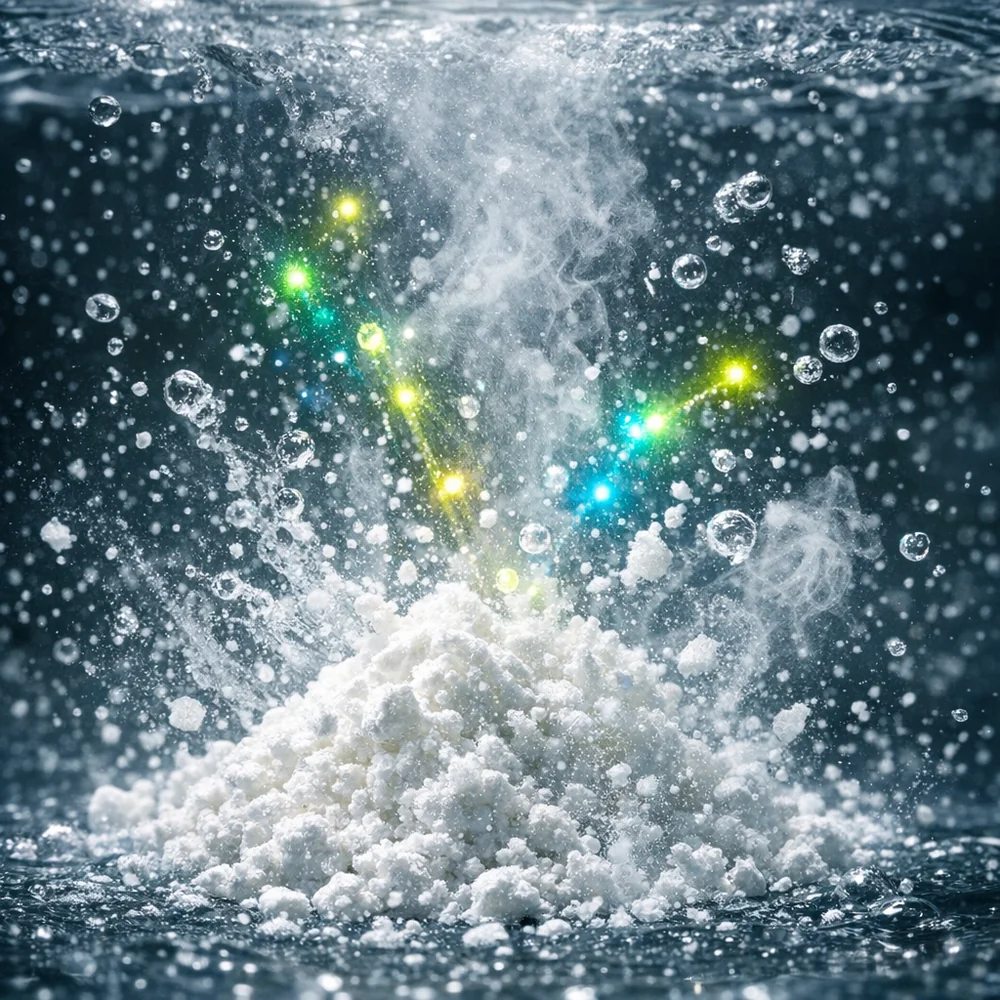
Now let us talk about what actually works best. Loose powder is the choice of pragmatists and chemists alike, and there are solid scientific reasons for this preference.
Enzyme stability is the first major advantage. In dry powder form, enzymes remain dormant and stable for long periods, sometimes over a year if stored properly. They only activate when they contact water in your dishwasher. This means the cleaning power you paid for is actually delivered to your dishes rather than degrading on a shelf.
Dosing control is the second advantage. With loose powder, you can adjust the amount based on how dirty your dishes actually are. A light load of coffee cups needs only a teaspoon; a greasy lasagna pan might need a full tablespoon. Pods give you no flexibility. They are sized for the dirtiest possible load in the largest possible machine, which means typical loads get massively overdosed.
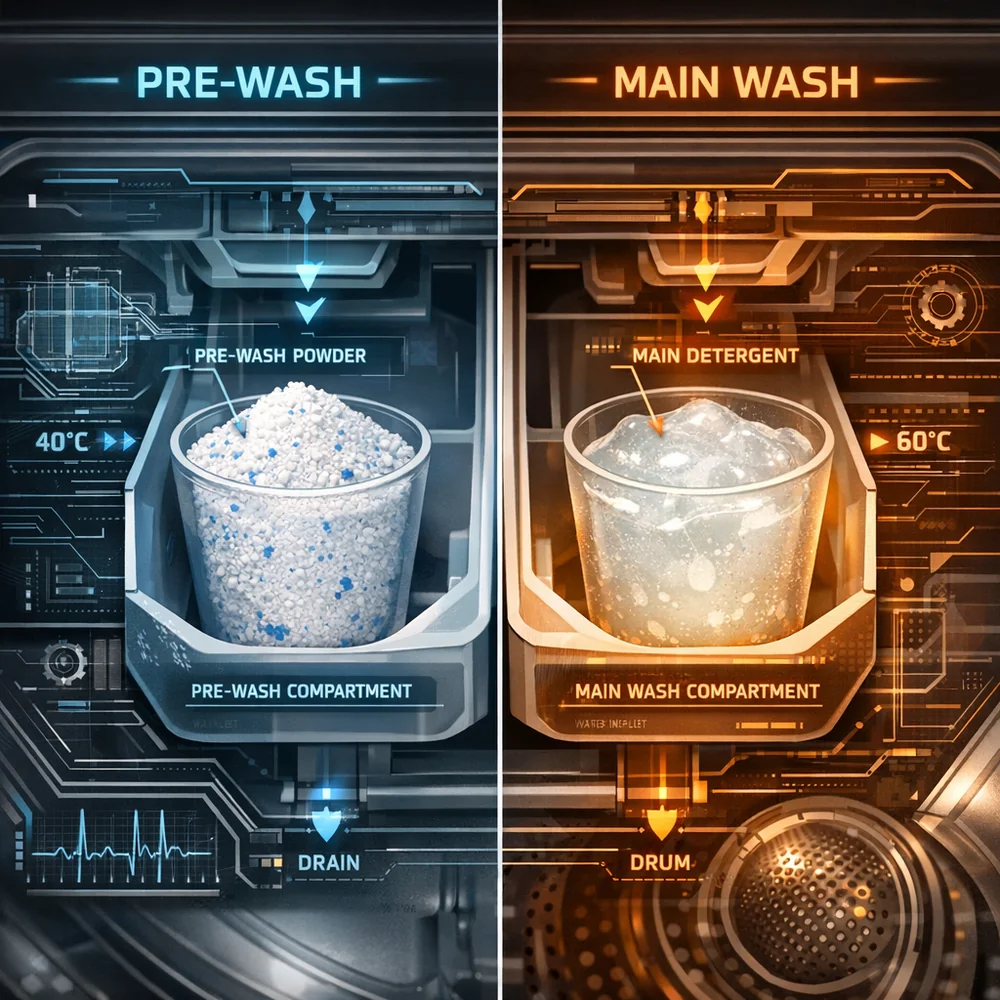
The killer feature, though, is pre-wash capability. This is something most people do not even realize their dishwasher has. Many machines include a small open cup next to the main detergent dispenser. This is for pre-wash detergent, which works during the initial rinse cycle before the main wash begins. You can shake a little powder into this cup (or just onto the door), giving that first fifteen-minute cycle actual cleaning power instead of just plain water.
The downsides are manageable. Powder is hygroscopic, meaning it absorbs moisture from the air. If stored under a humid sink, it can turn into a solid brick that will not dissolve properly and may jam your dispenser door. Keep it in a sealed container in a dry location. And yes, it can be messy to dispense compared to grabbing a pod, but that minor inconvenience is worth the performance benefits.
The Bottom Line Powder offers stable enzymes, adjustable dosing, and pre-wash capability that other formats cannot match. Store it dry and sealed to prevent clumping.
The Convenience Trap: Tabs and Pods
Tablets (compressed powder bricks) and pods (liquid and powder hybrids in water-soluble film) dominate the retail market because they eliminate measuring. Grab one, drop it in, close the door, done. The convenience is undeniable. The chemistry, unfortunately, works against you.
The fundamental problem is overdosing. Pods are sized for the worst-case scenario: the dirtiest possible load in the largest possible machine with the hardest possible water. For a typical suburban dishwasher running a moderate load, a pod delivers two to three times more detergent than the dishes actually need. This excess surfactant is difficult to rinse away completely. It leaves behind residue that causes etching and cloudiness on glassware, especially on delicate items.
You also lose all pre-wash capability with pods. You cannot split a pod in half to put some in the pre-wash cup. This means your pre-wash cycle runs with plain water, doing minimal cleaning, and then the main wash gets hit with a chemical overload all at once. The cleaning pattern is far less efficient than a properly dosed powder routine.
Then there is cost. Pods typically cost three to four times more per load than equivalent bulk powder. Premium pods with multiple chambers and fancy branding push that multiplier even higher. You are paying extra for packaging, convenience, and marketing, not for better cleaning chemistry.
The Bottom Line Pods overdose typical loads, cannot provide pre-wash cleaning, and cost significantly more than powder. Convenience comes at the expense of performance and value.
Manufacturing Secrets: How Detergents Are Born

Understanding how detergents are manufactured helps explain their different performance characteristics. The physical form dictates the production process, which in turn influences both price and effectiveness.
Premium powders are made in massive spray-drying towers. A liquid slurry containing surfactants, builders, and enzymes gets sprayed into a hot air vortex. The water evaporates almost instantly, leaving behind hollow, fast-dissolving beads that perform beautifully in dishwashers. Cheaper powders skip this step and simply mix dry ingredients mechanically, which is why they dissolve slower and can leave gritty residue.
Tablets are essentially pressed detergent pucks. High-pressure machines compress powder into solid blocks. To prevent crumbling during shipping and handling, binders must be added. These binders need to dissolve during the wash, but they also take up space that could otherwise hold active cleaning agents. A tablet often weighs more than the equivalent dose of loose powder but actually contains less enzyme payload because so much of the mass is binder material.
Pods add another layer of processing: the water-soluble film casing and the liquid chambers within. Each additional step adds manufacturing cost that gets passed on to consumers. The elaborate multi-chamber designs that marketing departments love to showcase do theoretically release different ingredients at different times, but in practice everything dissolves within the first few minutes anyway.
The Bottom Line Powder made by spray-drying dissolves quickly and efficiently. Tablets require binders that reduce active ingredient payload. Pod manufacturing complexity adds cost without proportional cleaning benefit.
The PVA Controversy: Is It Really Plastic?
The outer “skin” of a dishwasher pod is made of Polyvinyl Alcohol, commonly abbreviated as PVA. Marketing materials claim this film is “biodegradable” and “dissolves completely.” The environmental reality is more nuanced than those claims suggest.
PVA does indeed dissolve in water. The solid film becomes invisible liquid polymer chains, which sounds like it disappears. But those dissolved polymer chains still exist in the water. For them to truly biodegrade, they require specific bacteria and sufficient processing time. Many municipal wastewater treatment plants simply cannot provide these conditions.
A 2021 study estimated that up to 75% of PVA from detergent pods passes through wastewater treatment plants intact. It enters rivers and oceans still as dissolved polymer. While technically water-soluble, it behaves as a dissolved microplastic pollutant once it reaches natural waterways. The “dissolves completely” claim is technically true but misleading about environmental impact.
For eco-conscious households, this hidden plastic load is a compelling argument for returning to loose powder or at least choosing “naked” tablets without any plastic film coating. Every pod you skip prevents several grams of dissolved polymer from entering the water system.
The Bottom Line “Dissolvable” does not mean “biodegradable.” PVA film dissolves into polymer chains that most treatment plants cannot break down, effectively becoming liquid microplastic pollution.
Gel: The Middle Child
Gels enjoyed a brief heyday of popularity but have largely fallen out of favor for good reasons. They are chemically the weakest option in most situations.
The main advantage of gels is gentleness. Their non-abrasive nature makes them safer for delicate china and fine glassware. They also dissolve instantly, which can be helpful for short or cool wash cycles. If you frequently run delicate or quick cycles, gel might have a place in your routine.
The critical disadvantage is enzyme death. Remember that enzymes are fragile proteins that degrade in liquid environments. To keep enzymes shelf-stable in a gel, manufacturers must add expensive stabilizers. More commonly, they simply omit enzymes entirely and rely on chlorine bleach instead. But here is the catch: bleach and enzymes are mutually incompatible because bleach destroys proteins. You literally cannot have both in the same gel formulation.
This chemical limitation means gels struggle badly with dried-on proteins like egg yolk, cheese, or oatmeal. The same formula that dissolves quickly also lacks the enzymatic tools to handle anything but fresh soil. Over time, gels also separate into watery layers. Shaking helps temporarily, but an old bottle becomes significantly less effective.
The Bottom Line Gels dissolve quickly and are gentle on delicate items, but they typically lack enzymes due to stability issues. They perform poorly on dried protein stains.
Commercial vs. Residential Chemistries
You might have wondered why the 90-second cycle at a restaurant produces spotless dishes while your two-hour home cycle struggles with last night’s pasta. The answer is not just about machine quality. Commercial and residential detergents are radically different chemical formulations.
Commercial dishwashing uses high-alkalinity chlorine detergents that do not bother with gentle enzymatic action. They chemically burn food residue off dishes using raw corrosive power. The temperatures are dramatically higher as well. Commercial wash cycles hit 160°F, and sanitizing rinses reach 180°F. Home machines rarely top 150°F.
If you were thinking of buying commercial detergent for home use, stop right now. The chemistry is far too aggressive for residential machine components. Putting commercial liquid into a home dishwasher will destroy the rubber seals, corrode the pump internals, and degrade plastic components within months. What saves time on cleaning will cost thousands in machine replacement.
The Bottom Line Commercial detergents use aggressive chemistry and extreme temperatures that would destroy home machines. Never use commercial products in residential dishwashers.
Enzyme Stability and Shelf Life
All the chemistry we have discussed comes with an expiration date. Detergent is perishable, and understanding shelf life helps you get the cleaning power you paid for.
Powder maintains enzyme activity for 12 to 18 months if kept bone dry in a sealed container. Humidity is the enemy because moisture activates enzymes prematurely, causing them to degrade before they reach your dishes.
Gels degrade faster, typically losing significant potency after 6 months. The chlorine bleach that many gels rely on evaporates over time. Viscosity changes as the formula separates. An old bottle of gel is measurably less effective than a fresh one.
Pods last about 12 months before the PVA film becomes problematic. Old film can turn brittle and crack, releasing contents during storage. Or it can become excessively sticky, causing pods to fuse together in the container. Either failure mode means the pod will not perform as designed.
That bulk warehouse purchase of 200 pods might seem like a bargain, but only if you actually use them within a year. For a single-person household running three loads weekly, that quantity represents well over a year’s supply. You are essentially buying detergent that will chemically deactivate before you can use it all.
The Bottom Line Powder stays effective longest if kept dry. Gels degrade within six months. Buy quantities you can realistically use before enzyme activity diminishes.
Rinse Aid: The Invisible Hero
Many people skip rinse aid to save money, assuming it is an optional upgrade. This is a mistake that costs you more in frustration than it saves in product cost.
Modern energy-efficient dishwashers use what is called passive condensation drying. They do not have heating elements blowing hot air like older models did. Instead, they rely on residual heat in the dishes themselves, combined with the thermal mass of the stainless tub, to evaporate water as it condenses on cooler surfaces.
This system only works if water can sheet off dishes rather than beading up. Rinse aid is a surfactant that breaks the surface tension of water. Instead of forming droplets that cling to dish surfaces, water spreads into a molecularly thin film that evaporates almost instantly when the drying phase begins.
Without rinse aid, plastic items especially will always come out wet. Plastic is inherently hydrophobic, causing water to bead aggressively on its surface. No amount of “Extra Dry” settings can overcome this physics. If your plastics never dry, the answer is not a longer cycle or hotter settings. The answer is rinse aid.
The Bottom Line Modern dishwashers require rinse aid for effective drying due to condensation-based drying systems. Without it, plastic items will always emerge wet regardless of settings.
Cost Analysis
Let us talk actual numbers. The price difference between formats is substantial and compounds significantly over time.
Premium pods typically cost between 30 and 50 cents per load. Mid-range tablets run 20 to 30 cents. Name brand powder drops to 10 to 15 cents per load. Generic powder can go as low as 5 to 8 cents per load for essentially identical chemistry.
For a household running one load daily, switching from premium pods to name brand powder saves approximately $110 per year. Over a decade of dishwasher ownership, that is over a thousand dollars, enough to buy a new machine. The cleaning results, assuming proper loading and correct pre-wash dosing, are virtually identical between pod and powder users.
The only time pods make economic sense is for their convenience value if your time is genuinely expensive enough to justify the premium. For most households, the few seconds saved by not measuring powder cannot justify tripling or quadrupling the cost per load.
The Bottom Line Powder costs 5 to 15 cents per load versus 30 to 50 cents for pods. Annual savings exceed $100 for daily users. Cleaning results are equivalent with proper dosing.
The Myth of DIY Detergent Recipes
The internet is full of “mom hack” recipes for homemade dishwasher detergent, usually involving baking soda, borax, and vinegar. These are universally terrible ideas from a chemistry perspective.
The vinegar plus baking soda combination that many recipes call for is fundamentally flawed. Baking soda is a base; vinegar is an acid. Mixing them creates an impressive fizzing display, but the underlying chemistry is neutralization. You end up with water, carbon dioxide bubbles, and sodium acetate salt. The fizzing looks active and cleaning, but the resulting liquid has essentially zero cleaning power. You are washing dishes with salty water.
Borax, often touted as a “natural” cleaning booster, is not a detergent. It lacks the surfactants needed to lift grease and has no enzymes to digest proteins. Used alone, borax leaves a cloudy white film on glassware that is extremely difficult to remove. It boosts some aspects of cleaning but cannot replace purpose-built detergent chemistry.
The high salt content in DIY mixtures creates another problem: corrosion. These formulations can pit stainless steel tubs and attack heating elements over time. Saving ten dollars on detergent often leads to hundreds of dollars in machine damage later.
The Bottom Line DIY detergent recipes using baking soda and vinegar produce nearly inert mixtures. Borax is not a replacement for surfactants and enzymes. These formulations can damage your machine.
Hard Water Modifiers: Salt and Citric Acid Boosters
Even the best detergent struggles in hard water. Calcium and magnesium ions in hard water bind to detergent molecules and neutralize them before they can attack food soil. If you live in a hard water area, you need strategies beyond detergent alone.
If your dishwasher has a water softener compartment, typically a cap on the floor of the tub, use it. This chamber contains ion-exchange resin beads that actively pull calcium out of incoming water before it reaches the spray arms. The salt you pour in does not wash dishes directly; it regenerates the resin beads so they can continue softening water. This built-in system is the gold standard for hard water management.
If your machine lacks a softener, citric acid additives are powerful chelating agents that bind minerals. Products like LemiShine work by sacrificing citric acid molecules to tie up calcium, freeing your actual detergent to work on food. However, dosing matters. Citric acid is itself an acid that can neutralize the alkaline cleaning agents in your detergent. Use it sparingly, or add it to the pre-wash only so it drains away before the main enzyme wash begins.
The Bottom Line Hard water neutralizes detergent. Use your machine’s built-in softener if available. Citric acid boosters help sequester minerals but should be dosed carefully to avoid neutralizing detergent alkalinity.
Making the Smart Choice
After examining all the chemistry, manufacturing processes, environmental impacts, and cost structures, the winner for most households is clear: loose powder offers the best balance of performance, economy, and environmental responsibility.
Powder allows pre-wash dosing that other formats simply cannot provide. It keeps enzymes stable in their most dormant, effective state. It generates minimal packaging waste and no PVA microplastic pollution. And it costs a fraction of what pods charge for equivalent cleaning chemistry.
Use pods only as an occasional convenience when you genuinely cannot spend five seconds measuring powder. Retire gel bottles entirely unless you exclusively wash delicate items on short cycles where enzyme power is less critical.
By understanding the science behind the soap, you take control of your kitchen’s hygiene and your household budget. Stop paying for packaging, marketing, and water, and start paying for actual chemical cleaning power. Your wallet and your wine glasses will both thank you.
The Bottom Line Loose powder wins on enzyme stability, dosing flexibility, pre-wash capability, cost, and environmental impact. Use pods only for convenience emergencies.
References
- International Journal of Environmental Research and Public Health. Degradation of PVA in US Wastewater Treatment Plants.
- Journal of Surfactants and Detergents. Enzyme Stability in Liquid Formulations.
- Consumer Reports. Dishwasher Detergent Buying Guide.
- Environmental Science and Technology. Phosphorus Ban Efficacy.
- American Cleaning Institute. The Science of Dishwashing.