HE Washer Mechanics: The Physics of Low-Moisture Soil Removal
Table of Contents
Things You'll Learn From This Article:
- Less water in the drum is normal—HE machines clean by dropping and rubbing clothes together, not by soaking them.
- Regular detergent causes problems because too many suds cushion the clothes and stop them from scrubbing each other clean.
- HE detergent matters because it controls foam and keeps dirt suspended so it doesn’t settle back onto your clothes.
- Clothes clean better when they’re wet but not floating, since gravity helps push detergent deeper into the fabric.
- The spray you see during the wash cycle is there to keep clothes evenly soaked and prevent dry patches.
- The machine adjusts water level and cycle time on its own by sensing load weight and fabric type.
- If the washer pauses or restarts spinning, it’s usually fixing an uneven load to prevent damage.
- Faster spin speeds pull out much more water, which shortens drying time and saves energy.
- Overloading the washer reduces fabric movement, which weakens the cleaning action.
- Smelly washers usually come from buildup inside areas that never fully rinse, not from dirty clothes.
- Running a washer-clean cycle with heat or a cleaner helps remove residue that causes odors.
- Wash temperature matters more in HE machines, since small amounts of water heat up and cool down quickly.
- Keeping the washer level and spreading clothes evenly helps it spin faster and last longer.
High-efficiency washing machines work completely differently from the traditional top-loaders most people grew up with. The old approach was simple: fill a big tub with water, dunk the clothes in, and use an agitator to slosh everything around. HE machines take a fundamentally different path. They use minimal water, maximum mechanical force, and sophisticated sensors to achieve cleaner results with a fraction of the resources.
If you have ever wondered why your HE machine barely seems to have any water in it, or why using regular detergent causes it to overflow with suds, understanding the engineering behind these machines explains everything. The physics of low-moisture cleaning involves concentrating the chemistry and relying on gravity and fabric-to-fabric friction to do the heavy lifting. It is a completely different approach to laundry, and understanding it helps you get better results.
The mechanics involve complex fluid dynamics, precision sensors, and specially formulated detergent ingredients designed for concentrated environments. By understanding the cascade flow system and the centrifugal physics of the spin cycle, you can appreciate the sophisticated science that enables ultra-clean results with minimal environmental impact.
From Agitation to Dynamic Shearing
Traditional washing machines use a central agitator to drag clothes through a pool of water. This works, but it subjects fabric to significant mechanical stress as garments are twisted around a hard plastic column. HE machines replaced this approach entirely.
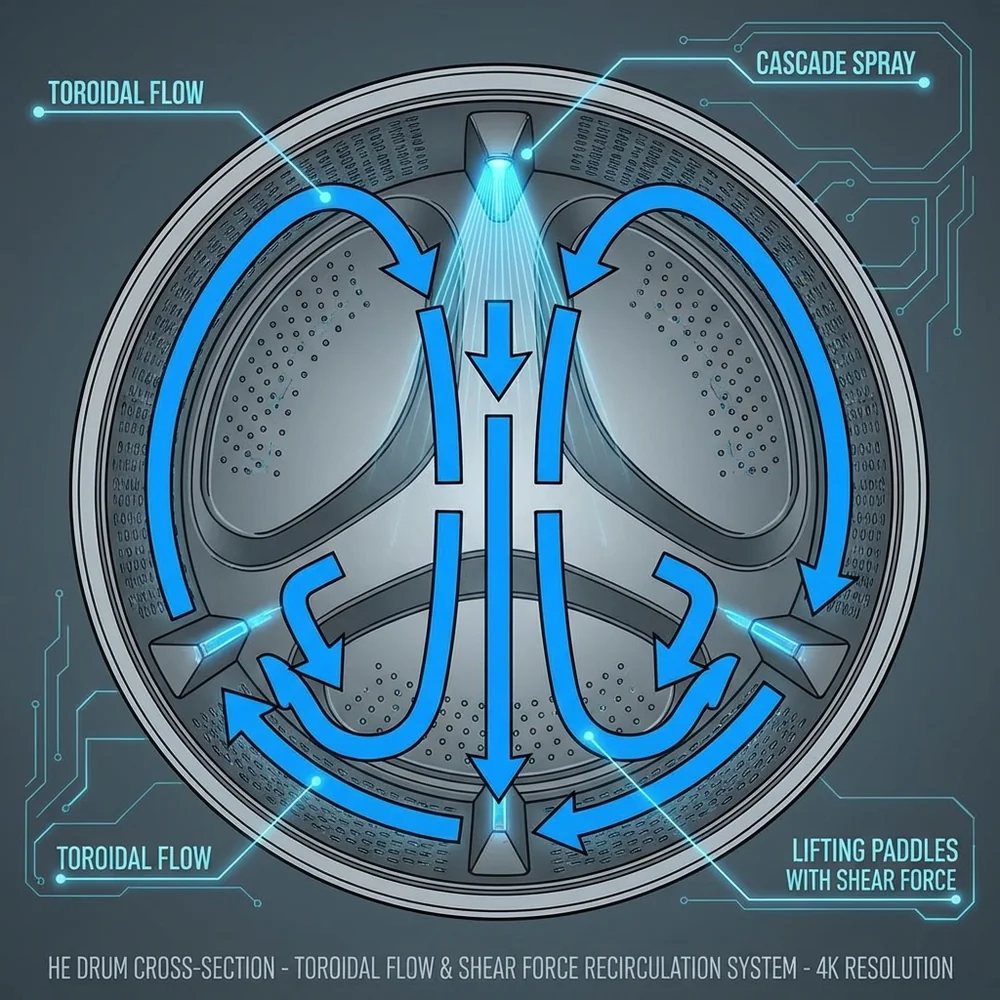
HE top-loaders use a low-profile impeller or wash plate instead of a tall agitator. This impeller creates a toroidal flow pattern where clothes move from the center to the perimeter and back again. The key difference is that clothes rub against each other (fabric-to-fabric friction) rather than against hard plastic. This gentler action produces less wear while still providing effective soil removal.
HE front-loaders take the concept even further. The horizontal drum features paddles or lifters that carry clothes to the top of the cylinder, where they plummet back into the small pool of wash water. This dropping action is called mechanical shearing. The impact energy of the clothes hitting the water provides the force needed to dislodge soil without requiring a large volume of water to create buoyancy.
Because the clothes are saturated but not submerged, gravity is fully utilized to pound detergent for dark fabrics deep into the fiber weave. The result is more effective particulate removal than simple immersion ever achieved.
The Bottom Line HE machines use gravity-driven impacts and fabric-to-fabric friction instead of agitator twisting. This provides effective cleaning with less mechanical stress on fabrics.
The Cascade Flow System
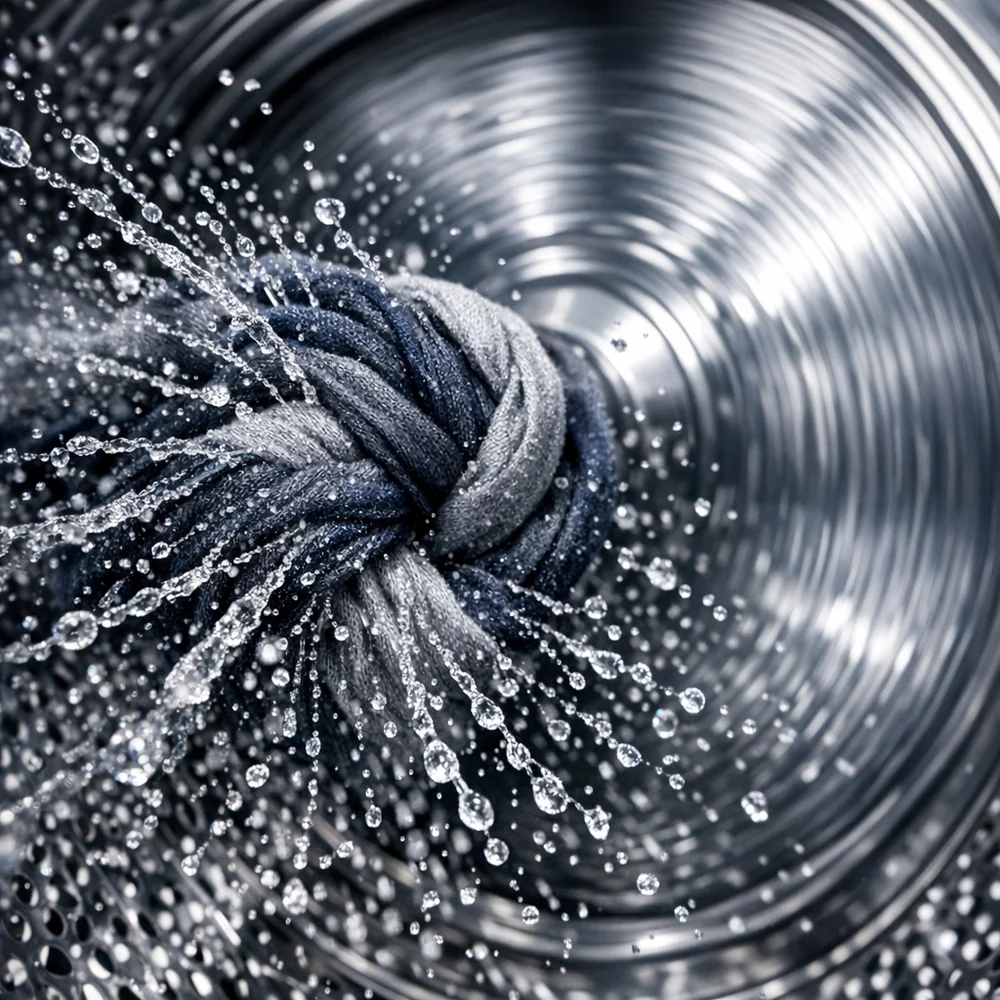
Since HE machines do not fill the drum with water, they need another way to keep fabrics saturated with cleaning solution. The answer is continuous recirculation through a cascade spray system.
A high-pressure pump draws water from the bottom of the tub and sprays it directly onto the top of the tumbling load. This creates a constant flow of active wash liquor through the fabric. The surfactants like SLS and SLES are constantly refreshed at the fabric interface rather than becoming saturated and inactive in a static pool.
This dynamic flow also displaces air trapped within fibers. As liquid cascades through the tumbling clothes, it reaches the innermost sections that static immersion might miss. The spray action more effectively transfers heat to the entire load, which matters for the thermodynamics of wash temperature.
The engineering of the spray nozzle and pump flow rate is calculated to match the absorption capacity of a typical load. This prevents “dry spots” that would leave some areas of the garment uncleaned.
Smart Sensors and Optimization
The intelligence of modern HE machines comes from their sensor arrays. These optimize every cycle based on the specific characteristics of the load.
The most basic sensor measures the torque required by the motor to turn the drum. By analyzing resistance and acceleration rate, the machine’s processor estimates the weight and absorbency of the fabric. Heavy towels get more water than light synthetics. This precision prevents the problems associated with foaming soaps mechanics, where too little water leads to excessive suds concentration.
Advanced machines include turbidity sensors that measure water clarity by passing a beam of light through the drain line. Cloudy water indicates soil is still being released, triggering extra rinse cycles. Clear water means the machine can skip unnecessary rinsing to save time and resources.
Out-of-balance sensors, typically accelerometers, detect when the load has clumped to one side. If imbalance is detected during high-speed spin, the machine stops and attempts to redistribute the clothes. This protects the bearings and suspension from the destructive forces that would otherwise occur.
The Bottom Line HE machines use multiple sensors to customize water levels, cycle length, and spin speed to the specific load. This optimization is impossible in traditional fixed-fill machines.
Why HE Detergent Is Not Optional
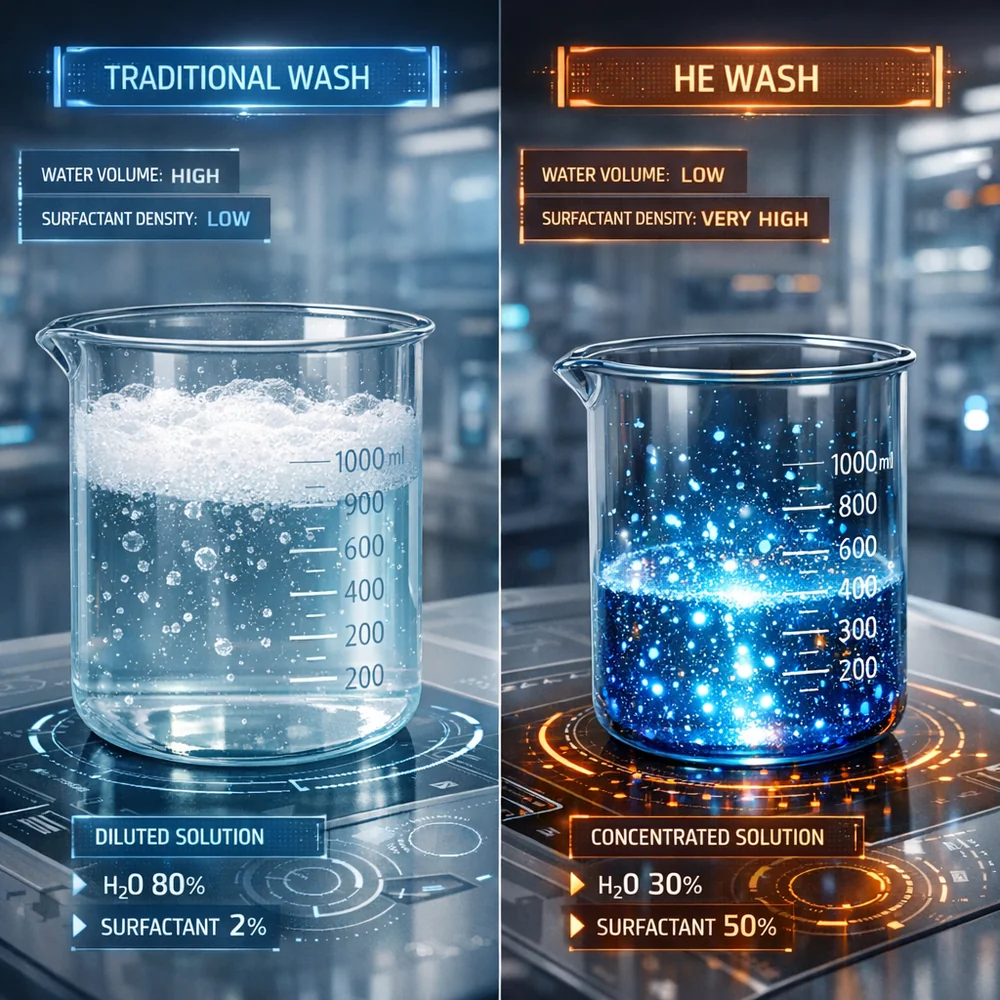
The chemical environment inside an HE drum is radically different from traditional machines. In a traditional wash, detergent is diluted into 15 to 20 gallons of water. In an HE wash, the same chemistry dissolves into only 2 to 5 gallons.
This extreme concentration is why HE-specific detergents are mandatory, not a marketing gimmick. Standard detergents produce too much foam, which acts as a cushion in the drum. The foam dampens the fall of the clothes and reduces the mechanical shearing force that HE machines depend on for cleaning. HE detergents contain suds suppressors that keep foaming soap mechanics under control.
The high concentration also demands superior soil-suspension properties. With less water to hold dirt in suspension, there is higher risk of redeposition back onto fabric. HE formulations include advanced polymers that grab dirt and ensure it stays in the aqueous phase until flushed away.
This is especially critical when dealing with hard water laundry chemistry. The reduced water volume means calcium and magnesium concentrations are proportionally higher, requiring more aggressive chelation by the detergent’s builders.
The Physics of High-Speed Spin
The final stage of HE mechanics is the high-speed spin cycle, where centrifugal force extracts as much moisture as possible.
Traditional machines spin at 600 to 800 RPM. HE machines, especially front-loaders, reach 1,200 to 1,400 RPM. Because centrifugal force increases with the square of rotational speed, doubling the RPM generates several times the G-force on water trapped in fibers.
This high-speed extraction is essential for energy efficiency. Removing water mechanically in the washer is far cheaper than evaporating it thermally in the dryer. A garment that leaves an HE machine at 1,400 RPM is significantly drier than one spun at 600 RPM, which translates directly to shorter drying times and lower electricity bills.
However, these speeds require precise engineering. The drum must be perfectly balanced, and the suspension springs and shock absorbers must be tuned to dampen vibrations. If the machine is not level or the load is imbalanced, centrifugal forces become destructive. Many machines use a liquid balance ring filled with heavy brine that automatically moves opposite to any garment clump to counteract imbalance.
The Bottom Line High-speed centrifugal extraction removes more water mechanically, reducing dryer time and energy consumption significantly compared to traditional spin cycles.
The Biofilm Problem
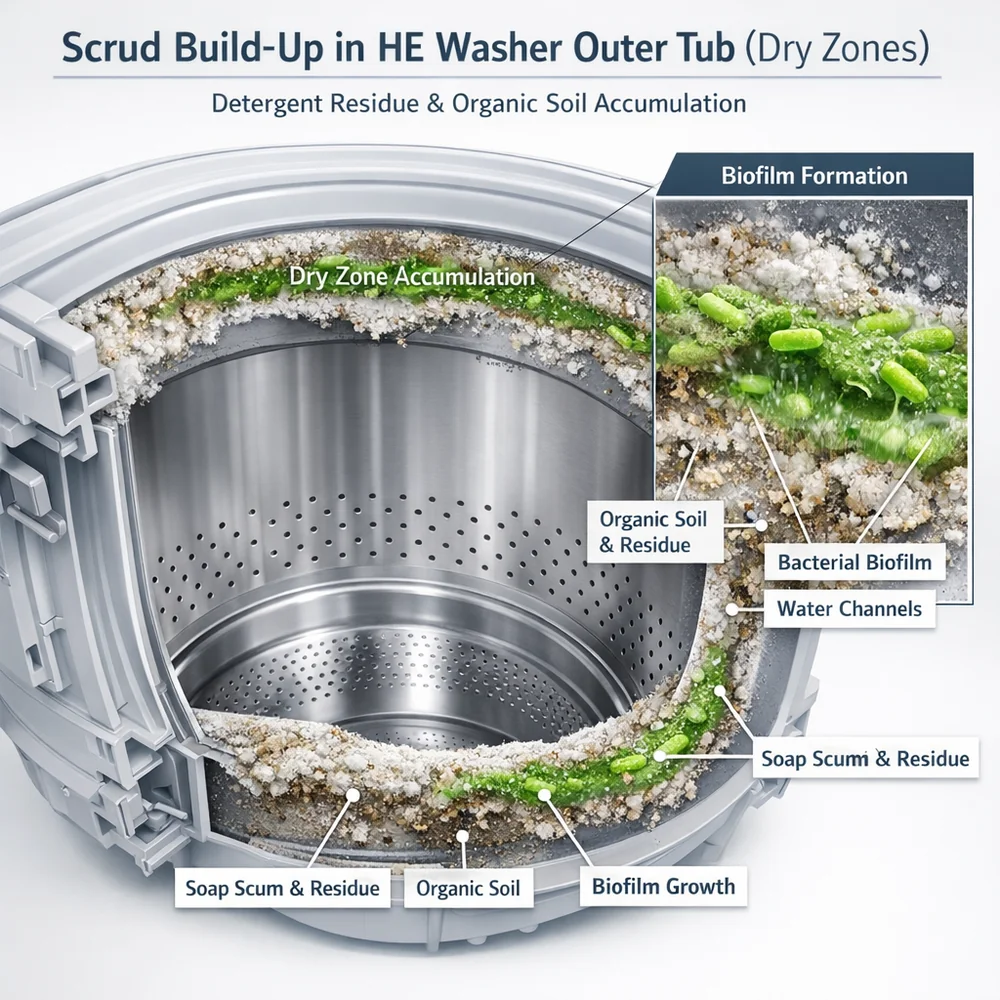
Low-water mechanics create an unintended consequence: certain areas of the machine are never thoroughly rinsed. Because the machine never fills completely, the outer tub (the stationary drum holding the water) has permanent “dry zones.”
These zones accumulate a mixture of residual detergent, fabric softener, and skin cells. Over time, this hardens into a waxy substance called “scrud” that provides a porous substrate for bacteria and mold. The resulting biofilm is often the source of sour smells in HE machines.
Manufacturers address this with specialized “Clean Washer” cycles that use high heat and higher water levels to dissolve scrud deposits. Addition of oxygen bleach chemistry or commercial machine cleaners is often required to oxidize the organic components. This is the trade-off of HE efficiency: saving water daily requires occasional high-volume maintenance cycles to preserve system hygiene.
Thermal Management Challenges
Low water volume changes how heat behaves during the wash cycle. Traditional machines used the large mass of water as a thermal buffer that maintained steady temperature. In HE machines, the “thermal mass” is primarily the wet fabric itself.
This means ambient room temperature and the starting temperature of the clothes have significant impact on final wash temperature. HE machines often use Automatic Temperature Control valves that mix hot and cold water in real-time based on thermistor readings at the inlet.
Precise temperature control matters for activation of biological enzymes. If water is too cold, enzymes remain dormant. If too hot, they denature and become useless. Because there is so little water, many HE machines include internal heaters that slowly bring the wash liquor to target temperature, enabling “Sanitize” and “Allergen” cycles that maintain specific temperatures for extended periods.
Conclusion
High-efficiency washing machines represent a fundamental rethinking of laundry physics. By moving away from bulk immersion and toward dynamic shearing and recirculation, these machines achieve excellent cleaning results with minimal resources.
The integration of smart sensors allows optimization that was impossible with fixed-fill traditional machines. Every watt and every milliliter is tailored to the specific load characteristics. But this efficiency requires user awareness. HE detergent is not optional. Regular maintenance cycles prevent biofilm buildup. Understanding the physics of the cascade and centrifugal spin allows you to use these machines to their fullest potential.
The mechanical evolution of laundry continues toward even lower moisture levels, perhaps incorporating ultrasonic vibrations or CO2-based systems in the future. For now, the HE washer remains the most advanced tool for balancing deep cleaning with environmental responsibility.
The Bottom Line HE mechanics link mechanical shearing, sensor feedback, and specialized chemical formulations to achieve peak efficiency. Understanding this system helps you get consistently excellent results.
References
- Schuler, S. (2014). The Science of Laundry. Cleaning Institute Publishing.
- Cross, J. (2018). Surface-Active Agents in High-Efficiency Environments. Academic Press.
- Karsa, D. R. (2006). Handbook of Surfactants. Blackie Academic & Professional.
- Smulders, E., et al. (2011). Laundry Detergents. Wiley-VCH.
- Zoller, U. (2008). Handbook of Detergents, Part E: Applications. CRC Press.