The Science of Optical Brighteners: Why Your White Clothes Glow
Table of Contents
Things You'll Learn From This Article:
- That glowing white look in clothes comes from added chemicals, not from better cleaning.
- Optical brighteners work by changing light, making fabric *look* whiter even if stains or residues are still there.
- Bleach removes stains, but brighteners just coat the fabric with a light‑emitting layer that builds up over time.
- White clothes can keep getting “brighter” with each wash because these chemicals don’t rinse out easily.
- Dark clothes can look faded or dusty because brighteners make them emit blue light instead of staying dark.
- Sensitive skin, eczema, or baby skin can react to brightener residue that stays in constant contact with the body.
- “Free and clear” or “brightener‑free” detergents matter if you want fewer hidden chemicals on your clothes.
- Military uniforms ban brighteners because they can make fabric glow under night‑vision equipment.
- These chemicals don’t break down well in wastewater and can end up lingering in rivers and lakes.
- You can spot brighteners at home by shining a black light on fabric and looking for a blue glow.
- Separating whites and darks isn’t just about color bleeding—it helps prevent brighteners from dulling dark clothes.
- Real whitening without brighteners means removing the yellowing itself, not covering it up with glow.
- Oxygen-based cleaners, sunlight, and careful washing can whiten fabric without leaving fluorescent residue.
- A garment that looks bright white isn’t necessarily cleaner—it may just be reflecting extra blue light.
Have you ever noticed that some white clothes seem to glow with an almost supernatural brightness, especially under certain lighting? That effect is not magic or superior cleaning. It is optical brighteners doing exactly what they were designed to do: trick your eyes into seeing something whiter than physically exists.
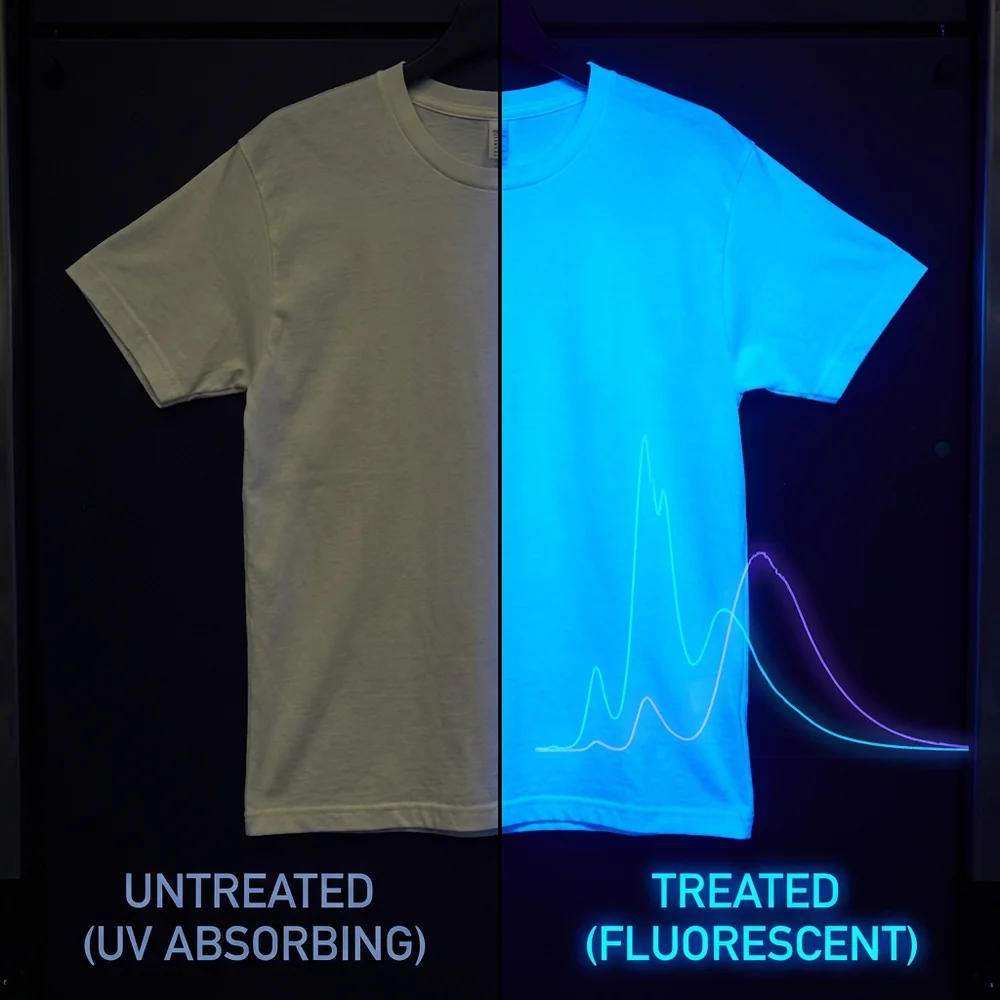
Optical brightening agents, also called fluorescent whitening agents, are synthetic chemicals added to most laundry detergents. Unlike bleach, which actually removes color molecules from stains, optical brighteners work by manipulating light. They absorb invisible ultraviolet radiation and re-emit it as visible blue light. This extra blue compensates for the natural yellowing of aged fibers, making fabrics appear dramatically whiter than they really are.
The important thing to understand is that these compounds do not clean anything. They deposit a thin layer of fluorescent dye onto your clothes that emits blue light back at you. For many people, this is fine. For others, including military personnel, people with sensitive skin, and anyone who wears dark clothing, optical brighteners create problems worth understanding.
How Fluorescence Creates the Glow
The core function of optical brighteners is based on fluorescence, a specific type of light manipulation that occurs at the molecular level.
Natural fibers like cotton absorb small amounts of blue light as they age. This causes them to reflect a yellowish spectrum, which our brains interpret as dingy or old. Optical brighteners are complex organic molecules with highly conjugated electron systems that can absorb high-energy UV photons, typically in the range below 400 nanometers.
When one of these molecules absorbs a UV photon, an electron gets excited to a higher energy state. As the molecule returns to its ground state, it releases that energy as a visible photon in the blue range, between 400 and 480 nanometers. This wavelength shift is called the Stokes shift, and it is the key to the brightening effect.
By depositing these molecules onto fibers, manufacturers ensure that clothes reflect more visible light than they receive from the visible spectrum alone. The UV light that would normally be invisible gets converted into visible blue light, creating a dazzling whiteness that is physically impossible for untreated fabrics to achieve.
The Bottom Line Fluorescence converts invisible UV light into visible blue light. This makes treated fabrics appear brighter than untreated ones because they are literally emitting extra light.
How We Perceive White
Human color perception depends on the balance of the visible spectrum reaching our eyes. A surface we perceive as “white” reflects all visible wavelengths roughly equally.
As textiles age or accumulate body oils and environmental pollutants, they begin absorbing blue light preferentially. The reflected light becomes dominated by yellow and red wavelengths, which we see as a dingy or warm tint. Optical brighteners artificially inject blue light back into the visual field, restoring the spectral balance and moving the color coordinates toward what we perceive as “blue-white.”
This correction is purely optical. The yellow organic residues causing the problem are often still present on the fiber. They are simply being overpowered by the intensity of the blue emission. It is like using a blue filter on a camera to correct for warm tungsten lighting: a cosmetic fix that addresses the visual symptom without resolving the underlying cause.
Why Brighteners Are Not the Same as Bleach
It is important to distinguish between bluing, bleaching, and optical brightening because they work completely differently.
Traditional laundry bluing adds a trace amount of actual blue pigment, like Prussian blue, to the wash. This works through subtractive color mixing. The blue pigment absorbs excess yellow light, resulting in a neutral gray that the eye perceives as white. While it neutralizes the yellow tint, it actually reduces the total amount of light reflected by the garment, making it look slightly darker.
Chemical bleaching, using chlorine or hydrogen peroxide, destroys the chromophores of stain molecules through oxidation. The color molecules are chemically broken apart so they can no longer absorb visible light.
Optical brighteners are essentially “colorless dyes” that deposit onto fibers and stay there. They possess high substantivity, meaning they have a chemical affinity for cellulose and synthetic fibers that prevents them from rinsing away. Each subsequent wash adds another layer of these molecules, leading to cumulative buildup over the life of the garment.
The Bottom Line Optical brighteners are permanent deposits that increase total luminous reflectance. Unlike bleach which removes color chemically, brighteners add visible light emission to mask residual discoloration.
The Chemistry Behind These Molecules

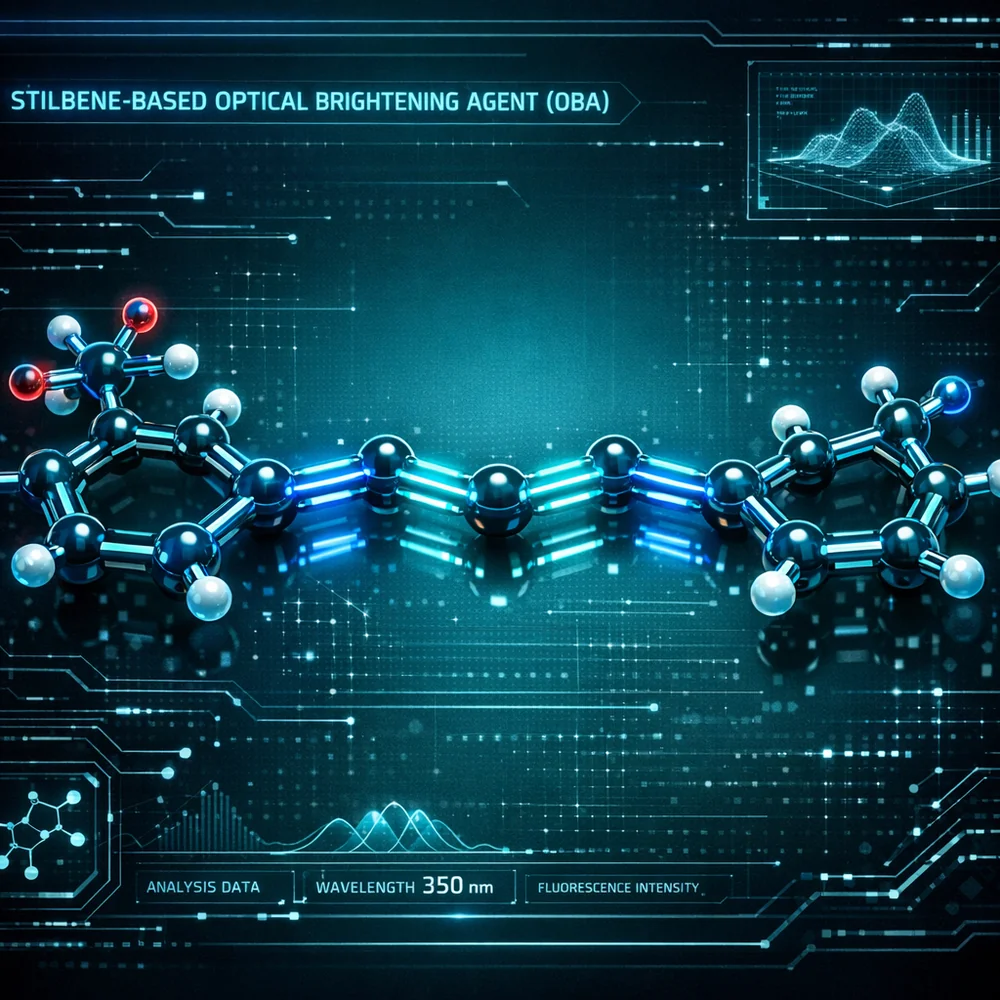
Most modern optical brighteners are synthesized from derivatives of 4,4-diaminostilbene-2,2-disulfonic acid, commonly abbreviated as DAS.
This structural core provides the flat, rigid framework necessary for efficient electron conjugation and fluorescence. During manufacturing, various functional groups are attached to tune the substantivity and the specific shade of blue emitted. Some brighteners are optimized for the high-affinity bonds of cotton, while others are engineered to penetrate the tight molecular structure of polyester or nylon.
The synthesis involves complex multi-step organic reactions including nitration, sulfonation, and reduction. Because these chemicals must remain stable under the harsh conditions of a washing machine with high pH, varied temperatures, and oxidizers present, they are engineered for extreme durability. This stability is a double-edged sword. While it keeps your shirts white for months, it also means the molecules do not break down easily once they enter the environment.
Skin Sensitivity Concerns

Because optical brighteners are designed to remain on fabric rather than rinse away, they are in constant direct contact with human skin.
For individuals with compromised skin barriers, such as those with eczema or psoriasis, this residue can trigger contact dermatitis. Friction from clothing against skin, combined with sweat, can facilitate the transfer of brightener molecules from textile to the stratum corneum. This is a primary concern for washing newborn clothes. Infants have thinner skin barriers and higher surface-area-to-mass ratios, making them more susceptible to chemical absorption and irritation.
Many medical professionals recommend using fragrance-free and dye-free detergents that specifically omit optical brighteners to reduce potential hidden chemical irritants. The blue glow of a onesie provides no hygienic benefit but introduces an unnecessary chemical vector to a sensitive environment.
The Bottom Line Stilbene-based brighteners adhere permanently to fibers, resulting in indefinite skin contact. In sensitive populations, this cumulative exposure can disrupt the skin’s natural barrier and trigger irritation.
Environmental Persistence
Optical brighteners are categorized as persistent pollutants because they resist conventional wastewater treatment.
Studies show that a significant percentage of these agents pass through municipal sewage systems without being degraded. Once they enter natural waterways, they bind to aquatic sediments or are absorbed by fish and invertebrates. Their intentional design for stability means they do not photodegrade quickly even when exposed to sunlight in rivers or lakes.
While not acutely toxic to humans in small doses, the long-term effects on endocrine systems of aquatic life are still being mapped. The shift toward biodegradable detergents often overlooks these fluorescent agents because they are used in small quantities, but their persistence makes them a cumulative environmental burden.
Why the Military Bans Brighteners
The United States military, along with many international defense forces, strictly prohibits optical brighteners on combat uniforms.
Modern camouflage is engineered to be effective across both visible and near-infrared spectrums utilized by night vision goggles. Optical brighteners absorb UV light and emit visible light, drastically altering the spectral signature of the fabric. To an enemy observer using night vision technology, a soldier wearing a uniform laundered with brighteners would appear as a brightly glowing beacon against a dark background.
This phenomenon is known as spectral flaring, and it completely compromises tactical concealment. Once a uniform has been contaminated with brighteners, the unwanted fluorescence is nearly impossible to remove because of the high substantivity of the chemicals. Military personnel are trained to inspect their detergents and use only approved, brightener-free soaps to maintain operational security.
The Bottom Line Military uniforms must remain NIR-compliant to avoid night vision detection. Optical brighteners destroy this compliance by causing fabric to fluoresce under infrared-enhanced optics.
What Brighteners Do to Black Clothes
The same mechanism that makes white clothes brighter paradoxically ruins the appearance of dark fabrics.
When optical brighteners deposit onto black or navy garments, they still absorb UV light and emit blue light. On a dark background, this blue emission appears as a dusty, chalky, or faded haze. The deep rich absorption of a black fabric is lost because the surface is literally emitting light back at the observer. This is a primary cause of the “prematurely aged” look that develops on dark jeans and formal wear.
To preserve dark color depth, use a dedicated detergent for dark fabrics that specifically omits optical brighteners and may include dye-transfer inhibitors. Keeping white and dark wash streams separate is the only way to ensure whites stay glowing and blacks stay deep.
Restoring Whiteness Without Brighteners
For those wanting to avoid synthetic brighteners, several approaches restore whiteness through actual soil removal rather than optical tricks.
The most effective method is sodium percarbonate, which provides oxidative cleaning of fibers. By removing the organic soils that cause yellowing, the true reflectance of the fiber is revealed. Another historical approach is laundry bluing at very low concentrations, which provides visual whitening through subtractive color mixing without fluorescent chemicals.
Natural UV radiation from the sun remains a potent whitening tool. Line-drying fabrics allows photons to break down fugitive organic stains while acting as a mild disinfectant. This traditional method achieves whiteness through actual purification rather than synthetic optical illusion. Our guide on whitening without bleach provides detailed home protocols for chemical-free approaches.
How to Detect Brighteners
Determining whether a garment or detergent contains optical brighteners is a simple home experiment.
A UV-A light source, commonly called a black light, will cause any material treated with brighteners to fluoresce with brilliant neon-blue glow. Perform this test in a dark room to see the secondary emission clearly. Fabrics that have never been treated, such as organic unbleached cotton, will appear flat, dark, or slightly brownish under the same light.
This verification method is particularly useful for those who need purity in their laundry environment for medical or tactical reasons. It can reveal hidden detergent residues on supposedly “clean” clothes and help identify which products contribute to the chemical load on your textiles.
The Bottom Line A black light test instantly reveals optical brightener presence. Treated fabrics glow brilliant blue, while untreated fabrics appear dark or yellowish.
Conclusion
Optical brighteners are a fascinating application of photophysics that has defined the modern aesthetic of clean laundry for decades. They provide brilliant, almost supernatural whiteness by converting invisible UV light into visible blue light.
However, this visual triumph comes with significant trade-offs in skin sensitivity, environmental persistence, and the degradation of dark garments. They are an optical mask, not a chemical purifier. The glow you see is real light being emitted, but it has nothing to do with cleanliness.
Whether you are a soldier maintaining tactical concealment, a parent protecting an infant’s sensitive skin, or someone who wants black jeans to stay black, choosing to opt out of optical brighteners is a choice for genuine over illusory cleanliness. By prioritizing real soil removal over fluorescent masks, results are truly clean in every sense of the word.
References
- Journal of Photochemistry and Photobiology. “Mechanism of Fluorescence in Stilbene-Based Whitening Agents.” Elsevier
- Military Research Technical Bulletin. “Visual and IR Signature Management of Combat Uniforms.” DOD
- Environmental Toxicological Chemistry. “Biodegradability and Aquatic Persistence of Modern FWAs.” Wiley
- Dermatology and Contact Allergy. “The Role of Laundry Additives in Atopic Dermatitis Triggers.” PubMed
- Textile Research Journal. “Substantivity and Accumulation of Optical Brighteners on Cellulose Fibers.” Sage