Wash Temperature Thermodynamics: The Energy of Molecular Activation
Table of Contents
Things You'll Learn From This Article:
- The wash temperature you pick decides whether detergent chemicals actually work or barely do anything.
- Warm water speeds up cleaning because heat makes molecules move faster and react more easily.
- Hot water helps remove greasy stains but can permanently set protein stains like blood or egg.
- Body oils don’t fully come out in cold water because they stay solid until warmed above about 30–40°C.
- A warm wash around 40°C is a practical middle ground for everyday clothes with normal body soil.
- Laundry enzymes only work well in a narrow temperature range and stop working if the water is too hot.
- Very hot cycles can kill stains and bacteria but also destroy the enzymes meant to clean them.
- Cold water detergents rely on stronger surfactants and special enzymes to make up for the lack of heat.
- Even the best cold-water detergent struggles with heavy grease because solid fats don’t melt.
- Cold washes are better suited for lightly soiled clothes and synthetic fabrics.
- Hot water makes fabrics shrink by relaxing fibers that were stretched during manufacturing.
- Heat makes dyes more likely to escape fabric, which is why hot washes cause color bleeding.
- Lower temperatures help keep dark and bright colors from fading or staining other clothes.
- Detergent needs enough warmth to dissolve and form micelles that trap and carry away oil.
- If the water is too cold, some detergents may not dissolve or clean at all.
- Synthetic fabrics can permanently lose shape when washed too hot because the fibers soften.
- Repeated hot washes slowly weaken cotton, making it thinner and easier to tear.
- Heating water uses far more energy than any other part of the wash cycle.
- Using warm or cold water saves electricity while still cleaning most everyday loads.
- Modern washers control temperature more precisely, giving more consistent cleaning year-round.
- Matching water temperature to the type of stain and fabric gives better results and less damage.
The temperature you select on your washing machine is not just a comfort setting. It is the single most important variable determining whether your detergent will actually work as intended. Temperature directly controls the speed of chemical reactions, the physical state of the oils you are trying to remove, and whether the enzymes in your detergent will function or die.
In thermodynamic terms, wash temperature represents the average kinetic energy of the water molecules. Higher temperatures mean molecules move faster, collide with more force, and undergo reactions more readily. This is why hot water has always been associated with thorough cleaning. However, that same energy can damage delicate fabrics, cause shrinkage, and waste electricity by the kilowatt.
Understanding the thermodynamics of washing allows you to make informed decisions based on the specific soil you are dealing with and the fabric you are washing. Whether you are trying to melt body oils, activate enzymes, or prevent dye from migrating, temperature is the lever that controls everything.

How Temperature Accelerates Chemical Reactions
To remove a stain, the chemical bonds holding the soil to the fabric must be broken, and the surfactants must overcome an energy barrier known as activation energy.
The Arrhenius equation describes this relationship mathematically, showing that even a small increase in temperature can lead to a significant increase in reaction rate. In the laundry tub, heat provides the necessary kick to allow surfactants to penetrate the oily layers of a stain. As the temperature rises, water molecules move faster, increasing the probability that a surfactant molecule will collide with a soil particle and successfully emulsify it. This is why hot water is traditionally associated with deep cleaning. It literally speeds up the physics of soil removal.
However, not all stains react to heat in the same way. While heat helps to dissolve grease, it can actually set protein-based stains like blood or egg. High temperatures cause proteins to denature and cross-link with the fabric fibers, creating a permanent chemical bond. This is why a thorough understanding of laundry enzyme biology is critical. Different enzymes have different thermal optima, and applying the wrong temperature can render the most expensive detergent entirely ineffective.
The Bottom Line Heat accelerates chemical reactions exponentially. But protein stains require cool pre-treatment because hot water causes them to denature and bond permanently to fibers.
How Heat Affects Surfactant Performance
The primary task of any surfactant is to lower the surface tension of water, and this process is highly dependent on the temperature of the solution.
As temperature increases, the cohesive forces (hydrogen bonding) between water molecules weaken. This means that surface tension naturally decreases as water gets warmer, even without the addition of soap. When surfactants like SLS or SLES are added to warm water, they can diffuse to the air-liquid and liquid-fabric interfaces more rapidly.
This speed of diffusion is known as surfactant kinetics. In cold water, surfactants move sluggishly, taking several minutes to fully coat the fabric surface. In hot water, this transition happens almost instantly. Furthermore, many non-ionic surfactants exhibit a cloud point, a specific temperature at which they become less soluble and form a separate phase. This phase separation, paradoxically, can sometimes improve the cleaning of hydrophobic soils, as the concentrated surfactant droplets attack the oils directly.
Managing these thermal transitions is a key part of formulating high-performance detergents that work across a wide temperature range, particularly in the low-volume environments of HE washers.
Why Body Oils Need Warm Water
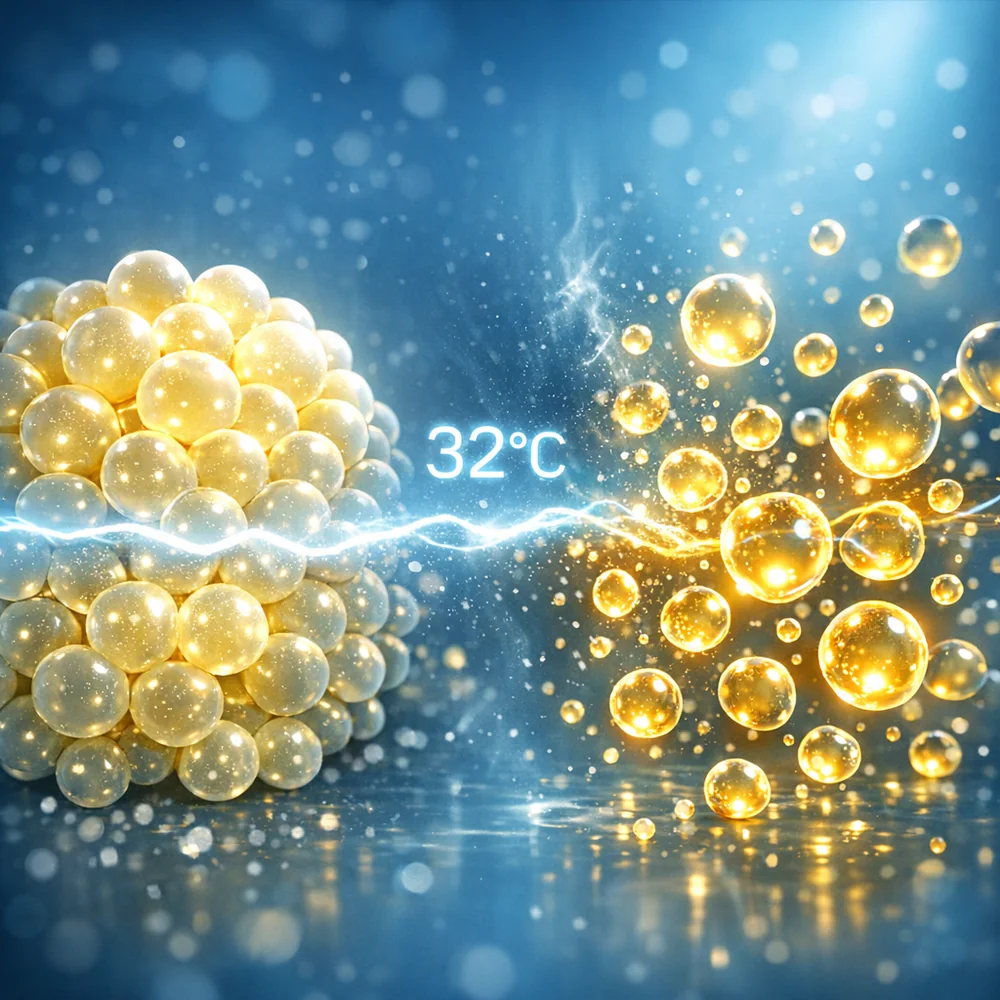
One of the most practical reasons for using heat in laundry is the physical melting of solid or semi-solid fats.
Human sebum (body oil) and many kitchen greases have melting points that range from 30°C to 45°C. Below these temperatures, the grease exists as a solid or a thick wax that is physically stuck within the weave of the fabric. Surfactants find it very difficult to emulsify a solid grease. However, once the wash temperature exceeds the melting point of the lipid, the fat turns into a liquid.
Once in a liquid state, the fat becomes significantly easier for surfactant micelles to encapsulate and carry away. This is why a warm wash around 40°C is often the sweet spot for everyday clothing. It provides enough thermal energy to transition the body oils into a liquid state without being so hot that it damages synthetic fibers like elastane or polyester.
If you attempt to wash sheets or pillowcases in cold water, you may remove the water-soluble dirt, but the solid sebum will remain. This eventually leads to the yellowing and sour smell associated with poorly laundered bedding.
The Bottom Line Body oils are solid below 32°C and cannot be emulsified effectively. A minimum wash temperature of 30°C to 40°C is needed to liquefy these fats for proper removal.
The Temperature Window for Enzyme Activity
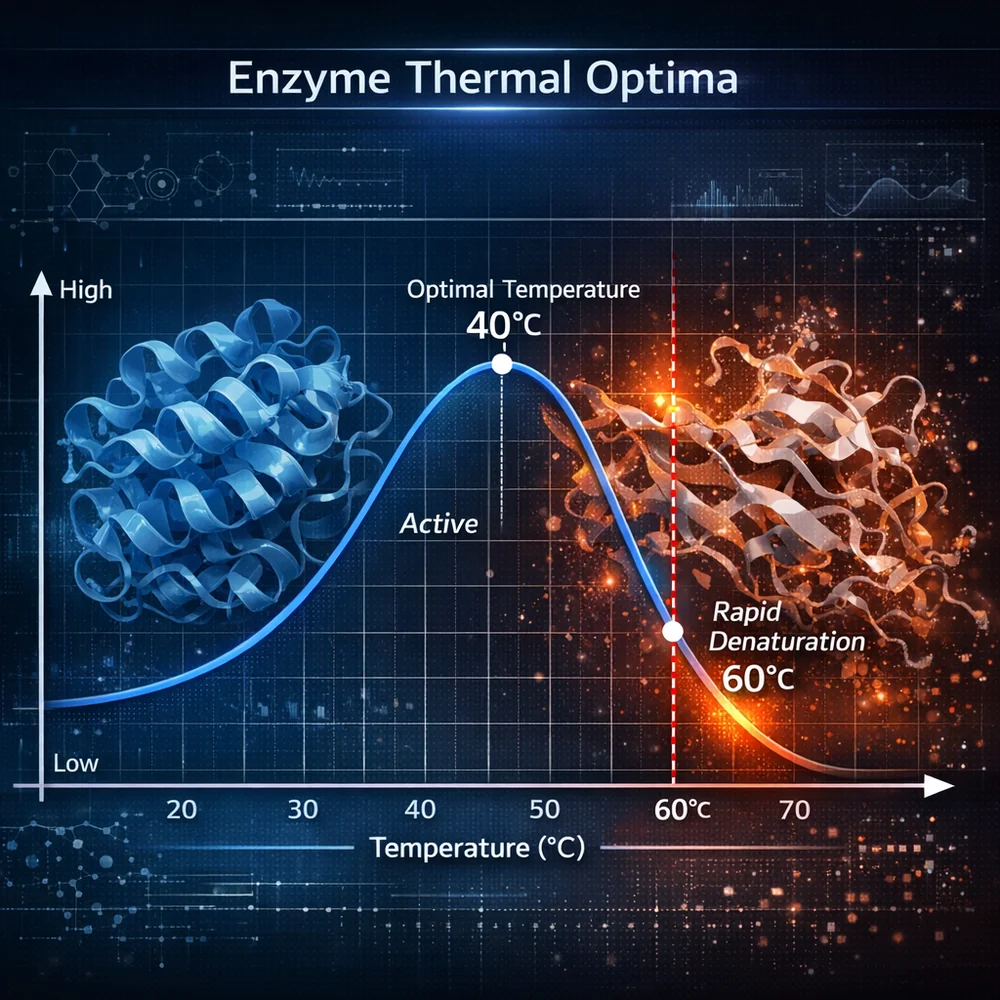
Laundry enzymes are biological catalysts that have evolved to work within very specific temperature brackets.
Proteases, which break down protein stains, and amylases, which target starches, typically have an optimal performance range between 30°C and 40°C. Within this window, the enzyme molecules have enough kinetic energy to vibrate and fit into the substrate molecule like a lock and key. If the water is too cold (below 20°C), the enzymes move too slowly to perform meaningful work, and the biological cleaning power of the detergent is wasted.
Conversely, if the temperature exceeds 60°C, the enzymes undergo denaturation. The complex three-dimensional structure of the protein collapses, and the enzyme loses its functional shape. Once denatured, it can never be restored.
This creates a technical challenge for sanitize cycles that use high heat to kill bacteria. While the heat kills the germs, it also kills the enzymes that were supposed to remove the stains. Modern enzyme stabilizers have pushed these limits slightly, but the fundamental thermodynamic constraint remains a core principle of enzyme biology.
How Cold Water Detergents Compensate
The global push for energy efficiency has led to the rise of cold water detergents, which must solve the problem of reduced molecular movement through chemical engineering.
In cold water, the rate of dissolution for solid or highly viscous detergent ingredients drops significantly. As discussed in the comparison of detergent forms, powders are particularly prone to clumping in cold water because there is not enough thermal energy to overcome the lattice energy of the salt crystals. Even liquid detergents become more viscous and flow less easily at low temperatures.
To compensate for the lack of heat, cold-water detergents use more aggressive surfactant blends and higher concentrations of specialized enzymes that have been bio-engineered to work at lower temperatures. These psychrophilic enzymes are derived from organisms that live in arctic environments, meaning they remain flexible and active even in near-freezing water. While these detergents are effective, they are still limited by the physical fact that solid fats will not melt in cold water. Therefore, cold water washing is best suited for synthetic fabrics and lightly soiled items, rather than heavy-duty cleaning of natural fibers or greasy workwear.
The Bottom Line Cold-water detergents use bio-engineered psychrophilic enzymes to replace the kinetic energy normally supplied by warm water. They work well for light soils but cannot melt solid body oils.
Why Hot Water Causes Shrinkage and Dye Bleeding
Higher temperatures increase the entropy (disorder) of the system, which manifests in the fabric as shrinkage and dye loss.
Natural fibers like cotton and wool are under internal tension from the manufacturing process. When they are exposed to high heat and water, the hydrogen bonds within the cellulose or keratin fibers are disrupted. This allows the fibers to relax and spring back to their natural, shorter state, resulting in shrinkage. The tumble action of the machine provides the mechanical energy for this relaxation to happen more quickly.
Color migration, or dye bleeding, is also a thermodynamic process. Dyes are held to the fabric by relatively weak van der Waals forces or hydrogen bonds. Heat provides the kinetic energy for the dye molecules to break these bonds and migrate into the wash water. Once in the water, they can easily find their way to other garments. This is why washing lights and darks together in hot water is a recipe for disaster. Keeping the temperature low keeps the dye molecules locked in place, although this must be balanced against the need for soil removal.
How Temperature Affects Micelle Formation

The formation of micelles, the spherical aggregates of surfactants that trap oil, is a temperature-dependent process governed by the Critical Micelle Temperature, also known as the Krafft point.
Below the Krafft point, the surfactant remains in its crystalline state and is relatively insoluble, meaning it cannot form micelles or perform cleaning work. As the wash temperature rises above the Krafft point, the solubility increases sharply, allowing the surfactant molecules to spontaneously assemble into micelles. This phase transition is a classic example of the hydrophobic effect, where the system minimizes its free energy by hiding the hydrophobic tails from the water. In cold water, if the temperature is below the Krafft point for a specific surfactant, the detergent will literally sit at the bottom of the drum as an inert solid.
The Critical Micelle Concentration (CMC) also changes with temperature. While the relationship is complex and depends on the specific chemical structure of the surfactant, generally higher temperatures can lower the CMC for non-ionic surfactants. This means that in a warm wash, you need less total detergent to achieve the same cleaning power as you would in a colder wash.
Why Synthetics Have Temperature Limits
The thermal stability of a garment is determined by the glass transition temperature of its constituent polymers.
Synthetic fibers like polyester and nylon are essentially long-chain plastics. Below their glass transition temperature, the polymer chains are frozen in a rigid, glassy state. When the wash temperature approaches or exceeds this threshold, the chains become mobile, turning the fiber rubbery. This state is when the fabric is most susceptible to permanent deformation or the setting of wrinkles.
For many common synthetics, the glass transition temperature is surprisingly low, often between 50°C and 70°C. Washing these items in sanitize cycles (which can reach 65°C or higher) often leads to permanent loss of the garment’s shape.
Natural fibers like cotton do not have a glass transition temperature in the same way, but they are sensitive to a phenomenon called heat of wetting. When dry cotton is first exposed to water, it releases a small amount of thermal energy. However, as the temperature of the water increases, the swelling of the fiber also increases. This excessive swelling can lead to the rupture of the weak hydrogen bonds that hold the cellulose chains together. Over time, repeated high-heat washes will cause the cotton to become thinner and more prone to tearing.
The Bottom Line Synthetic fibers have glass transition temperatures above which they become rubbery and prone to permanent wrinkling. Cotton swells excessively in hot water, weakening its structure over repeated washes.
Energy Consumption and Machine Efficiency
The heating of water is the single most energy-intensive part of the laundry process, often accounting for 80 to 90 percent of the machine’s electrical consumption.
In a standard wash cycle, the electrical resistance element in the machine must convert thousands of watts of electricity into thermal energy to raise the temperature of the water. In the context of HE washer mechanics, the lower volume of water means the machine can reach its target temperature more quickly and with less energy. However, the machine’s sensors must work harder to maintain that temperature against the cooling effect of the room and the ambient temperature of the clothes.
Modern machines often use automatic temperature control to mix hot and cold water to reach a precise warm setting. In older machines, warm was simply a 50/50 mix of whatever was in the pipes. This led to massive variability depending on the season. In winter, a warm wash might be as cold as a cold wash in the summer. Precision temperature control ensures that the chemical kinetics remain consistent throughout the year, regardless of the external climate.
Conclusion
Understanding the thermodynamics of wash temperature allows for a more scientific and efficient approach to garment care.
Heat is a powerful tool for melting fats, accelerating surfactant kinetics, and activating biological enzymes. However, it is also a dual-edged sword that can damage fabrics and waste significant energy if used indiscriminately. The modern warm wash between 30°C and 40°C provides the optimal thermodynamic environment for the vast majority of textiles, providing enough energy for lipid phase transitions and enzyme activity without reaching the entropy-driven thresholds of shrinkage and dye loss.
As we move toward a future of sustainable laundry, the role of heat will continue to decrease in favor of more advanced chemical solutions. Bio-engineered enzymes and high-solubility surfactants are already making cold-water washing a viable reality for most loads. However, for specific challenges like sanitization or heavy grease removal, the laws of thermodynamics still dictate that a targeted application of heat remains the most effective solution. By matching the temperature to the soil type and the fabric’s thermal stability, you can achieve high-performance results that preserve both your clothes and the environment.
References
- Atkins, P., & de Paula, J. (2014). Physical Chemistry. Oxford University Press.
- Schramm, L. L. (2005). Emulsions, Foams, and Suspensions: Fundamentals and Applications. Wiley-VCH.
- Smulders, E., et al. (2011). Laundry Detergents. Wiley-VCH.
- Versluijs, P. (2011). Textile Chemicals: Environmental Data and Facts. Springer Science & Business Media.
- Rosen, M. J., & Kunjappu, J. T. (2012). Surfactants and Interfacial Phenomena. John Wiley & Sons.