Detergent Forms: The Science of Liquid, Powder, and Pod Delivery Systems
Table of Contents
Things You'll Learn From This Article:
- Different detergent types are built for different jobs, so picking the right one can save money and give better results.
- Powder works best for whites, muddy clothes, and heavy dirt because it contains dry bleach ingredients that activate in water.
- Powder struggles in cold water and can leave residue if it doesn’t fully dissolve, especially in hard water.
- Liquid detergent starts cleaning right away, which makes it a better choice for cold-water washes.
- Greasy stains like cooking oil, makeup, and body oils come out more easily with liquid detergent.
- Liquids can’t include some strong whitening chemicals, so they’re not ideal when bright whites are the goal.
- Pods pack a lot of cleaning power into a small dose by keeping ingredients separated until the wash starts.
- Pods are convenient, but the dose is fixed, so you can’t use less for small or lightly dirty loads.
- Very cold, low-water cycles can cause pods to only partly dissolve and leave film on clothes.
- Hard water affects cleaning, and powders usually handle it better because they include minerals that soften the water.
- Liquids are often better for dark clothes in hard water because they’re less likely to leave chalky marks.
- Powder and pods are lighter to ship than liquids, which usually means a lower environmental footprint because less water and plastic are involved.
Walk down the laundry aisle of any grocery store and you face an overwhelming choice: liquid in giant jugs, powder in cardboard boxes, colorful pods that look almost like candy. Most people pick based on habit, price, or whatever is on sale. But these different formats are not just marketing variations. They represent completely different chemical engineering approaches, each with real advantages and limitations depending on what you are actually trying to clean.
The choice between liquid, powder, and pods comes down to fundamental chemistry. What chemicals can you keep stable in a water-based solution versus a dry solid? How quickly does each format dissolve and start working? What kinds of stains respond best to which active ingredients? When you understand these underlying principles, picking a detergent stops being guesswork and becomes a strategic decision.
This matters because using the wrong format for your situation means wasted money and subpar results. Powders are terrible at dissolving in cold water but amazing at whitening. Liquids handle grease beautifully but cannot include certain powerful bleaching agents. Pods offer convenience and concentrated power but take away your ability to adjust the dose. Understanding the detergent ingredients overview across formats helps you optimize your routine for your specific needs.
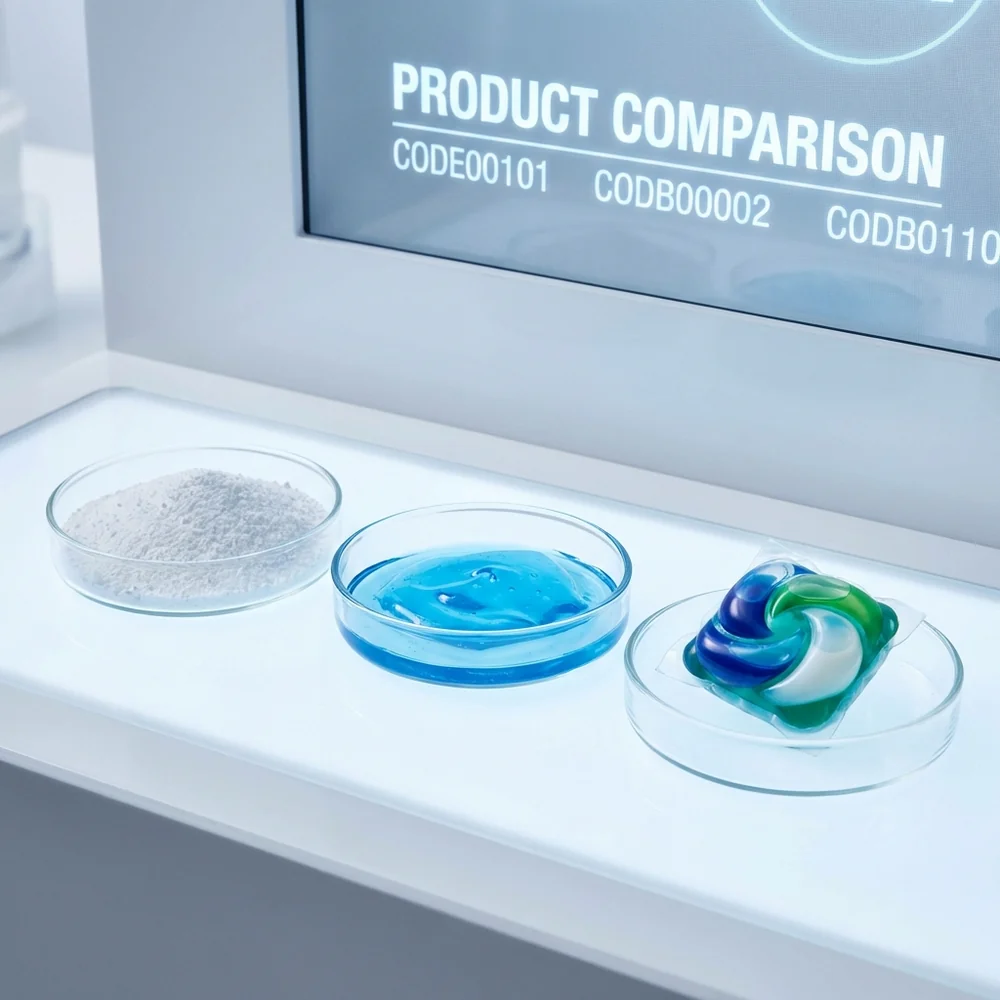
Powder Detergents: The Original Powerhouse
Powder detergents dominated the market for decades before liquids took over, and they still have chemical advantages that no other format can match. The key is that powders are completely dry, which opens up formulation possibilities that liquid environments simply do not allow.
The core of most powder detergents is built around sodium sulfate (a filler that helps the powder flow smoothly) and zeolites (mineral particles that soften water). Because there is no water in the formula, powders can include sodium percarbonate, the active ingredient in oxygen bleach chemistry. This is a huge advantage for whitening and stain removal. In a liquid detergent, hydrogen peroxide would start reacting with other ingredients immediately and lose most of its power within weeks. In a powder, these reactive oxygen molecules stay dormant until the moment they hit your wash water.
This makes powders the clear winner for muddy laundry, clay stains, and heavy particulate soil. The high alkalinity of powders (usually pH 10.5 to 11.5) swells cotton fibers and helps dislodge embedded particles. The anionic surfactants common in powder formulas are especially good at keeping dirt suspended in the water so it rinses away instead of redepositing on your clothes.
The trade-off is that powders can be harsh on dyes. The high pH and oxidizing agents that make them great for whites can fade colors over time. They also need to dissolve before they start cleaning, which is a real problem in cold water cycles where the crystals may never fully break down.
The Bottom Line Powder detergents can include stable oxygen bleach that is impossible to formulate in liquids. This makes them the best choice for whitening, particulate stains, and high-alkalinity cleaning.
Liquid Detergents: Instant Action and Grease Power
Liquids took over the detergent market for good reasons. They are convenient to pour, they never leave undissolved residue on clothes, and they start working the instant they hit the water. But their dominance also reflects a genuine chemical advantage when it comes to certain types of stains.
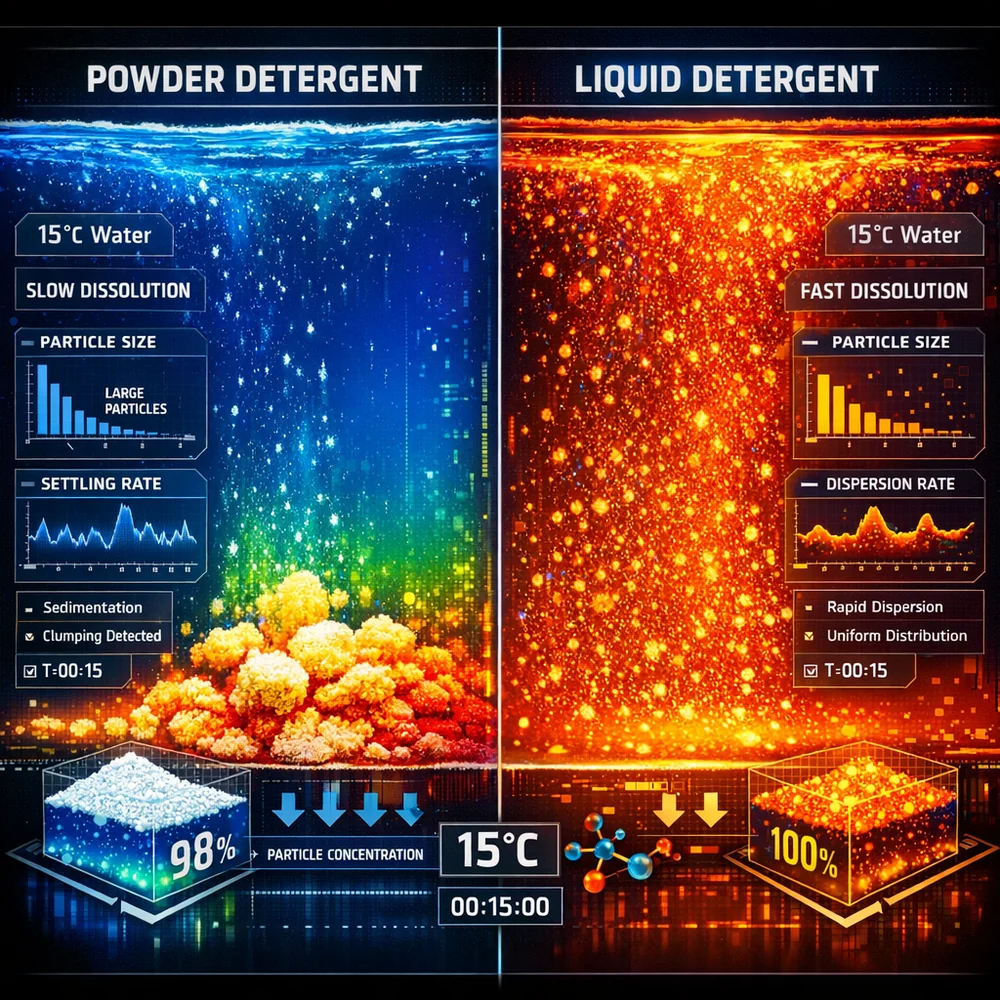
Because liquids are “pre-dissolved,” they do not need time or heat to disperse. In ultra-cold water cycles, a liquid detergent is already interacting with your clothes while a powder might still be sitting in clumps at the bottom of the drum. This immediate solubility is critical for modern washing habits where energy-saving cold cycles are becoming the norm.
The chemistry of liquid formulas favors non-ionic surfactants like alcohol ethoxylates. These molecules are less affected by hard water laundry chemistry than the anionic surfactants in powders. More importantly for everyday laundry, non-ionics are the champions of grease removal. They can penetrate the hydrophobic layers of skin oils, makeup, and cooking grease far more effectively than anionic surfactants.
The biggest challenge in liquid formulation is keeping enzymes stable. Laundry enzyme biology is complex because enzymes are proteins. In a water-based environment, proteases (protein-digesting enzymes) tend to attack each other and themselves. Without special stabilizers like boron compounds or specific glycols, the enzymes would be dead before the product even reached store shelves. This stabilization technology is why premium liquids cost more than basic powders.
Pods: Multi-Chamber Engineering
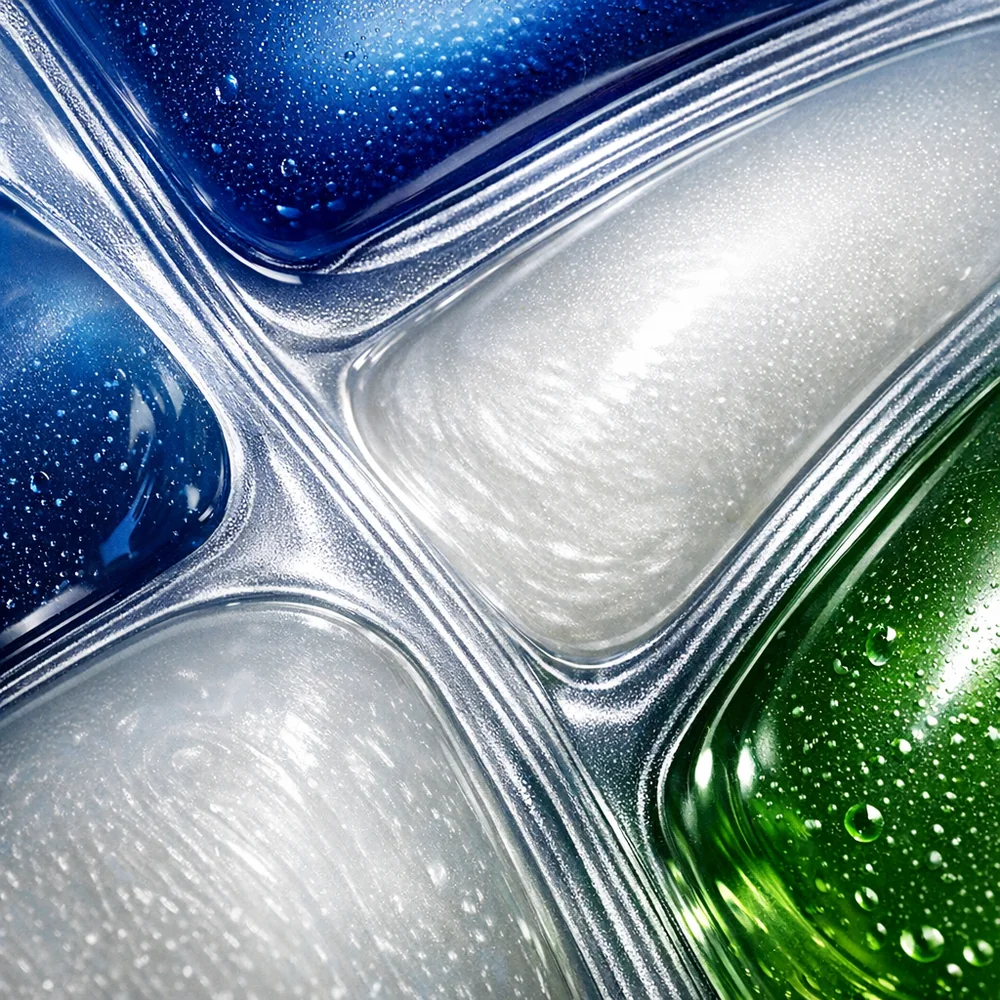
Detergent pods are a masterclass in polymer science. The outer film is made of polyvinyl alcohol (PVA), a synthetic water-soluble material that is stable when exposed to the concentrated detergent inside but dissolves rapidly in the bulk water of your washing machine. This threshold behavior is carefully engineered through the chemical composition of the film.
The real innovation in pods is compartmentalization. A single pod can have separate chambers containing ingredients that would react with or degrade each other if mixed. One chamber might hold surfactants, another a fabric conditioner, and a third a liquid oxygen bleach or specialized enzyme blend. By keeping them physically separated until the moment of use, formulators can pack more active ingredients at higher concentrations than any single-phase liquid could handle.
When the pod breaks open, it releases a concentrated burst of cleaning chemicals that creates a high-energy environment within seconds. This initial hit of surfactant is actually more intense than what you get from pouring liquid detergent, which tends to dilute more gradually.
When comparing laundry detergent sheets vs. pods, the multi-chamber architecture of pods typically allows for more complex and potent chemical profiles. Sheets are essentially single-layer systems that cannot accommodate incompatible ingredients.
The Bottom Line PVA film technology enables pods to keep incompatible chemicals separated until washing. This allows for higher concentrations and more complex formulas than single-phase products.
Matching Format to Stain Type
From a purely scientific perspective, the nature of your stain should drive your detergent choice. Different soil types respond to different chemical approaches.
Greasy stains like cooking oil, makeup, and the notorious “ring around the collar” from body oils are best tackled with liquid detergents. The non-ionic surfactants immediately “wet” the oily layer and begin emulsifying it. The instant solubility means no waiting for powder to dissolve before cleaning begins.
Earthy stains like mud, grass, and clay respond better to powder detergents. The high alkalinity breaks the electrostatic bonds between clay particles and fabric fibers. The builders specifically target the mineral ions that essentially “cement” dirt to your clothes. If you have kids who play sports on natural turf, powder is your friend.
Pods work well for mixed-soil loads typical of a family household, but they have one major drawback: fixed dosing. If you are washing a small load or lightly soiled items, a pod delivers excess surfactants that can cause foaming problems (see foaming soap mechanics). With powder or liquid, you can reduce the dose to match the actual need. This flexibility is especially important for high-efficiency machines that use minimal water.
The Hard Water Factor
Your local water chemistry matters more than most people realize when choosing a detergent format. Hard water is full of dissolved calcium and magnesium that interfere with cleaning.
In regions with extremely hard water, powders have historically been the better choice because of their high concentration of “builders.” These are molecules like zeolites and sodium carbonate that bind up calcium and magnesium, essentially softening the water so surfactants can do their job. Modern liquids include chelators like citrates that help with hard water, but they can still be overwhelmed in very hard water areas.
The physical trade-off with powder in hard water is residue. If the powder does not fully dissolve, it can react with minerals to form white, chalky deposits visible on dark fabrics. This is why many people in hard water areas prefer liquid for dark clothes and synthetics while reserving powder for whites and linens where the residue is less noticeable and the bleaching power is most beneficial.
The Bottom Line Powders contain more builder capacity for very hard water, but may leave visible residue. Liquids work better for darks and synthetics in mineral-rich water.
Environmental Considerations
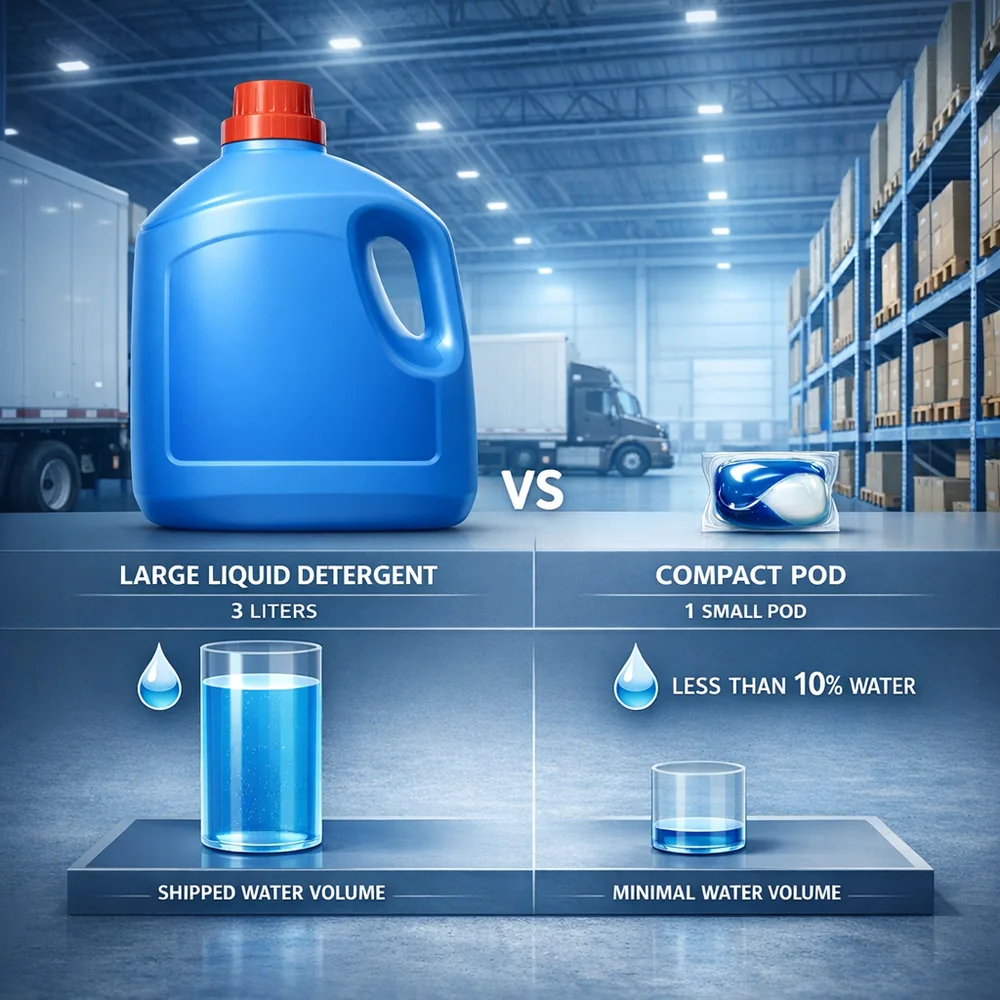
The environmental impact of different detergent formats is largely about weight and water content. Liquid detergents are 50 to 80 percent water. This “shipped water” adds significant weight to transportation, increasing fuel consumption and carbon emissions throughout the distribution chain.
Powders are nearly 100 percent active ingredients (including builders and fillers). They are the most logistically efficient format to transport because you are moving cleaning power, not water. Pods and detergent sheets are also highly concentrated, requiring far less packaging material per dose than the giant plastic jugs used for liquid.
Packaging is another consideration. Liquid bottles are typically made from HDPE plastic that is recyclable in theory but often contaminated with residual soap that complicates the recycling process. Powders traditionally come in cardboard boxes with a much lower plastic footprint.
The industry is moving toward ultra-concentrated liquids and compact pods that minimize shipped water, aligning with zero-waste laundry routines that many consumers are now prioritizing. But if you are strictly optimizing for carbon footprint, powder in a cardboard box remains the winner.
Temperature and Solubility
The temperature of your wash water has a huge impact on which detergent format performs best. This is pure thermodynamics.
Liquids have a massive advantage in cold-water washing. Since they are already in fluid form, they disperse instantly and start interacting with fabrics immediately. There is no crystalline structure to break down, no thermal energy required to get the chemicals mobile.
Powders need heat to dissolve properly. In water below about 60°F (15°C), many powder detergents fail to break apart completely. The result is clumping in the detergent drawer or white streaks on your clothes where undissolved product landed. This incomplete dissolution also means the laundry enzymes in the powder never activate.
Pods fall somewhere in between. The liquid core is ready to work, but the PVA film requires a combination of heat and mechanical agitation to rupture. In very cold, low-water high-efficiency cycles, pods have been known to “ghost” meaning they leave a sticky, partially dissolved piece of film on the clothes; rather than breaking open properly.
If you are committed to cold-water washing for energy savings, liquid is almost always the technically superior choice. Reserve pods and powders for warm or hot cycles where their specialized chemistry can fully unleash.
Conclusion
There is no universal “best” detergent format. The right choice depends on what you are washing, how you are washing it, and the chemistry of your local water supply.
Powder detergents remain the champions of whitening and heavy soil removal. Their ability to include stable oxygen bleach and high concentrations of builders makes them irreplaceable for certain jobs. But they struggle in cold water and can leave residue in hard water areas.
Liquid detergents offer unparalleled convenience and grease-fighting power. Their instant solubility makes them ideal for cold cycles, and the non-ionic surfactants handle body oils and makeup better than any powder. The trade-off is that they cannot include certain powerful active ingredients.
Pods provide high-tech convenience and concentrated power through multi-chamber engineering. They are perfect for standardized loads but remove your ability to adjust dosing for light loads or heavily soiled items.
By understanding the molecular advantages of each format, you can make smarter decisions. Use powder for that load of muddy sports gear. Use liquid for delicate synthetics washed in cold water. Use pods when convenience matters and the load matches the fixed dose. Matching the delivery system to the job prevents damage and ensures maximum cleaning efficiency.
The Bottom Line No single format wins every scenario. Liquid excels at grease and cold-water solubility. Powder dominates whitening and particulate removal. Pods offer concentrated convenience with less dosing flexibility.
References
- Zoller, U. (2008). Handbook of Detergents, Part E: Applications. CRC Press.
- Smulders, E., et al. (2011). Laundry Detergents. Wiley-VCH.
- Karsa, D. R. (2006). Handbook of Surfactants. Blackie Academic & Professional.
- Tadros, T. F. (2005). Applied Surfactants: Principles and Applications. Wiley-VCH.
- Myers, D. (2006). Surfactant Science and Technology. John Wiley & Sons.