Laundry Detergent Sheets vs Pods: Environmental Impact and Performance Analysis
Table of Contents
Things You'll Learn From This Article:
- You can’t assume pod film “disappears” just because it dissolves; much of it can pass through wastewater treatment and end up in rivers or lakes.
- Cold water washing makes it more likely that pods won’t fully dissolve, which can leave residue on clothes or send solid fragments down the drain.
- Shipping water has a real climate cost, and liquid detergent is mostly water you’re paying to move around.
- Sheets are the lightest option to ship and store because they’re almost entirely water-free until you use them.
- Pods usually clean better than sheets on heavy stains, especially greasy or protein-based messes like food, sweat, or mud.
- Sheets tend to work fine for lightly worn everyday clothes, but they may struggle with very dirty loads.
- Both pods and sheets cost more per load than bargain liquid detergent, and sheets are often slightly more expensive than pods.
- Washing mostly in cold water favors sheets over pods, since thin sheets break down more easily than pod film.
- Sheets avoid the plastic film used in pods, which removes one source of environmental uncertainty.
- Pod packaging still often includes plastic for moisture protection, while sheet packaging is more likely to be fully cardboard and recyclable.
- Pods pack more cleaning ingredients into a small dose, which is why they perform closer to liquid detergent than sheets do.
- Sheets take up very little space and can fit in drawers, backpacks, or suitcases without worry about leaks.
- Traveling with detergent is easiest with sheets, since they’re flat, lightweight, and not restricted like liquids.
- Pods are convenient for travel compared to liquids, but they can burst under heat or pressure.
- If storage space is tight, both pods and sheets are far easier to manage than bulky liquid jugs.
- Your best choice depends on what you value most: stain-fighting power, lower packaging waste, cold-water reliability, or simple portability.
The laundry aisle has expanded beyond the traditional liquid-or-powder binary to include formats promising both convenience and environmental responsibility. Detergent pods revolutionized the category a decade ago with their pre-measured doses and burst of concentrated cleaning power. Now detergent sheets offer an alternative that eliminates the plastic film wrapping each pod, appealing to consumers troubled by packaging waste.
Yet comparing these formats requires looking beyond the immediately visible plastic to examine the full lifecycle of each product. The polyvinyl alcohol film that contains pods dissolves in water, but whether it truly disappears raises questions that researchers are only beginning to answer. Sheets avoid this film entirely but may introduce other tradeoffs in cleaning performance and ingredient concentration.
This guide provides the technical foundation for choosing between these formats based on environmental impact, practical performance, and cost. The analysis resists simple conclusions because the tradeoffs are genuine and depend on individual priorities.
What Actually Happens to PVA Film
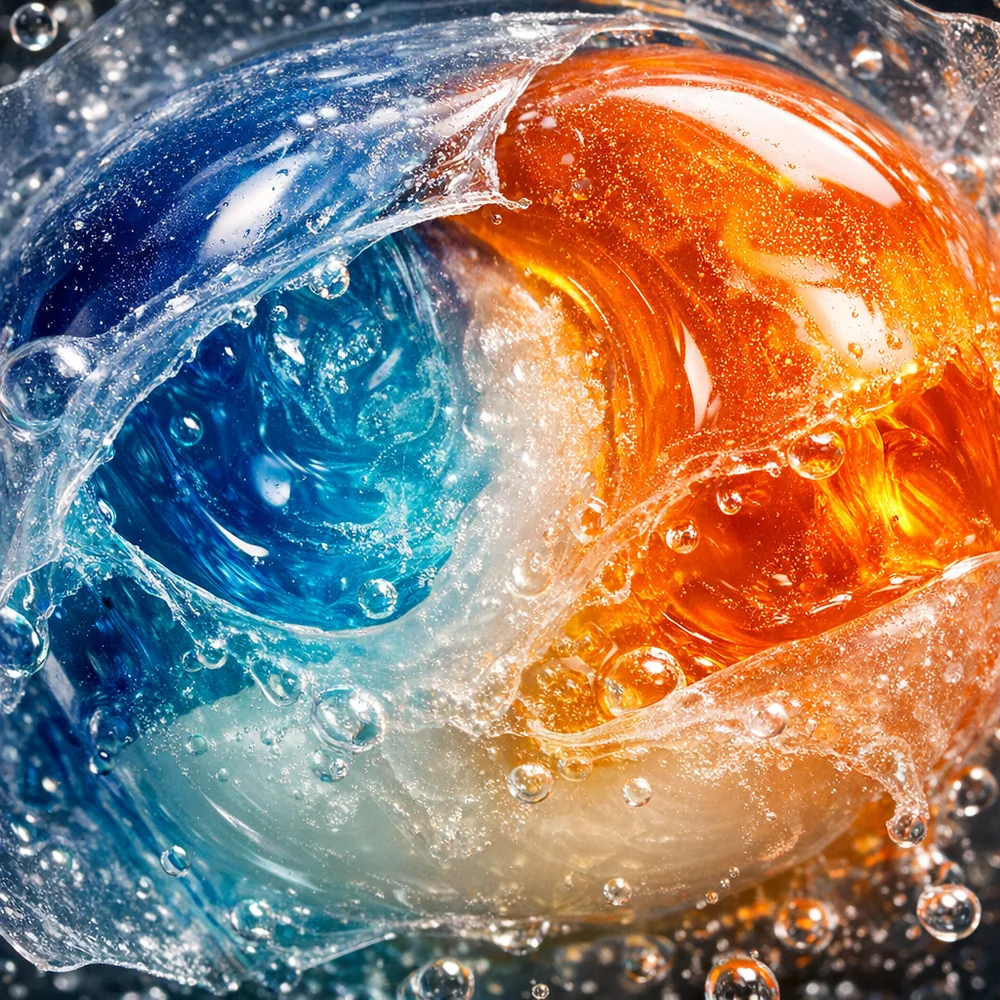
The translucent film encasing detergent pods consists of polyvinyl alcohol, a water-soluble polymer designed to dissolve completely during the wash cycle. This dissolving behavior distinguishes PVA from conventional plastics and has allowed pod manufacturers to position their products as environmentally benign. The reality proves more complex.
PVA dissolved in water does not simply vanish. The polymer molecules disperse throughout the wash water, eventually flowing to wastewater treatment facilities or septic systems. Research in environmental chemistry journals indicates that municipal treatment plants vary significantly in their ability to remove PVA from effluent. Some treatment processes achieve near-complete removal while others discharge substantial PVA quantities into receiving waters.
The fate of PVA in aquatic environments remains under active investigation. Laboratory studies demonstrate that certain bacteria can metabolize PVA given sufficient time and appropriate conditions. However, environmental conditions often differ from laboratory ideals. Cold temperatures, low bacterial populations, and the presence of other contaminants can all slow or prevent PVA degradation in natural systems.
A 2021 study from researchers at Arizona State University found that approximately 75 percent of PVA from detergent pods was not effectively treated at wastewater plants and could end up in the environment. This finding challenged manufacturer claims about complete biodegradation and prompted calls for more transparent environmental impact disclosure.
Key Insight: PVA film dissolves but does not disappear. Much of it passes through wastewater treatment and enters rivers and oceans as dissolved plastic.
The Carbon Cost of Shipping Water
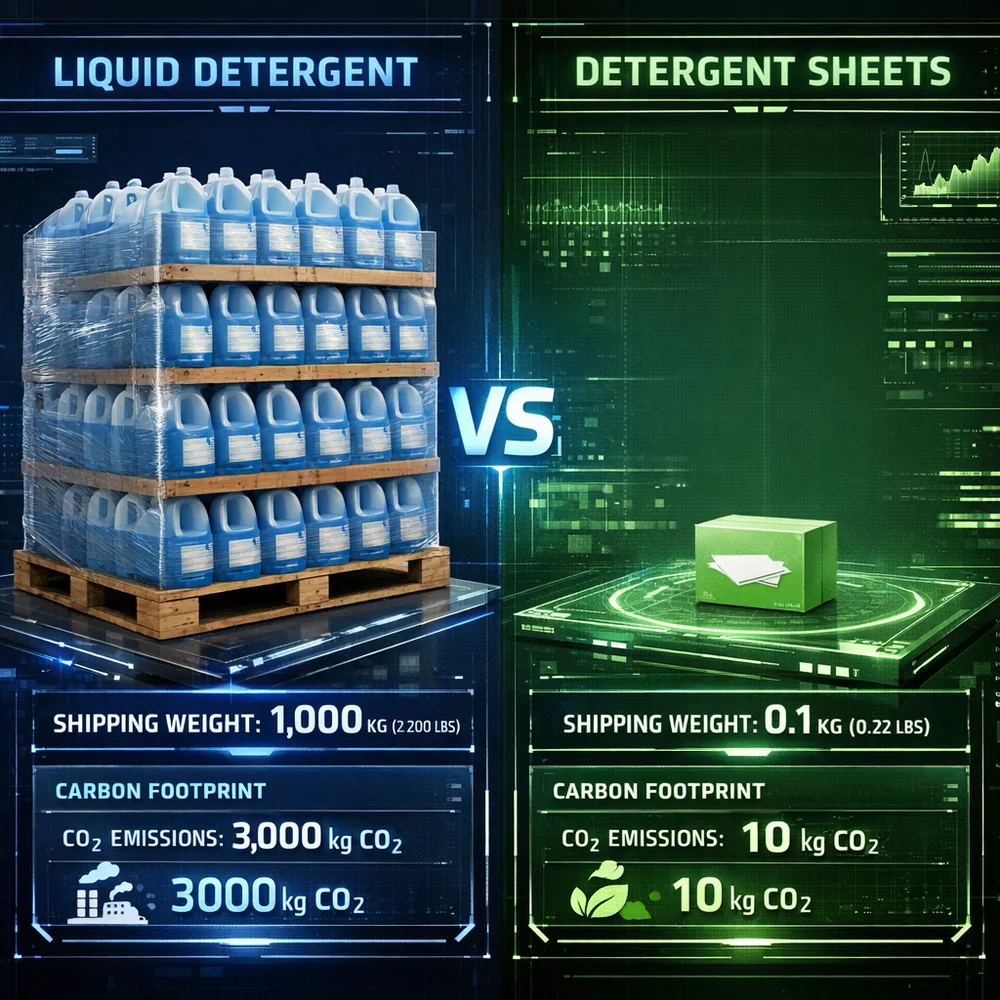
Liquid detergent bottles contain substantial water that serves no cleaning function. This water weight must be manufactured into the product, packaged, warehoused, and transported across potentially thousands of miles before reaching your laundry room. The carbon emissions associated with moving this useless water represent a genuine environmental burden that concentrated formats address.
Pods reduce but do not eliminate water weight. The concentrated gel or liquid inside each pod still contains water as a solvent and suspension medium. However, the amount is far less than in a comparable liquid detergent bottle. One analysis estimated that pods contain about 90 percent less water by weight than equivalent liquid detergent volumes.
Sheets go further by eliminating water almost entirely. The active ingredients are applied to a thin paper or fiber substrate that dissolves during washing, with water added only at the point of use. This waterless format allows more product to fit in smaller packages, shipped in lighter boxes, using less fuel per unit of cleaning power delivered.
The carbon arithmetic clearly favors sheets for this particular variable. However, carbon footprint encompasses more than shipping weight. Manufacturing processes, raw material sourcing, and end-of-life disposal all contribute to overall impact. A complete lifecycle assessment might reveal surprising offsetting factors not captured in simple shipping weight comparisons.
Key Insight: Pods contain 90% less water than liquid detergent; sheets contain essentially zero. This dramatically reduces the carbon footprint of shipping.
The Microplastic Question
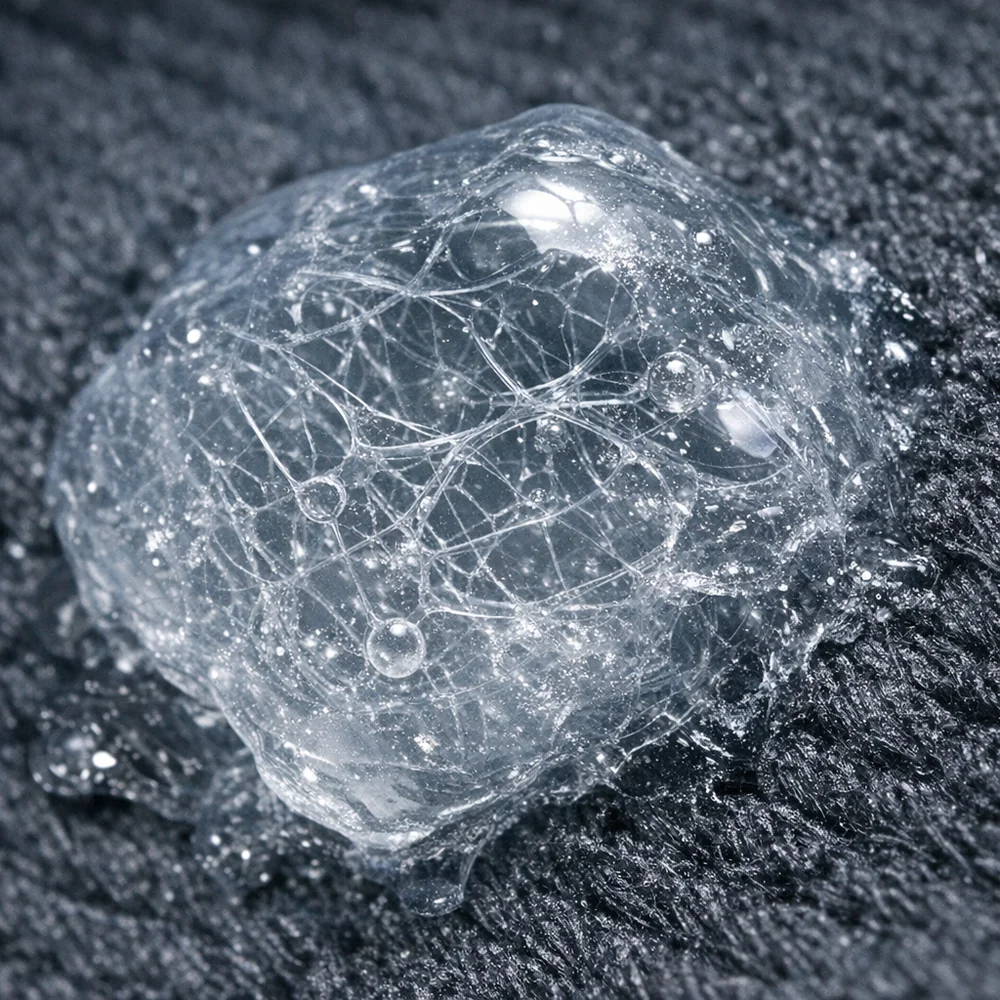
Beyond PVA’s aquatic fate as dissolved polymer, questions arise about whether pod films generate microplastics during dissolution. Microplastics are defined as plastic particles smaller than 5 millimeters, and their presence throughout the environment has become a significant concern for ecosystem and human health.
The dissolution process for PVA differs from the fragmentation process that creates microplastics from conventional plastic. PVA hydrates and disperses molecularly rather than physically breaking into smaller pieces. In this sense, properly dissolved PVA does not generate microplastics as traditionally defined because the particles are molecular chains rather than solid fragments.
However, incomplete dissolution can produce undissolved film fragments that would qualify as microplastics. This incomplete dissolution occurs more frequently in cold water, short wash cycles, or when pods become stuck in fabric folds without adequate water contact. The fragments that survive the wash cycle may enter wastewater as solid particles rather than dissolved polymer.
Sheets avoid this concern by construction. The substrate material, typically plant-based fiber or paper, dissolves through different mechanisms than PVA and faces less scrutiny regarding microplastic generation. However, the surfactant coating on sheets may incorporate binders or processing aids whose environmental fate deserves examination equivalent to that given to PVA.
Key Insight: PVA dissolves molecularly, not fragmenting into microplastic particles. However, “dissolved plastic” still raises environmental concerns.
Cold Water Performance
Energy-conscious laundry practice increasingly favors cold water washing, which reduces electricity consumption for water heating. Both pods and sheets are marketed as effective in cold water, but their dissolution behavior differs when warm water is unavailable to accelerate the process.
PVA film dissolves more readily in warm water, with the dissolution rate decreasing as temperature drops. Manufacturers have reformulated pod films over the years to improve cold-water solubility, but challenges remain. Consumer reports of undissolved pod residue on clothing correlate strongly with cold water washing, particularly in high-efficiency machines with limited water volume.
Sheets face similar thermodynamic constraints but often perform somewhat better in cold water due to their thinner profile and larger surface-area-to-volume ratio. The surfactant coating can begin releasing immediately upon water contact, while the fiber substrate swells and disintegrates without requiring complete dissolution before cleaning action begins. See our guide to dissolvable tablets for more on dissolution kinetics.
Neither format matches liquid detergent for instant dissolution in cold water. The pre-dissolved state of liquid products means no dissolution step is required at all. For users committed to cold-water washing through all seasons, this dissolution reliability represents a genuine advantage of traditional liquid formats.
Key Insight: Pods dissolve faster in warm water. In cold water or HE machines with low water volume, residue on clothes is a common complaint.
What Things Actually Cost
Economic comparison between pods and sheets requires normalizing for cleaning capacity. Each format claims to clean one standard laundry load, but these definitions vary and may not match your particular laundry conditions. Standardized cost-per-load calculations provide a starting point.
Pod pricing typically ranges from $0.20 to $0.40 per pod for mainstream brands at retail prices, with premium and eco-focused brands reaching $0.50 to $0.60. Bulk purchasing and subscription models reduce these figures somewhat. At the midpoint of $0.30 per load, a household washing 8 loads weekly spends approximately $125 annually on pod detergent.
Sheet pricing clusters slightly higher, with most products falling between $0.25 and $0.45 per sheet. Startup brands and premium formulations may exceed this range. At $0.35 per load for 8 weekly loads, annual spending reaches about $146, representing roughly a 15 percent premium over mid-range pods.
Both formats cost more per load than economy liquid detergent, which can drop below $0.10 per load when purchased in large containers on sale. The comparison shifts when environmental externalities like plastic bottle manufacturing, disposal, and shipping weight carbon emissions are valued. However, consumers with constrained household budgets may find these premiums difficult to absorb.
Key Insight: Pods average $0.30/load; sheets average $0.35/load. Both cost more than liquid detergent but offer convenience and waste reduction.
Heavy Stain Performance
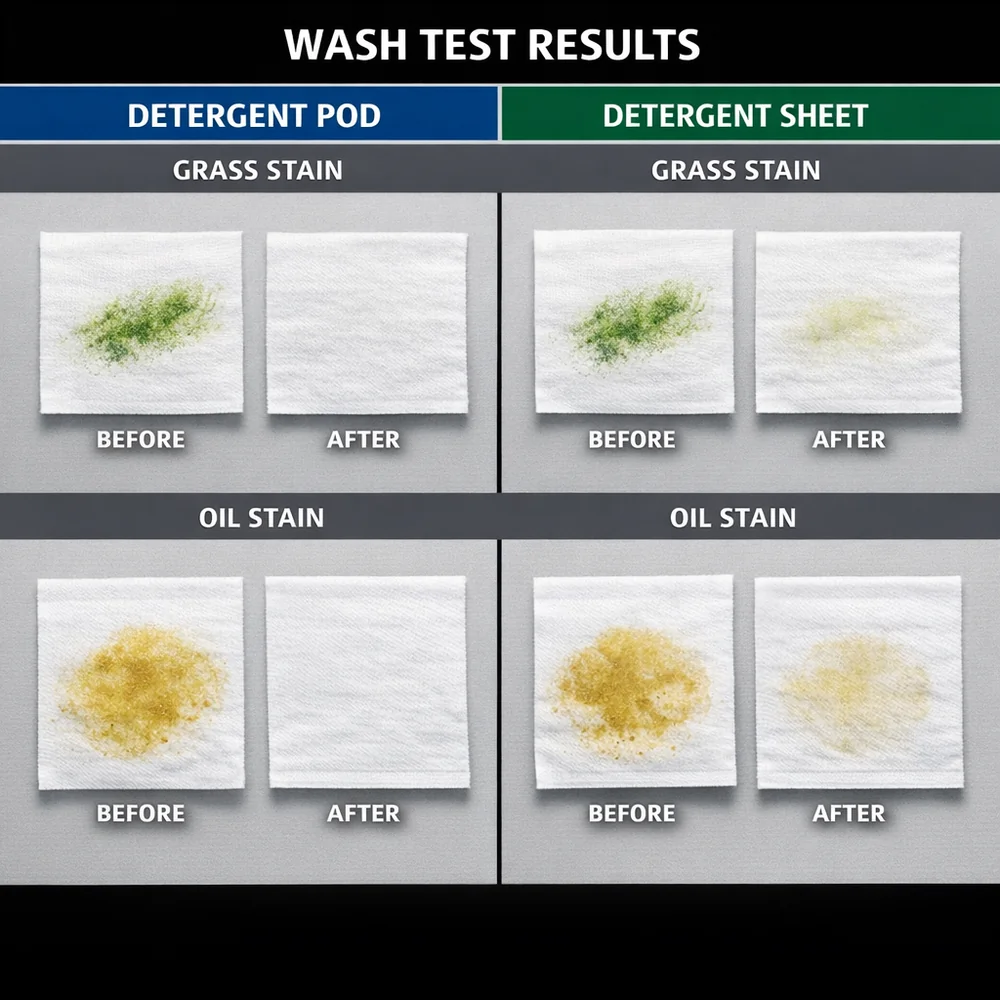
Marketing claims for both pods and sheets emphasize convenience without sacrificing cleaning power. Testing by consumer organizations and independent laboratories largely supports these claims for typical laundry loads with moderate soiling. The more relevant question involves performance on challenging stains and heavily soiled items.
Pods generally perform comparably to equivalent liquid formulations because they contain similar active ingredients in concentrated form. The gel or liquid format allows incorporation of enzymes, surfactants, and optical brighteners at effective concentrations. Premium pods may include multiple chambers with separated ingredients that do not interact until the wash cycle provides water contact.
Sheets face inherent limitations from their dry format. The thin substrate constrains the total mass of active ingredients that can be incorporated, and some beneficial components like certain enzymes perform better in liquid environments. Consumer testing has occasionally shown sheets trailing pods and liquids on specific stain types, particularly protein-based stains requiring enzymatic treatment.
The practical significance of these differences depends on your typical laundry composition. Households with young children, athletes, or manual laborers generating heavily soiled clothing may notice sheets underperforming. Households with predominantly light soiling from office work and casual wear may find sheets entirely adequate.
Key Insight: Pods match liquid detergent on tough stains because they contain the same active ingredients in concentrated form. Sheets may trail slightly.
Storage and Space
The compact format of both pods and sheets provides tangible storage advantages over bulky liquid detergent bottles. For households with limited laundry room space or those who prefer minimal visual clutter, these smaller packages offer practical benefits beyond their environmental claims.
Pods require containers to prevent moisture exposure that could prematurely dissolve the PVA film. Original packaging typically provides adequate protection, as do aftermarket pod storage containers with secure lids. The space reduction compared to liquid bottles is approximately 70 to 80 percent by volume.
Sheets achieve even greater space reduction, storing flat in pouches or cardboard boxes that fit in drawers, cabinets, or mail slots for subscription delivery. A 60-load supply of sheets might occupy the space of a small paperback book, compared to a gallon jug of liquid detergent delivering similar load capacity.
This compact storage also benefits transportation efficiency beyond the manufacturing-to-retail supply chain. Sheets fit easily in luggage for travel, in car compartments for laundromat use, or in shared housing situations where residents maintain personal laundry supplies.
Key Insight: Sheets store flat like paper, taking 90% less space than an equivalent supply of liquid detergent bottles.
Packaging Comparison
The packaging that contains pods or sheets contributes to overall environmental impact beyond the products themselves. Examining packaging materials, recycling compatibility, and end-of-life fate completes the sustainability picture.
Pod containers range from plastic tubs with challenging recyclability to cardboard boxes with plastic bags inside. Even eco-conscious pod brands often use some plastic for moisture protection. The trend toward cardboard-primary packaging represents progress, but completely plastic-free pod packaging remains rare due to the moisture sensitivity of PVA film.
Sheet packaging frequently achieves the plastic-free standard that environmentally motivated consumers seek. Cardboard boxes, sometimes with paper film wrapping, can be recycled with conventional paper and cardboard streams or composted where facilities exist. This packaging simplicity represents one of sheets’ clearest environmental advantages over pods.
Key Insight: Most sheet brands offer cardboard-only packaging that is fully recyclable. Pod packaging typically includes some plastic for moisture protection.
Active Ingredient Concentrations
The fundamental difference between pods, sheets, and liquid detergent involves how active ingredients are packaged and delivered. Understanding these concentration differences helps evaluate whether cleaning power claims are plausible.
Liquid detergent typically contains 20 to 40 percent active surfactant ingredients by weight, with the balance consisting of water, stabilizers, fragrances, and other additives. The water serves as a carrier but dilutes the product, requiring larger volumes to deliver adequate cleaning power.
Pods concentrate active ingredients much higher, with some formulations reaching 70 to 80 percent active content. This concentration allows small pods to match or exceed the cleaning power of larger liquid doses. The remaining mass consists of the PVA film and any stabilizers required for the concentrated formulation.
Sheets occupy an intermediate position. The substrate itself contributes weight without cleaning function, analogous to water in liquid products. The surfactant coating must adhere to the substrate during storage and release during washing, which may limit achievable concentrations. Some sheet formulations address this by making the substrate itself dissolve into additional cleaning capacity.
Key Insight: Pods pack more surfactant per gram than liquids. Sheets face physical limits on how much active ingredient can coat a thin substrate.
Travel Convenience
Beyond environmental and performance considerations, format convenience affects practical purchasing decisions. Travel presents a scenario where format differences become particularly pronounced.
TSA liquid restrictions of 3.4 ounces per container in a quart-sized bag complicate air travel with liquid detergent. Bringing enough detergent for an extended trip requires careful planning and potentially sacrificing bag space for multiple small containers. Checked bag leakage risk adds further complication.
Pods improve on liquids for travel by containing individual doses in compact, reasonably pressure-resistant packages. A few pods can handle a week’s laundry without approaching liquid restrictions. However, pods do occasionally rupture under extreme pressure or temperature exposure during travel.
Sheets excel for travel convenience. Their flat format takes minimal space, creates zero leakage risk, and presents no issues with security screening. A strip of ten sheets for a two-week trip adds negligible weight and occupies less space than a charging cable. For frequent travelers, this convenience factor may outweigh other considerations.
The pod versus sheet comparison reveals no clear winner for all situations. Each format presents a different bundle of advantages that matter more or less depending on individual circumstances and values. Environmental impact, cleaning performance, cost, and convenience all enter the evaluation with different weights for different consumers.
Pods offer proven cleaning performance comparable to liquid detergent, with substantial reductions in packaging waste and shipping weight. The PVA film controversy injects uncertainty into their environmental assessment, but this remains an evolving question where future research may clarify outcomes. Cost and availability favor pods given their longer market presence and wider distribution.
Sheets maximize environmental benefits for packaging and shipping while accepting potential tradeoffs in cleaning power for challenging soils. Their plastic-free packaging appeals strongly to those following a zero-waste laundry routine. For higher-performance natural options, check our guide on plant-based detergent efficacy. Higher cost per load and occasional performance limitations on heavy stains represent the primary compromises.
Neither format is wrong. Both represent genuine improvement over conventional liquid detergent in multiple dimensions. The choice depends on which improvements matter most to you and which tradeoffs you can most comfortably accept.
Key Insight: Sheets travel best: no liquids restrictions, lightweight, spill-proof. Pods work well too but take more space and could burst under pressure.
The Bottom Line
References
- ASU News. “Laundry Pods and PVA Fate in Wastewater.”
- Forbes. “Laundry Detergent Sheets vs. Pods: Which Is Best?”
- ScienceDirect. “Biodegradation of Polyvinyl Alcohol.”
- Treehugger. “Are Laundry Detergent Sheets Better Than Pods?”
- EPA. “Identifying Greener Cleaning Products.”