Commercial Laundry Workflow: How to Optimize Industrial Efficiency
Table of Contents
Things You'll Learn From This Article:
- Sorting laundry correctly at the start saves money, protects fabrics, and prevents dirty items from contaminating cleaner ones.
- High-volume items run best through continuous tunnel washers, while special or delicate items need separate machines with custom settings.
- Automated chemical dosing keeps washes consistent and safe by adding the right amounts every time without relying on guesswork.
- Tracking linen inventory helps you avoid running out of sheets or storing more than you actually need.
- Sudden temperature changes damage fabrics, so cooling linens down gradually helps them last longer and look better.
- Well-maintained ironers and folders prevent wrinkles, re-washes, and slowdowns at the finishing stage.
- Controlling hygiene at every step is more reliable than only testing clean items at the end.
- Reusing water and heat from previous cycles cuts utility costs and reduces waste without lowering wash quality.
- Keeping dirty and clean areas physically separated is essential to stop germs from spreading back onto clean linens.
- Smooth laundry operations come from controlling small details consistently rather than fixing problems after they happen.
Optimizing a high-volume commercial laundry workflow is a complex engineering challenge that integrates the principles of thermodynamics, fluid dynamics, and industrial automation. In large-scale facilities processing thousands of pounds of linen daily, even minor inefficiencies in water flow or chemical dosing can lead to massive operational costs and environmental impacts. Successful workflow management requires you to transition from batch-oriented thinking to continuous-flow systems where the movement of textiles is synchronized with the availability of cleaning energy and water resources. Your primary objective is to maximize throughput while maintaining a medical-grade level of sanitization and fiber preservation.
At the core of this industrial science is managing the “Taction Triangle,” which is a delicate balance between chemical action, thermal energy, mechanical agitation, and time. By utilizing advanced technologies such as tunnel washers (Continuous Batch Washers) and automated extraction presses, you can achieve a level of consistency and efficiency that is physically impossible in small-scale environments. This article details the technical strategies and mechanical systems you need to optimize the life cycle of industrial textiles from soil intake to clean dispatch.
Soil Sorting Classifications in Healthcare
Optimizing your laundry workflow begins at the point of soil intake where rigorous sorting protocols determine the specific wash formula required for each load. In a healthcare setting, you must classify textiles not only by color and fiber type but also by biohazard risk and soil density. Classifications typically include “general linen” (sheets and towels), “patient wear” (scrubs and gowns), and “high-soil items” (operating room linens and incontinent pads). Each classification is subjected to a unique combination of enzymes, temperatures, and mechanical agitation patterns.
Failure to sort correctly can lead to “soil transfer” where contamination from a heavily soiled item migrates to a lightly soiled one during the wash. To prevent this, commercial facilities use automated overhead rail systems to transport sorted bags to the appropriate washer. This minimizes manual contact and ensures that your laundry staff is not exposed to aerosolized pathogens.
The precision of initial sorting is the most critical variable in determining the final stain reclamation rates of the facility. Efficient sorting ensures that every pound of linen receives the exact amount of chemical energy it requires, which prevents redundant chemical usage and unnecessary thermal stress.
The Bottom Line Soil sorting is the primary filter in industrial laundry logistics. By classifying linens based on microbial load and fiber chemistry, you can apply targeted wash formulas that maximize soil removal while minimizing redundant chemical and thermal stress.
Tunnel Washer Mechanics vs Extractor
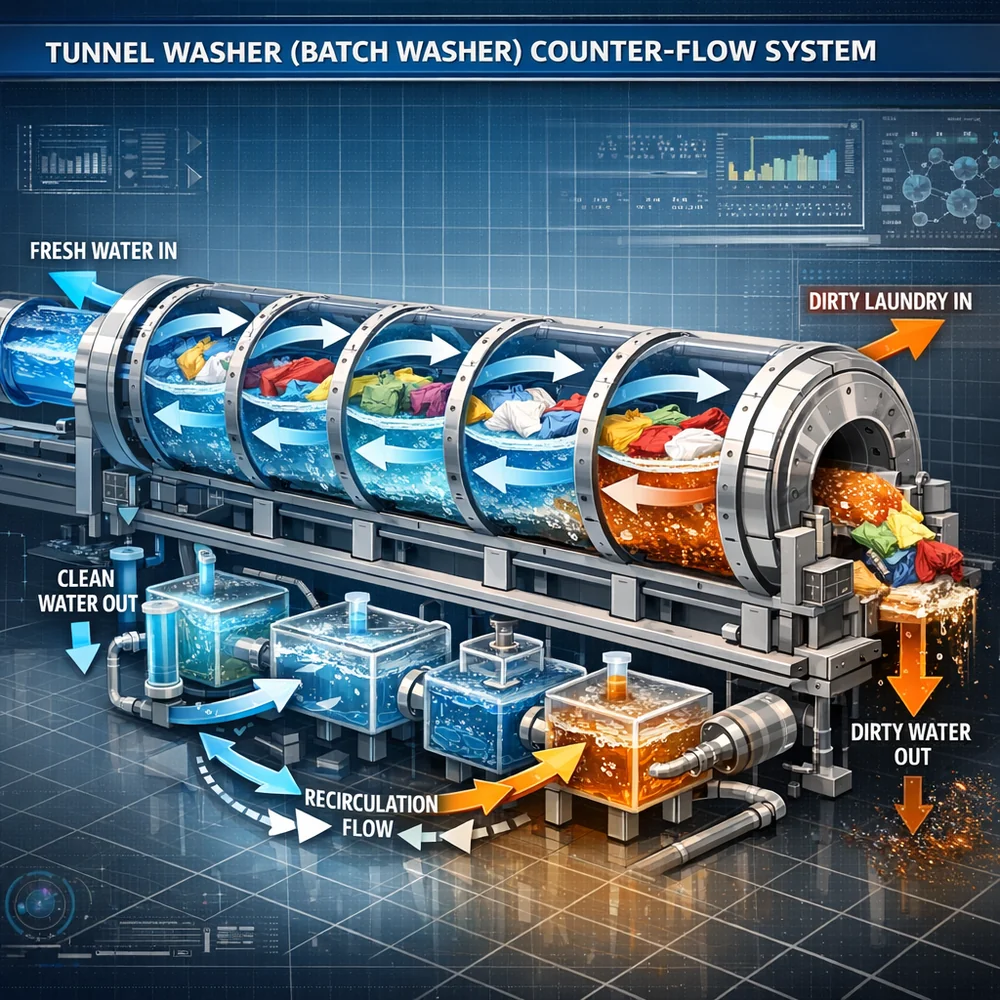
The choice between a Continuous Batch Washer (tunnel washer) and a standalone Washer-Extractor is a fundamental infrastructure decision that dictates your facility’s efficiency profile. Tunnel washers operate on a counter-flow principle where the linen moves forward through a series of compartments while the water moves in the opposite direction. This creates a continuous concentration gradient where the linen is met by increasingly clean water at every stage. This design allows for massive water recovery because the final rinse water is often reused as the initial “flush” water for the next incoming batch.
Standalone extractors are batch-oriented and require fresh water and chemicals for every fill. While less efficient in terms of water and energy, extractors offer greater flexibility for processing small, specialized loads that require unique chemical treatments such as firefighter turnout gear decon. In a fully optimized workflow, a facility utilizes tunnel washers for high-volume items (bedding and towels) and a battery of smaller extractors for specialized items. This hybrid model ensures that you can achieve both the economies of scale and the technical precision necessary for a diverse client base.
Automated Chemical Dosing Systems
In a high-capacity commercial laundry, manual chemical dosing is physically impossible and technical dangerous. Modern facilities utilize central chemical dosing stations that serve a battery of machines via a network of pneumatic and peristaltic pumps. These systems are programmed with “recipes” that are triggered by the machine’s internal controller. The system monitors the flow of every detergent, builder, bleach, and souring agent to ensure that the stoichiometry of the wash liquor is maintained within 1% of the target values.
Advanced dosing systems also incorporate real-time sensors for pH, conductivity, and Oxidation-Reduction Potential (ORP). If a sensor detects that the pH is not reaching the required level for alkaline hydrolysis, it can automatically inject additional booster chemicals. This dynamic response compensates for variations in water alkalinity or soil load intensity.
Furthermore, the data logged by these systems provides a “chemical audit trail” that is essential for meeting regulatory standards in healthcare. Automated dosing eliminates the variability of human error and ensures that every load achieves its microbial kill target.
The Bottom Line Automated dosing replaces human variability with electronic precision. By integrating real-time feedback loops from titration sensors, industrial systems maintain the chemical equilibrium necessary for professional-grade soil extraction and sanitization.
Managing Linen Par Levels

Industrial workflow optimization extends beyond the washroom into the logistics of inventory management, specifically the maintenance of “par levels.” A par level refers to the total amount of linen needed to sustain a facility’s operations. A standard “3-par” system includes one set of linen in use, one set in the laundry being processed, and one set on the shelf ready for use. Managing these levels is critical to preventing bottlenecks because too much linen leads to excessive storage costs and too little linen creates emergency shortages that disrupt the washroom schedule.
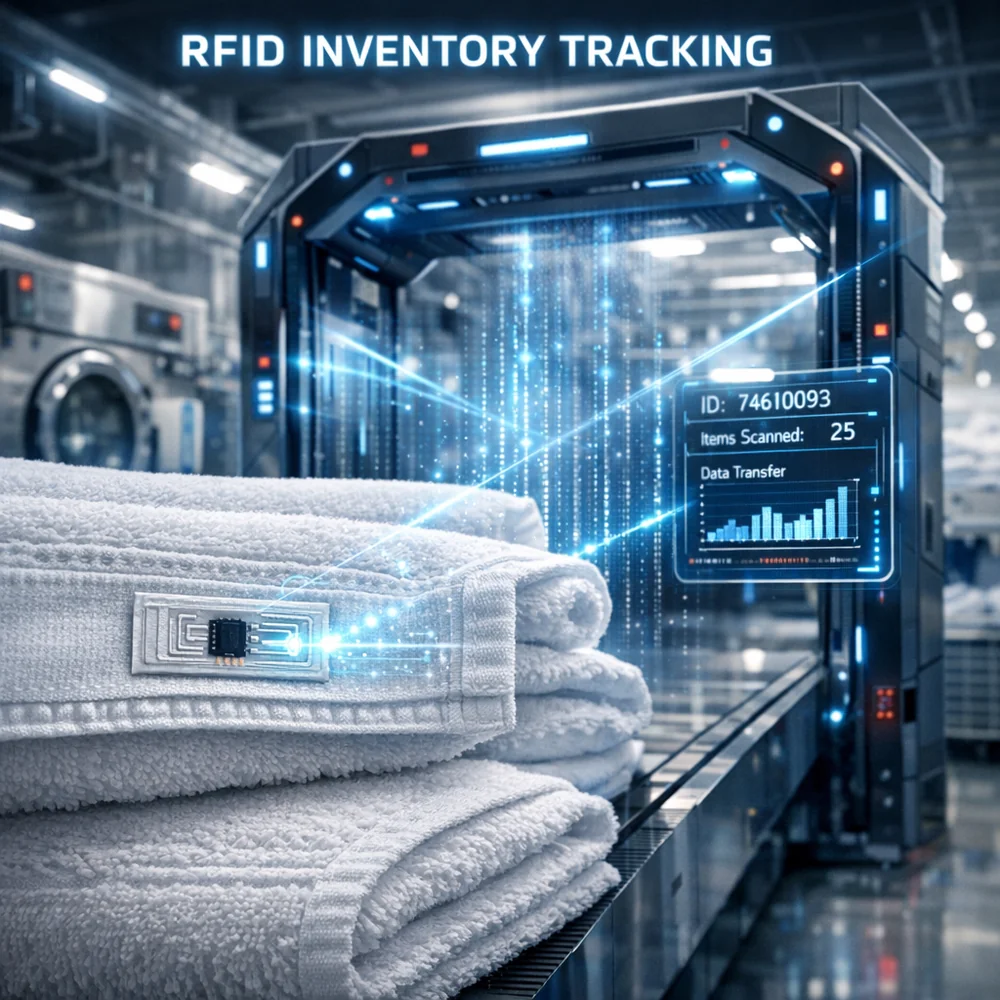
To optimize par levels, facilities use barcode or RFID (Radio Frequency Identification) tracking systems. Every sheet and towel is embedded with a tag that can be scanned as it enters and leaves the laundry. This provides real-time data on the “rotation speed” of the inventory and helps identify “ghost inventory” that has been lost or stolen.
By analyzing these usage patterns, laundry managers can predict peak demand periods and adjust their production schedules accordingly. Efficient par management ensures a smooth flow of materials through the plant and prevents the “hurry-up and wait” syndrome that plagues unoptimized facilities.
Preventing Thermal Shock in Linens
Thermal shock is a physical phenomenon that occurs when cotton or synthetic fibers are subjected to rapid changes in temperature, leading to permanent creasing and fiber fracture. In a commercial washer, the transition from a 71°C (160°F) sanitization cycle to a cold rinse can “shock” the fibers while they are in a softened, expanded state. This causes the fibers to contract unevenly and results in the “graying” of the fabric as the distorted fibers trap soil and refract light inconsistently.
To prevent this, optimized workflows incorporate a “cool-down” step at the end of the high-heat cycle. The temperature of the wash liquor is gradually reduced by injecting tempered water before the liquor is drained. This allows the fibers to stabilize and contract slowly.
Professional laundry managers monitor the “temperature gradient” of their cycles to ensure that the rate of cooling does not exceed 5°C (10°F) per minute. This technical discipline is what allows commercial linens to survive 150+ wash cycles while maintaining a smooth, hotel-quality hand-feel.
The Bottom Line Fiber longevity is protected by managing the rate of thermal transition. By implementing controlled cool-down ramps, facilities prevent the microscopic fracturing of fibers that leads to graying, pilling, and loss of absorbency.
Ironer and Folder Maintenance
The “finishing” stage of the laundry workflow, specifically ironing and folding, is where the physical quality of the product is finalized. High-speed flatwork ironers (mangles) use heated rollers and high pressure to simultaneously dry and press linens. The temperature of the ironer chest must be maintained between 160°C and 180°C (320°F to 356°F) to ensure the moisture is flashed off instantly. If the ironer is too cool, the linen will emerge damp and prone to mildew, but if it is too hot, the chemicals used in optical brighteners science may yellow.
Maintenance of the ironer padding and the folding air-jets is essential for throughput. If the ironer belts are worn or misaligned, the linen will “tailor” or wrinkle and require a slow and expensive re-wash. Modern folders use photocells to detect the leading and trailing edges of the sheet, firing air-knives with millisecond precision to create a perfect fold.
A well-maintained finishing line can process 800 to 1,000 sheets per hour with a single operator. This level of mechanical efficiency is the final link in the chain that converts a soiled hotel sheet back into a premium guest-room item.
RABC Risk Analysis Biocontamination Control
Risk Analysis and Biocontamination Control (RABC) is the industrial framework for managing the microbial safety of textiles. Based on the EN 14065 standard, RABC involves identifying every point in the laundry workflow where a textile can become contaminated. This includes the transport carts, the sorting tables, the air in the plant, and the hands of the operators. For each risk point, you must implement a “control measure” (such as a cart wash cycle or a hand-sanitization station) and a method for verifying that the control is working.
An optimized RABC system uses microbiological “swab tests” to monitor the cleanliness of the finished products and the environment. By trending these results over time, laundry managers can identify emerging biohazard risks before they lead to patient or guest infections. RABC represents a shift from “testing the end product” to “controlling the process.” In a fully optimized workflow, biocontamination control is so deeply integrated into the mechanical and chemical protocols that sanitized output is a statistical certainty, not an ad-hoc achievement.
The Bottom Line RABC is the scientific methodology for “process control” in hygiene. By identifying and monitoring every potential contamination point in the plant, facilities can guarantee consistent microbial safety without relying on destructive end-product testing.
Water Recovery and Recycling Systems
Commercial laundry is an inherently water-intensive industry, but modern optimization focuses heavily on water recovery. Advanced facilities utilize “water rooms” where effluent from the final rinse cycles is collected, filtered, and treated for reuse in the initial fill cycles. These systems use ceramic microfiltration and UV-sterilization to ensure the recovered water is free of pathogens and odors. By recycling up to 70-80% of their water, industrial laundries significantly reduce their utility costs and environmental impact.
Thermal recovery is often paired with water recycling. Heat exchangers are used to transfer the thermal energy of the hot waste-water to the incoming cold fresh water, pre-heating it and reducing the demand on the facility’s steam boilers. In a tunnel washer, this thermal integration is built into the machine’s anatomy.
The counter-flow design ensures that every joule of heat is used to its maximum potential. Water and energy recovery are not just “green” initiatives because they are critical economic factors that distinguish a profitable commercial operation from an unoptimized one.
Separating Sterile and Non-Sterile Zones
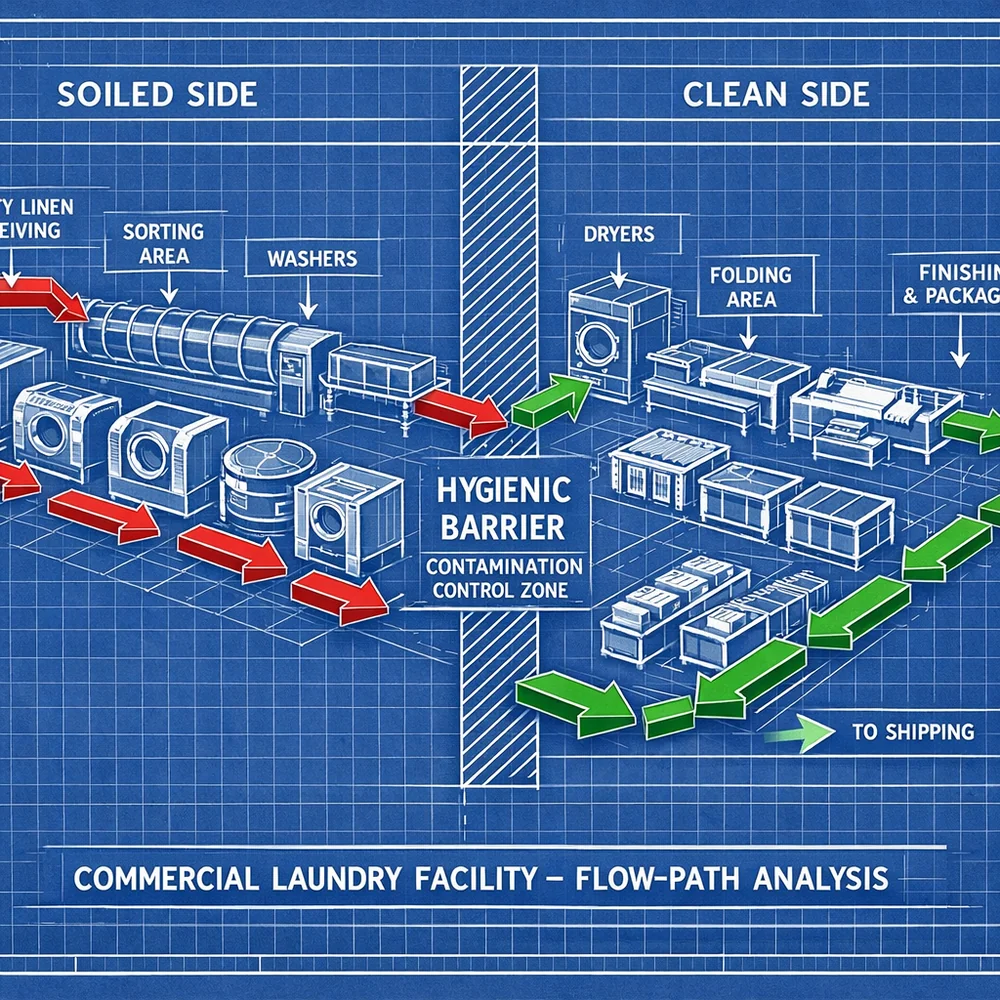
The final architectural feature of an optimized commercial laundry is the absolute physical separation of sterile and non-sterile zones. This is typically achieved through a “barrier” design where the soiled intake area is kept at negative air pressure relative to the clean finishing area. This prevents the movement of airborne dust and pathogens from the soiled bags toward the clean sheets. Staff members are often restricted from moving between these zones unless they pass through a “decontamination locker” and change their PPE.
In healthcare-certified laundries, the barrier wall is the physical manifestation of this separation. The washing machines are installed through the wall as detailed in the barrier washing machines explained guide. No textile ever returns to the “dirty” side of the plant once it has been disinfected.
This one-way workflow is the ultimate safeguard against cross-contamination. By treating the facility as a high-precision hygiene plant rather than just a “wash room,” industrial operations achieve the levels of consistency required for the most sensitive medical and laboratory applications.
Conclusion
Optimizing a commercial laundry workflow is an ongoing process of technical refinement and industrial discipline. By integrating the mechanics of tunnel washers with the precision of automated chemical dosing and the administrative rigor of par level management, you can achieve unparalleled levels of efficiency. The focus on thermal shock prevention and rigorous RABC monitoring ensures that the high throughput of the plant does not come at the expense of textile quality or microbial safety.
Ultimately, the science of industrial laundry is about controlling variables. A facility that can maintain a stable “Taction Triangle” while maximizing water and heat recovery is a facility that will thrive in a competitive marketplace. As automation and sensor technology continue to evolve, the distinction between “standard” laundry and “optimized hygiene processing” will only widen. This commitment to technical excellence is what allows commercial laundries to serve as the invisible backbone of the hospitality and healthcare sectors, providing the clean textiles that are essential for safety, comfort, and professional service.
References
- Textile Service Magazine. “The Engineering of Continuous Batch Washers.” TRSA
- Clean Show Technical Papers. “Thermodynamics of Water Recovery in Commercial Laundry.” Clean Show
- Journal of Industrial Engineering. “Optimizing Inventory Flow in Textile Logistics.” ScienceDirect
- European Standard EN 14065. “Textiles , Laundry Processed Textiles , Biocontamination Control System.” CEN
- International Journal of Environmental Research. “Water Footprint and Effluent Treatment in Industrial Laundries.” Springer