Industrial vs Home Detergent: Science of Professional Cleaning
Table of Contents
Things You'll Learn From This Article:
- Home detergents are made to be gentle and simple, while industrial detergents are much stronger and tailored for specific types of dirt and machines.
- Very high pH levels in professional laundry help break down heavy grease, but those levels would damage home machines and irritate skin without proper neutralizing steps.
- Industrial laundries have to add an acid rinse at the end to bring fabrics back to a skin-safe pH and prevent yellowing or itching.
- Bleach use in professional settings is carefully measured by machines, not poured by hand, so fabrics get sanitized without being weakened.
- Different bleaches are chosen based on the type of stain, not used as one-size-fits-all products like in most homes.
- Automated pumps measure detergent down to the milliliter, which prevents waste, uneven cleaning, and machine problems caused by too much soap.
- Sensors in commercial machines can adjust chemicals mid-wash if a load turns out dirtier than expected.
- Large laundries reuse water and heat from earlier cycles, cutting water use dramatically compared to home washing.
- Advanced filters and UV systems clean recycled water so it can be safely reused without spreading odors or germs.
- Industrial detergents are built to handle extreme grease and oil that would overwhelm typical household products.
- Low-foam formulas matter in big machines because too many suds reduce the physical action that actually pulls dirt out.
- The final acid “souring” step also helps prevent mineral buildup that makes fabrics look gray and old.
- Professional detergents must work smoothly with high-heat ironing and folding machines to avoid wrinkles and jams.
- Unlike home softeners, industrial finishing chemicals are designed to keep towels absorbent, not slick.
- In commercial laundry, the real cost is measured per kilogram of clean linen, not per bottle of detergent.
- A more expensive detergent can save money overall if it shortens cycles, reduces rewashing, and extends fabric life.
- Handling industrial detergents requires safety training, protective equipment, and strict storage rules because the chemicals are corrosive.
- Professional laundry is less about “washing clothes” and more about running a controlled chemical process from start to finish.
The chemical landscape of industrial laundry detergents is fundamentally different from that of consumer products found in retail environments. While home detergents are engineered for broad-spectrum safety and ease of use in diverse domestic machines, industrial detergents are precision-engineered for specific soil loads and large-scale mechanical systems. Professional-grade cleaning relies on a “controlled aggression” approach utilizing high levels of alkalinity, specialized builders, and concentrated surfactant matrices that would be physically and chemically incompatible with residential plumbing and standard top-loading machines.
From a thermodynamic perspective, industrial detergents are optimized to perform within the rigorous constraints of high-volume tunnel washers and commercial extractors. These environments allow for the manipulation of wash liquor parameters such as pH, ionic strength, and temperature with a degree of accuracy that is unattainable in a domestic setting. This article examines the molecular distinctions between these two classes of detergents illustrating the synergistic interactions that enable professional facilities to achieve medical-grade sanitization and consistent whiteness retention.
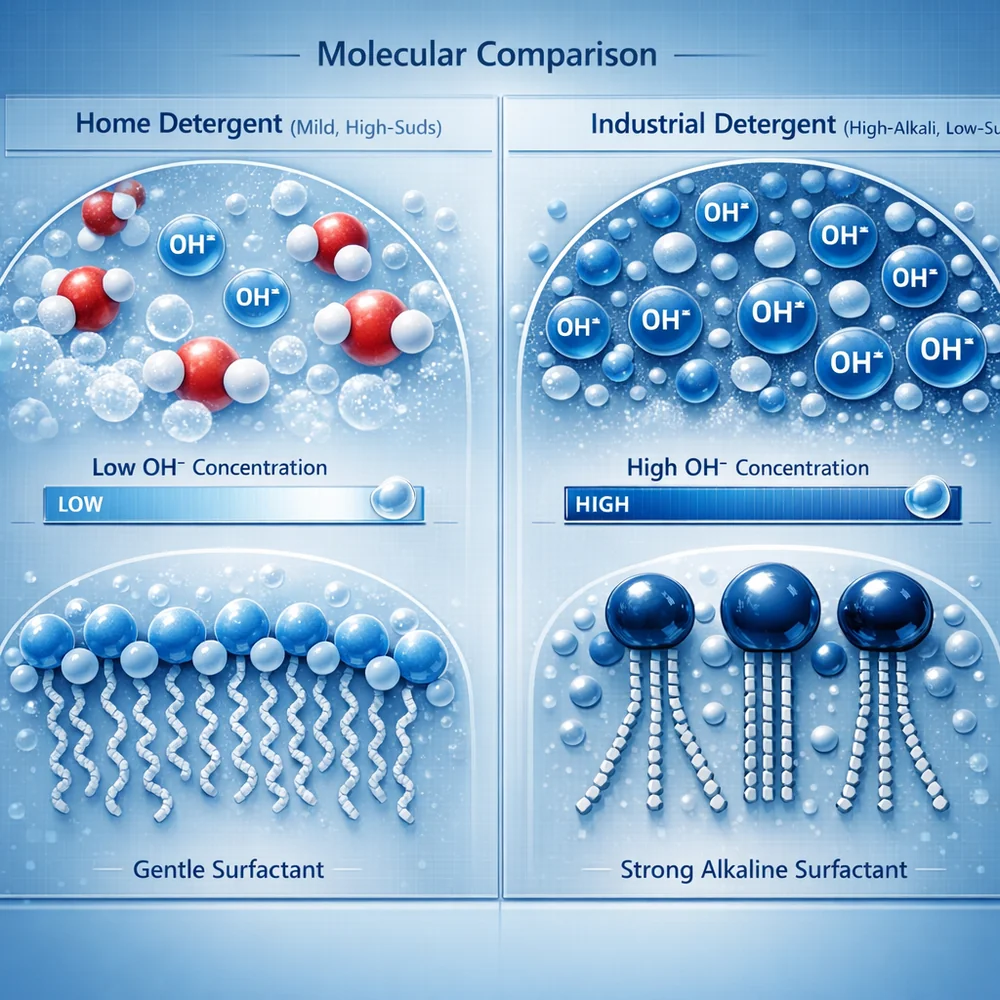
Alkalinity Levels and pH Buffering
The most significant chemical differentiator between industrial and home detergents is the level of alkalinity and the sophistication of the pH buffering systems. Consumer detergents are typically designed to be near-neutral or slightly alkaline (pH 8.0 to 10.0) to prevent accidental skin irritation and to protect delicate household fabrics. In contrast, industrial detergents utilize “builders” like sodium hydroxide or sodium metasilicate to push the wash liquor pH to 11.0 or even 12.0. This high-alkaline environment is essential for the alkaline hydrolysis of animal fats because it converts insoluble grease into water-soluble soaps.
To maintain this high pH throughout the wash cycle despite the introduction of acidic soils, industrial formulas are heavily buffered. This “alkaline reserve” ensures that the cleaning power does not drop as the detergent is consumed by the soil. However, this aggressive chemistry necessitates a professional “souring” step in the final rinse cycle. Using a triprotic acid like phosphoric acid, industrial systems neutralize the residual alkalinity to a final fabric pH of 5.5 to 6.5. Without this precise neutralization, the high residual pH would lead to yellowing during high-heat drying and severe skin irritation for the end-user.
The Bottom Line Industrial detergents use high alkalinity as a primary chemical “engine” for soil extraction. Success relies on maintaining an alkaline reserve through buffering followed by a mandatory acidic neutralization step to ensure fabric safety and user comfort.
Chlorine Bleach Concentration Differences
Bleaching protocols in professional settings are managed with a level of precision that far exceeds domestic usage. In a home environment, chlorine bleach is often added manually which leads to wide variations in concentration and potential fiber damage. Industrial systems utilize automated dosing to maintain a stable concentration of available chlorine typically between 50 and 150 parts per million (ppm). This concentration is high enough to achieve a professional virucidal kill but low enough to preserve the tensile strength of the cotton fibers.
Furthermore, industrial facilities often transition between sodium hypochlorite (chlorine) and sodium percarbonate (oxygen) based on the specific requirements of the load. While home users might use “color-safe” bleach as an all-purpose additive, professional managers select their oxidant based on the Oxidation-Reduction Potential (ORP) required for the target soil. High-standard facilities monitor ORP in real-time to ensure that the oxidative energy is sufficient to break the chromophore bonds of stains without inducing “over-bleaching” which can lead to the premature thinning of towels and linens.
Automatic Dosing Pump Systems
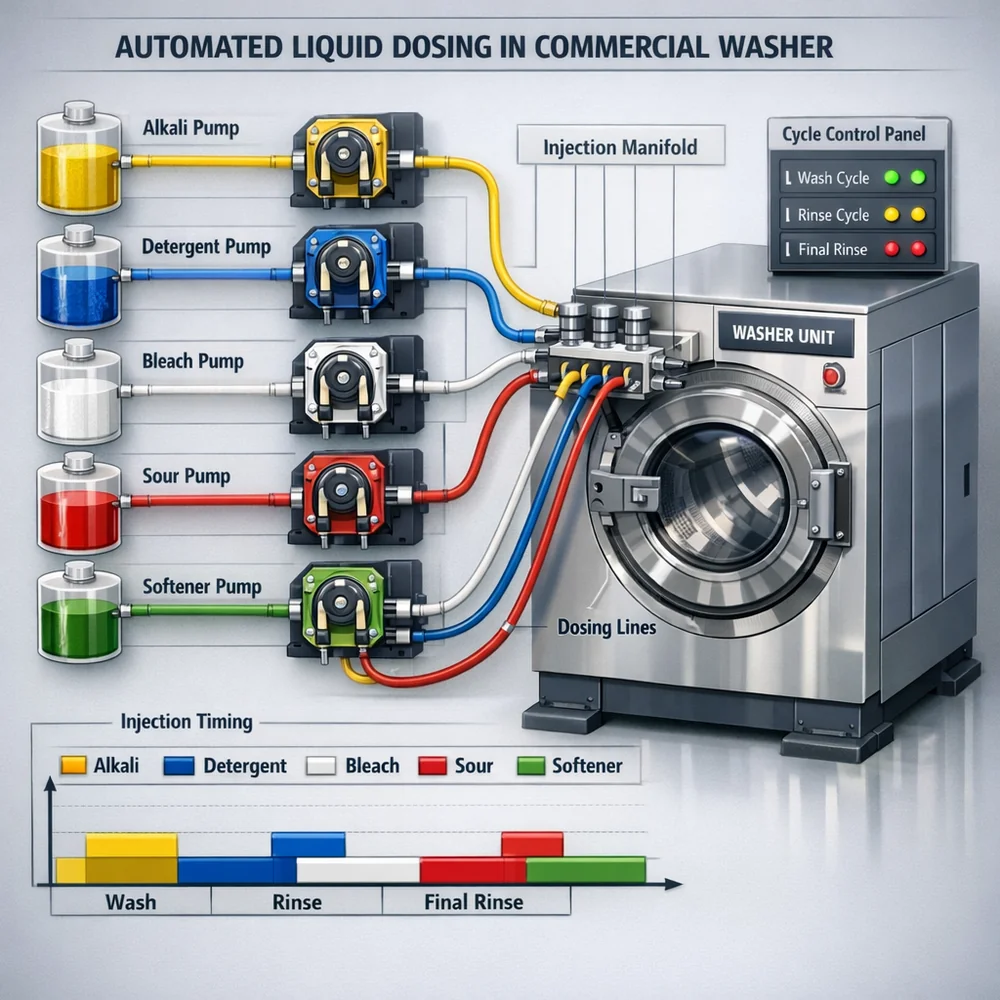
The delivery of industrial detergents is performed by a sophisticated network of peristaltic and pneumatic pumps collectively known as an automated dosing system. These systems are programmed with “wash recipes” that are triggered by the machine’s central controller. Unlike a home user who may measure detergent by the “capful”, a professional system measures every milliliter of chemical based on the exact weight and soil classification of the load. This eliminates the “over-dosing” that often occurs in homes which can lead to excessive sudsing and machine failure.
These dosing systems are also integrated with real-time sensors that monitor the conductivity and turbidity of the wash liquor. If the sensors detect a higher-than-expected soil load, the system can automatically inject additional surfactant or builder boosters. This dynamic response ensures that every load achieves a consistent level of cleanliness regardless of the incoming soil variability. The maintenance of these pumps is a critical operational task because a single failed valve can disrupt the stoichiometry of the entire wash cycle and lead to rejected batches or fabric damage.
The Bottom Line Automatic dosing transforms laundry chemistry from an ad-hoc task into a high-precision manufacturing process. By metering chemicals based on real-time sensor feedback, industrial systems optimize cleaning efficiency while minimizing chemical waste.
Water Recycling and Filtration in Commercial Tunnel washers
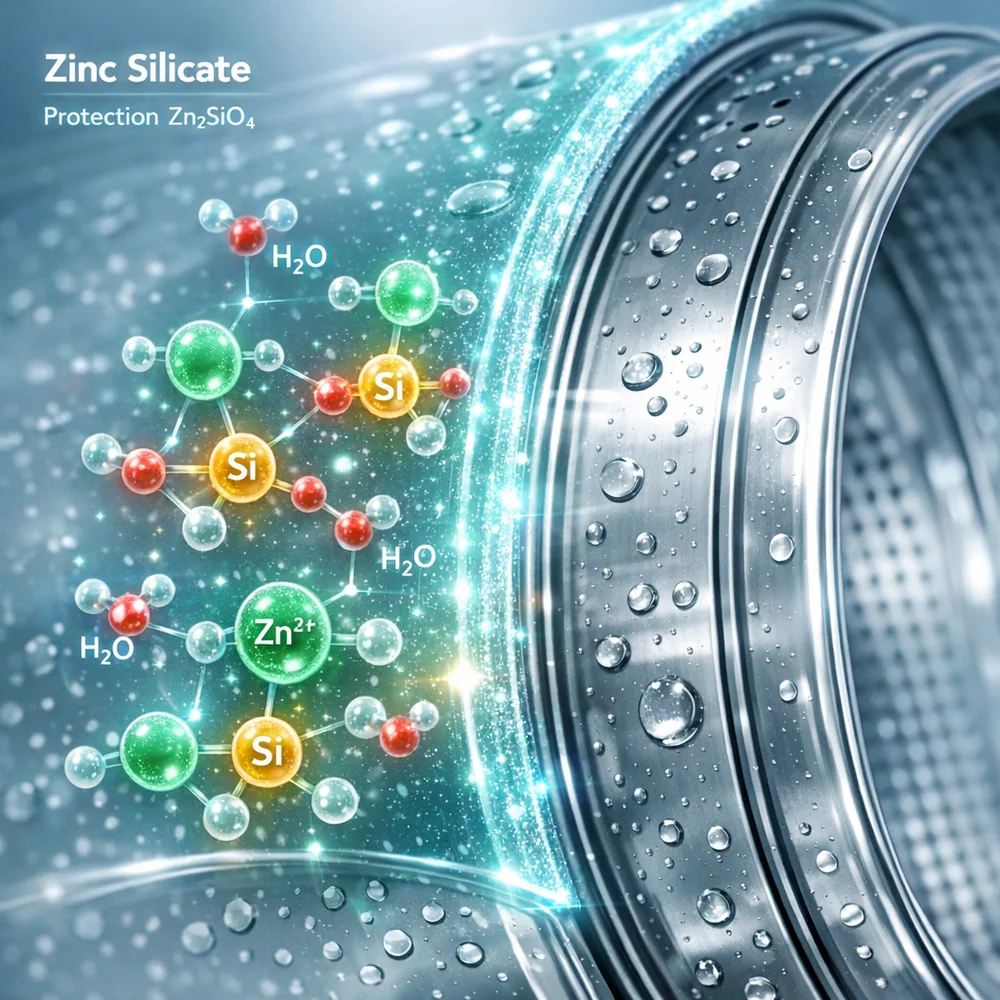
Industrial operations are increasingly defined by their ability to recycle water and heat which is a capability entirely absent in domestic laundry. Commercial tunnel washers (Continuous Batch Washers) are designed to reuse water from the final rinse cycles as the “flush” water for the next incoming batch of soiled linen. This counter-current flow ensures that the cleanest water is always used for the final stages while the heavily soiled initial stages utilize recycled water that still contains residual thermal and chemical energy.
To make this recycling possible, industrial facilities utilize advanced filtration systems including ceramic microfiltration and UV-sterilization. These systems remove particulates, pathogens, and odors from the effluent allowing for a water recovery rate of up to 80%. This not only reduces utility costs but also significantly lowers the volume of wastewater that must be treated for phosphorus and nitrogen removal. For a modern facility, water recycling is a critical component of their commercial laundry workflow optimization bridging the gap between economic profitability and environmental stewardship.
Surfactant Load for Heavy Soil
The surfactant profiles of industrial detergents are formulated to handle extreme concentrations of non-polar soils such as petroleum-based greases and heavy vegetable oils. While home detergents use a blend of anionic and non-ionic surfactants for general versatility, industrial formulas often prioritize high-HLB (Hydrophilic-Lipophilic Balance) non-ionic surfactants. These molecules are superior at emulsifying heavy grease loads and remain stable in the high-alkalinity and high-temperature environments characteristic of professional laundering.
Industrial surfactants are also designed to be “low-sudsing” to accommodate the high mechanical energy of commercial extractors. Excessive foam in an industrial machine can create a “suds lock” which cushions the mechanical impact of the falling linen and reduces the physical extraction of soil. By using defoamers and low-foam surfactant matrices, industrial detergents allow for maximum mechanical action. This allows the facility to achieve a higher degree of soil removal with shorter cycle times which increases the overall throughput of the plant.
The Bottom Line Industrial surfactants are engineered for “interfacial tension reduction” rather than foam production. By minimizing suds, professional formulas maximize the mechanical energy of the machine ensuring deep soil extraction even in high-density loads.
Souring Agents for pH Neutralization
The “souring” phase is the final essential step in the industrial laundry chemical cycle serving to neutralize the aggressive alkalinity of the wash phase. Professional souring agents utilize diluted acids such as silicofluorides, phosphoric acid, or citric acid to bring the fabric pH back to a skin-compatible level of 5.5 to 6.5. This neutralization is not just for user comfort; it is also a vital protection for the fabric because residual alkalinity can cause “chemical yellowing” when the linens are exposed to the intense heat of industrial ironers and dryers.
Proper souring also aids in the removal of mineral scales and trace metal ions that can lead to “graying” of the fabric. Many souring agents include chelative additives that bind to calcium and iron preventing them from depositing on the fibers. For facilities processing hospital-grade laundry standards, the souring step is a mandatory quality control point verified through daily titration of the finished linens. The transition from a highly alkaline wash to a slightly acidic finish is the signature of a professionally managed laundry process.
Pressing and Finishing Compatibility
Industrial detergents must be formulated to be compatible with high-speed finishing equipment such as flatwork ironers (mangles) and automated folders. Residual chemicals from the wash cycle can interfere with the “slip” of the linen through the ironer rollers leading to jams or “tailoring” (wrinkling). Professional formulas often include finishing aids or “softeners” that are specifically designed to be heat-stable at the 160°C to 180°C temperatures used in industrial pressing.
Unlike domestic fabric softeners which are often based on cationic surfactants that can reduce fabric absorbency, industrial finishing agents are designed to maintain the “wicking” properties of the cotton. This is particularly important for hotel towels and restaurant napkins where the goal is to achieve a “crisp” but soft hand-feel that signals quality to the guest. By ensuring that the detergent and finishing agents work in harmony, industrial facilities can achieve a level of aesthetic consistency that is the benchmark of the hospitality industry.
The Bottom Line Industrial detergents are the foundation of the finishing process. Compatibility with high-heat pressing ensures that the linens exit the plant with the precise combination of softness, absorbency, and structural stiffness required for premium service.
Cost per kg of Linen Analysis
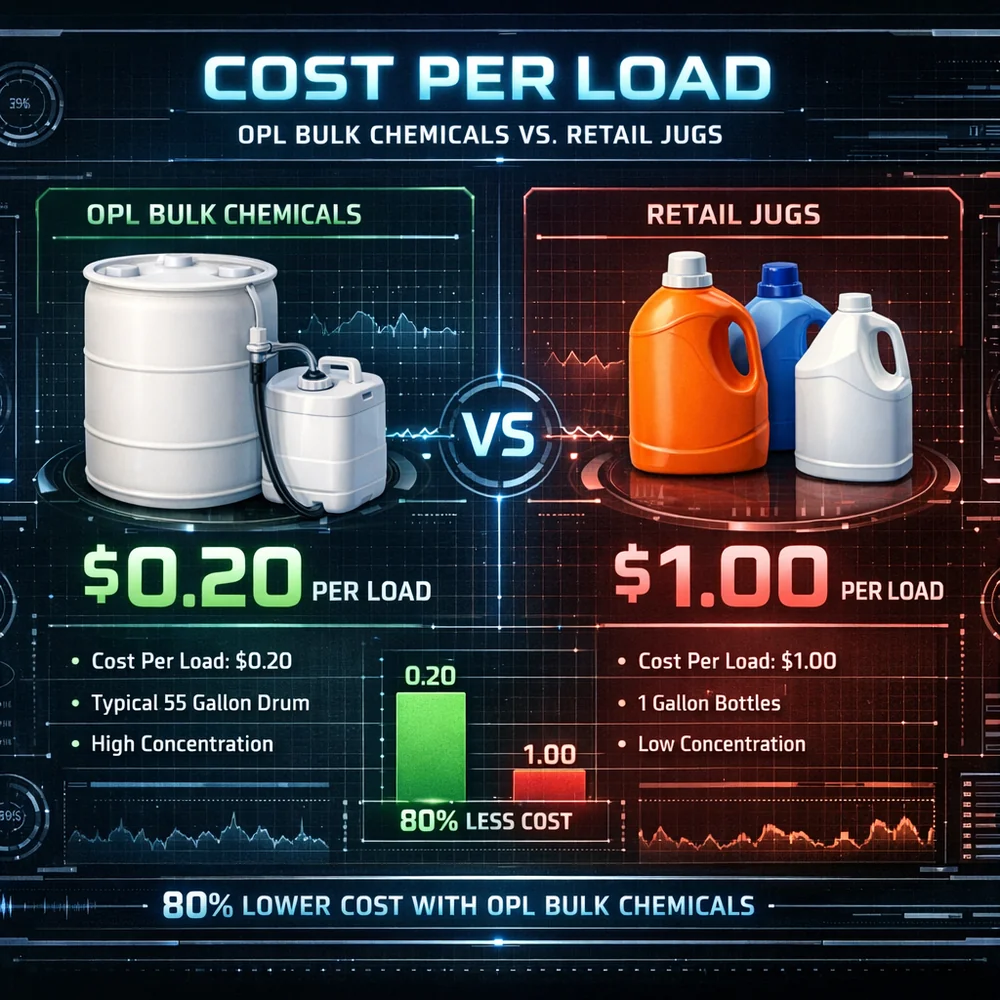
In the industrial sector, the efficiency of a detergent is measured not by the “price per gallon” but by the “total cost per kilogram of clean linen.” This metric includes the cost of the chemicals, the utility consumption (water and heat), the labor required for processing, and the impact on the linen’s life cycle. An expensive high-concentration industrial detergent may actually be more cost-effective than a cheaper home detergent if it allows for shorter cycles, lower water usage, and fewer rejected “re-wash” batches.
Industrial managers use “cost-in-use” models to evaluate their chemical suppliers. These models account for the “reclamation rate” which is the percentage of items that require specialized treatment for stubborn stains. A detergent that reduces the reclamation rate from 5% to 2% can save a facility thousands of dollars in labor and utility costs annually. This focus on long-term operational efficiency is what drives the continuous innovation in OPL vs outsourced laundry analysis and other industrial strategy decisions.
Hazardous Chemical Handling
The use of concentrated industrial detergents introduces significant safety and regulatory requirements related to hazardous chemical handling. Unlike home detergents which are generally non-hazardous, industrial builders and bleaches are often classified as corrosive or toxic. Facilities must implement rigorous training programs for staff, maintain Safety Data Sheets (SDS) for every chemical, and ensure the presence of emergency eye-wash stations and spill-containment kits.
Storage is also a technical challenge because industrial chemicals are often delivered in 55-gallon drums or bulk tanks requiring specialized secondary containment systems to prevent accidental releases into the environment. Furthermore, the handling of these chemicals is subject to OSHA regulations and local fire codes. By treating laundry chemicals with the same respect as pharmaceutical or manufacturing reagents, industrial facilities ensure a safe working environment while maintaining the high levels of chemical energy necessary for professional-grade cleaning.
Conclusion
The distinction between industrial and home detergents is a reflection of the different priorities of the consumer and professional markets. While home detergents prioritize safety, scent, and simplicity, industrial formulas are built for efficiency, precision, and “total soil eradication.” The use of high alkalinity, automated dosing, and sophisticated water recycling allows professional facilities to achieve sanitization and whiteness levels that are physically impossible to replicate in a domestic environment.
Ultimately, the success of an industrial laundry operation depends on the masterful application of these chemical tools. The transition from a soiled hotel sheet to a pristine, hygienic, and perfectly pressed item is the result of a complex chemical orchestration. As the industry continues to advance toward greater sustainability and automation, the role of specialized industrial detergents will only become more critical. A professional facility does not just “wash” linen; it utilizes a high-precision chemical manufacturing process to ensure that every textile meets the highest standards of industrial hygiene.
References
- Journal of Surfactants and Detergents. “Comparative Analysis of Surfactant Efficacy in Industrial vs. Domestic Laundry.” Springer
- Textile Research Journal. “Effects of High Alkalinity on Cotton Fiber Tensile Strength.” Sage Journals
- Laundry and Cleaning News. “The Evolution of Automated Dosing Systems in Commercial Plants.” LCN
- American Oil Chemists’ Society. “Chemistry of Souring and pH Neutralization in Professional Laundry.” AOCS
- Industrial Hygiene Review. “Safety Protocols for Concentrated Chemical Storage in Large Scale Facilities.” IHR