Streak-Free Glass and Mirror Cleaning: Molecular Flatness and Residue Control
Table of Contents
Things You'll Learn From This Article:
- Streaks are leftover stuff on the glass, not bad wiping, so the goal is removing residue completely, not just spreading it around.
- Regular glass sprays often cause streaks because dyes, fragrances, and detergents stay behind after drying.
- Tap water makes glass cloudy because minerals dry into a film, especially noticeable in sunlight or backlit mirrors.
- Distilled water matters because it dries without leaving anything behind, so it doesn’t create new streaks.
- Soap and detergents make glass dirtier over time by leaving a thin film that attracts dust and fingerprints.
- A simple mix of distilled water and isopropyl alcohol cleans well and evaporates cleanly without residue.
- Vinegar helps with light mineral spots, while alcohol works better on oily fingerprints and smudges.
- For very dirty glass, it helps to clean twice: once to remove grime, then again with alcohol and distilled water to strip residue.
- The type of cloth matters—cotton leaves lint, while microfiber is designed to grab residue without shedding.
- Waffle-weave microfiber works best for wet cleaning, and flat-weave microfiber works best for the final dry buff.
- Microfiber cloths need special care—wash them without cotton items or fabric softener to keep them effective.
- Spraying cleaner directly on mirrors can damage them by letting liquid seep behind the edges.
- Spraying the cleaner onto the cloth instead of the mirror protects the mirror backing from corrosion.
- Alcohol-based cleaners are safer for mirrors than ammonia, which can damage the reflective layer.
- Wiping one side of glass vertically and the other horizontally helps you quickly tell which side still has a streak.
- Folding your cloth and using a fresh section for each pass prevents re-depositing dirt and residue.
- Firm, even pressure during the final dry wipe helps remove invisible films and improves clarity.
- Normal cleaning won’t fix scratches or etched glass—those need polishing, not more cleaner.
- Cerium oxide polish can remove light scratches and mineral etching by leveling the glass surface.
- Some glass problems are structural, not dirty, and need tools that physically restore the surface rather than just clean it.
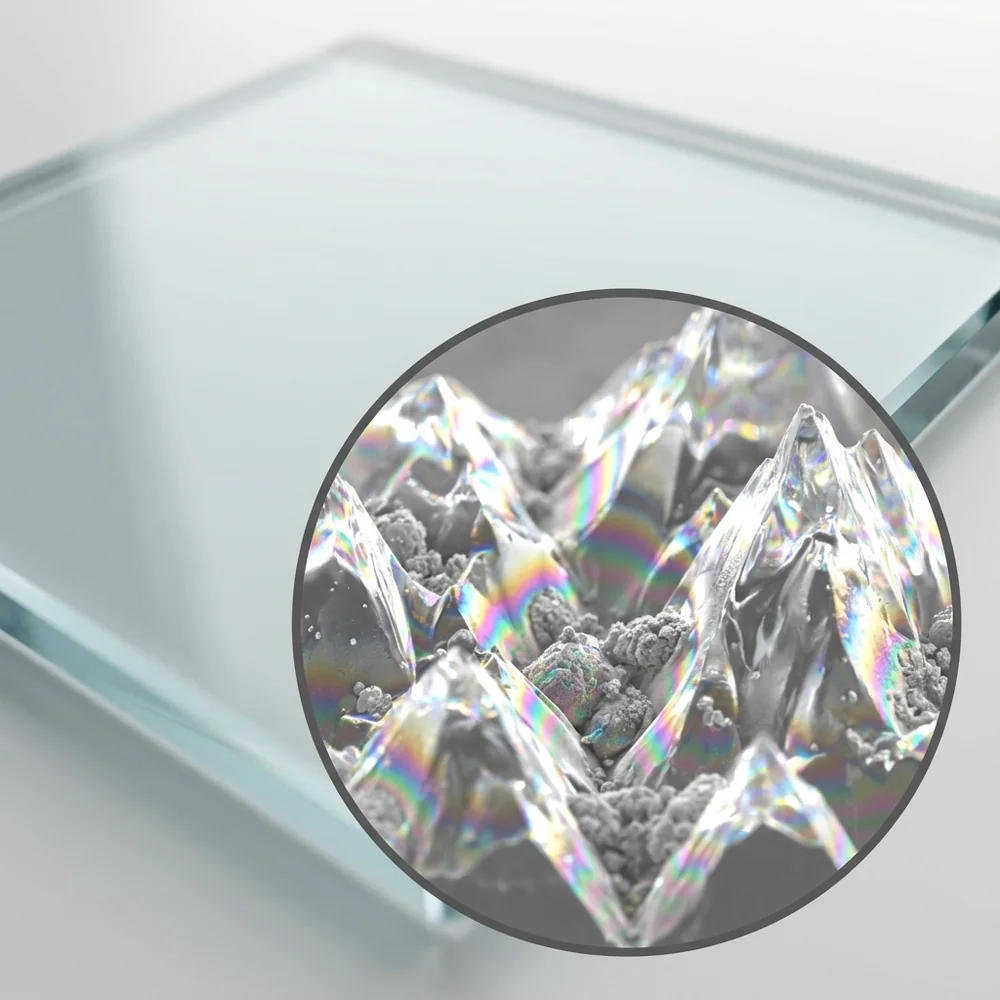
Streaks on glass aren’t a mystery. They’re physical layers of residue that weren’t completely removed during cleaning. When light hits these thin films of dried detergent or mineral deposits, it scatters instead of passing through cleanly. Your eye perceives this scattering as smudges and streaks. Achieving true optical clarity requires eliminating these invisible layers entirely.
This is why most commercial glass cleaners fail in direct sunlight.
The surfactants, dyes, and fragrances in typical sprays leave behind non-volatile solids that look fine in dim light but become obvious when backlit. Hard water compounds the problem by depositing calcium and magnesium every time water dries on the surface. The solution is approaching glass as an optical component rather than just another household surface. By understanding what causes streaks, you can eliminate them at the source.
What Creates Streaks
Streaks on glass come from two sources: chemical residues and mineral deposits. Chemical residues are the non-volatile ingredients in cleaning products. When the liquid carrier evaporates, dyes, fragrances, and inactive surfactants stay behind as a translucent film. This is why blue window cleaners often leave visible hazing in direct sunlight.
Mineral deposits come from hard water.
Calcium and magnesium ions dissolved in tap water precipitate out as the water dries. These mineral spots actually bind to the glass at a molecular level, making them extremely difficult to remove once set. Reference our hard water laundry guide for more on how these ions behave.
To achieve clinical clarity, both residue types must be eliminated. The most reliable approach is using a zero-solids cleaning solution: distilled water combined with a volatile solvent like isopropyl alcohol. The alcohol dissolves oils and speeds evaporation, while the purity of distilled water ensures no new minerals are deposited. By eliminating solids from your cleaning liquid, you eliminate the material that forms the streaks.
Key Insight: Streaks are formed by non-volatile solids, including detergent residues and hard water minerals, left behind after evaporation. Minimizing total dissolved solids in the cleaning solution is the only reliable way to ensure a zero-residue finish.
The No-Soap Rule
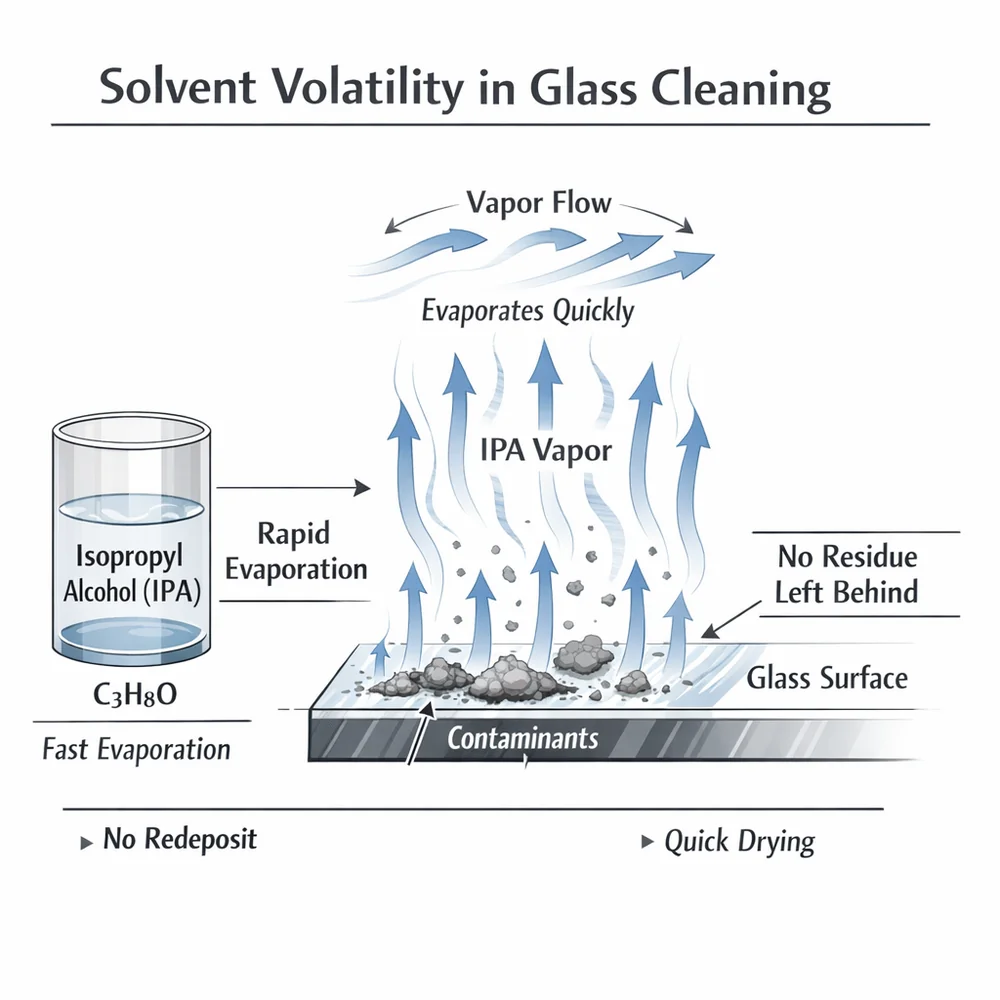
The most important principle in professional glass cleaning is avoiding soap and traditional detergents entirely. Soap molecules form a durable, translucent film that is nearly impossible to rinse away completely from glass. This film then acts as a magnet for dust and future fingerprints, creating a cycle where your windows get dirty faster after each cleaning.
Instead, use volatile solvents that evaporate completely.
White vinegar is effective because its low pH dissolves light mineral scale. Isopropyl alcohol is superior for lipophilic contaminants like skin oils because it dissolves them and then evaporates without residue. A 50/50 mixture of distilled water and 70 percent isopropyl alcohol is an industrial standard for precision glass cleaning.
For heavily soiled glass, a two-stage process works best. Stage one uses a very dilute surfactant wash to break down bulk dirt. Stage two, the critical phase, uses alcohol and distilled water to strip away any remaining soap film. The no-soap rule simplifies the mechanical process too: without suds to manage, there’s no need for excessive rinsing.
Key Insight: Detergent surfactants leave a persistent surface film that attracts dirt and causes smearing. Volatile solvents like isopropyl alcohol allow total soil removal without depositing new residues.
Why Distilled Water Matters
Distilled water is the single most important secret to streak-free glass. Standard tap water contains 100 to 500 parts per million of dissolved minerals. When you clean with tap water, you’re essentially applying a liquid mineral slurry that dries into a cloudy film. Distilled water has a total dissolved solids reading of zero.
It leaves nothing behind.
Distilled water also enhances the efficacy of any solvent you add to it. Because the water is “empty” of minerals, it has more capacity to dissolve environmental contaminants from the glass surface. This is the principle behind the high-solvency water used in laboratories for cleaning precision lenses. For homeowners, distilled water eliminates the need for expensive commercial cleaners entirely.
The difference is most visible on mirrors with direct backlighting or exterior windows in bright sunlight. These conditions highlight the cloudiness caused by tap water minerals that you wouldn’t notice in normal indoor light. Reference our robot mop guide for more on preventing mineral scaling in other equipment. Store distilled water in a clean, airtight container to maintain its purity.
Key Insight: Tap water minerals are a primary cause of surface spotting and cloudiness. Using zero-TDS distilled water ensures no minerals are deposited, maximizing light transmission and reflection.
Choosing the Right Microfiber Weave
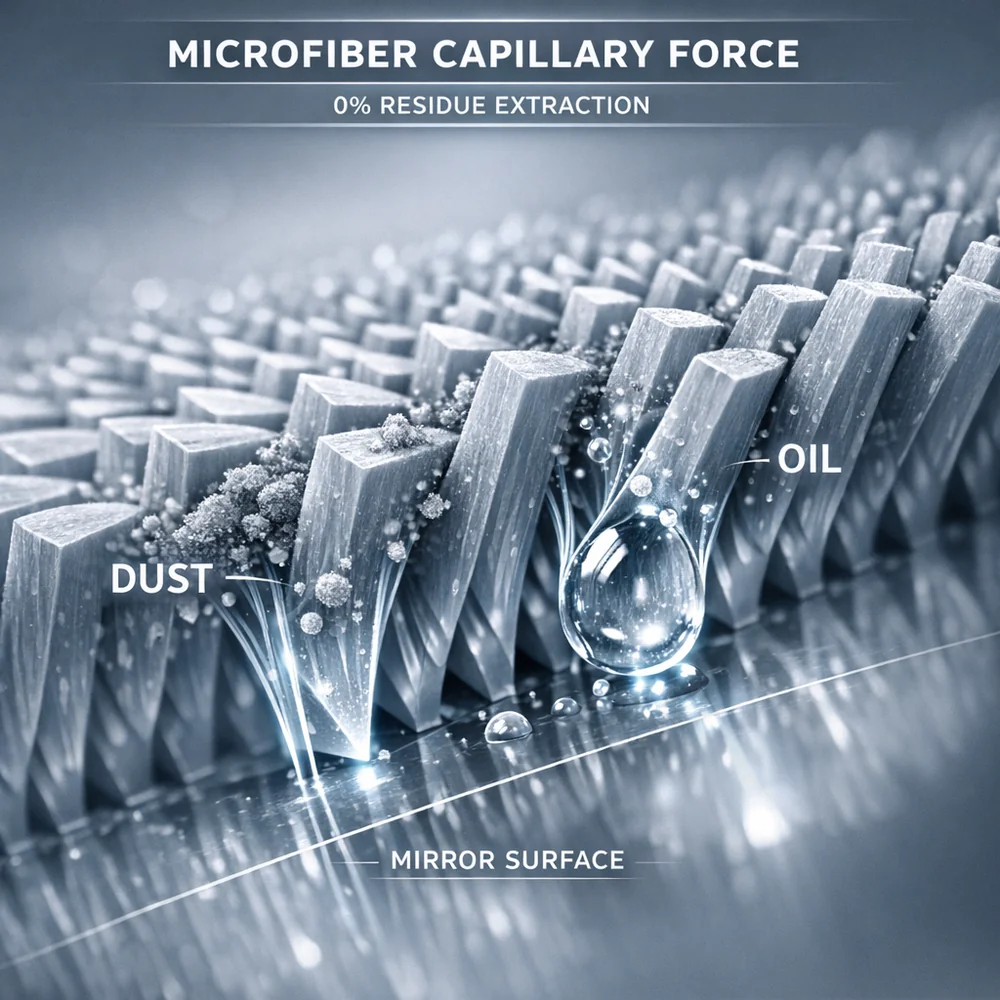
The mechanical component of glass cleaning matters as much as the chemical one. Traditional cotton towels shed cellulose fibers that become trapped on the glass through static attraction, leaving lint behind. Effective glass cleaning requires specialized microfiber cloths, but not all microfiber is equal.
Flat-weave microfiber is ideal for final buffing.
Its tightly-knit, smooth surface makes maximum contact with the glass, allowing you to shave off any remaining microfilm at a molecular level. Waffle-weave microfiber features a honeycomb texture that creates small pockets for absorption. This weave is better for the initial wet cleaning phase because it holds more liquid and traps larger particles in its pockets, preventing them from scratching.
The professional approach uses both: waffle-weave for wet cleaning and flat-weave for dry buffing. This “waffle-wet, flat-dry” system maximizes absorption while ensuring a lint-free, optically flat finish. As discussed in our microfiber care guide, these cloths must be washed separately from cotton laundry and never with fabric softener, which destroys their static properties.
Key Insight: Textile weave dictates mechanical efficiency. Using waffle-weave for wet cleaning and flat-weave for buffing maximizes liquid absorption while ensuring a lint-free, optically flat finish.
Protecting Mirror Backings

Mirrors are glass with a thin reflective coating bonded to the back. This coating is extremely vulnerable to moisture and chemical corrosion. If cleaning solution seeps behind the edge through wicking, it causes oxidation that manifests as “mirror rot”: black, blotchy areas along the edges where the reflective layer has delaminated.
Never spray cleaning solution directly onto a mirror.
Instead, spray the solution onto your microfiber cloth and then wipe the glass. This cloth-first application prevents liquid from pooling at the bottom edge where wicking is most likely. Ammonia-based cleaners are particularly dangerous because ammonia can penetrate the protective paint on the back and accelerate oxidation of the silver layer.
The soap-free alcohol protocol is much safer for mirrors because it uses a pH-neutral solvent that won’t attack the backing. If your mirror has a decorative frame, be extra careful: liquid can become trapped against the edge for days and promote rot. After cleaning the main surface, use a dry flat-weave cloth to carefully buff the edges.
Key Insight: Metallic mirror backings are susceptible to corrosion from liquid wicking and aggressive chemicals like ammonia. Applying solution to the cloth rather than the glass prevents edge-rot and preserves the reflective layer.
Directional Wiping for Troubleshooting
When cleaning windows, it can be hard to tell whether a streak is on the interior or exterior surface. This leads to frustrating cycles of re-cleaning the wrong side while the real smudge persists. Directional wiping solves this problem.
Use vertical strokes on one side and horizontal strokes on the other.
If you see a horizontal streak, you know immediately it’s on the horizontal-wipe side. This diagnostic protocol eliminates guesswork and reduces the total friction applied to the glass. When wiping, use a clean section of cloth for each pass. Folding the cloth into quadrants and flipping to a fresh side ensures you’re always applying clean material.
For the final dry pass, apply firm, uniform pressure to achieve optical flatness. Much like the loading mechanics of a dishwasher ensure complete coverage, this grid approach ensures every inch is addressed. Moving from random wiping to a directional system minimizes rework and maximizes precision.
Key Insight: Directional wiping, vertical on one side and horizontal on the other, provides visual diagnosis of streak location and ensures systematic coverage. This discipline reduces over-cleaning and ensures total surface restoration.
Industrial Polishing for Deep Scratches
For glass with significant etching or scratches, standard cleaning won’t restore clarity. These structural failures require industrial polishing techniques that grind away the top layer at a microscopic level. Cerium oxide is a specialized polishing compound with a unique affinity for glass. It removes light scratches and mineral etching without creating cloudiness.
Apply cerium oxide with a felt pad using low-speed circular motion.
The goal is creating enough friction to level surface imperfections without generating excessive heat that could stress the glass. For more on heat risks with synthetic materials, see our microfiber melting points guide. Automotive clay bars can also be used on wet glass to pull out embedded pollutants, providing a level of smoothness that no liquid cleaner can replicate.
These industrial-grade interventions return glass to its factory state. They address the structural failure of the surface rather than just cosmetic dirt. While not needed for routine maintenance, integrating these tools into your cleaning kit ensures every glass surface can be fully restored.
Key Insight: Structural glass failures like etching and scratches require polishing compounds like cerium oxide to restore surface levelness. Clay bar technology provides a mechanical shave that removes embedded pollutants for a truly smooth optical finish.
Conclusion
Streak-free glass cleaning comes down to eliminating what causes streaks: non-volatile residues from cleaning products and mineral deposits from hard water. Transition to a soap-free protocol using distilled water and isopropyl alcohol. These volatile solvents evaporate completely, leaving nothing behind to scatter light.
Match your tools to the task. Use waffle-weave microfiber for wet cleaning and flat-weave for final buffing. Apply solutions to the cloth rather than directly to mirrors to protect vulnerable backings. Use directional wiping patterns to diagnose streak location and ensure complete coverage.
For structural issues like scratches and mineral etching, industrial polishing compounds can restore optical clarity. By treating glass surfaces with the same precision applied to laboratory optics, you achieve a level of transparency that transforms the light and space in your home.
References
- Hustvedt, G., et al. (2012).
“Optical Clarity and Surface Residues: A Study on Domestic Glass Cleaners.” Journal of Applied Polymer Science. Evaluation of surfactant-free vs. commercial sprays.
- International Fabric Institute. (2015).
“Textile Engineering for Optics: Weave Selection in Microfiber.” IFI Technical Bulletin. 934. 1-10.
Technical analysis of flat vs. waffle weave performance. 3.
Smith, J. A., et al. (2010).
“The Chemistry of Glass Corrosion: Hard Water Minerals and pH Sensitivity.” Journal of Building Engineering. A study on the bonding of calcium carbonate to silicate matrices. 4.
World Health Organization (WHO). (2019). “Best Practices for Maintaining High-Reflection Surfaces in Health Environments.” WHO Technical Guidance.
Official protocols for the care of mirrors and lenses. 5. U.S. Environmental Protection Agency (EPA).
(2020). “Disinfectant Residues and Surface Transparency.” EPA Technical Bulletin. Official guidance on balancing hygiene with optical clarity in shared spaces.