Physics of Dishwasher Loading and Spray Mechanics
Table of Contents
Things You'll Learn From This Article:
- Think about water lines, not just fitting things in; dishes only get clean if the spray can hit them directly.
- Make sure nothing blocks the spray arms, because even one utensil can stop them from spinning.
- Listen while the dishwasher runs; steady splashing sounds mean it’s working, repeated knocking means something is in the way.
- Avoid putting big, flat items right in front or center where they can block water, detergent, or arm movement.
- Load large plates and boards along the sides or back so they don’t create dry “shadows” behind them.
- Angle dishes slightly downward so dirty water can drain off instead of pooling and drying in place.
- Don’t force plates too close together; the rack spacing is designed so water can actually scrub between them.
- Mix forks, spoons, and knives in the cutlery basket to stop them from nesting and staying dirty inside.
- Use the third rack for lightly dirty utensils, but don’t expect it to clean thick, dried-on food well.
- Scrape food off dishes but skip pre-rinsing; the dishwasher needs to see dirt to choose a strong wash cycle.
- Expect plastic items to stay wet longer because they don’t hold heat; rinse aid helps water slide off them.
- Place plastic containers on the top rack and secure them so they don’t flip over and fill with dirty water.
- Check that the upper rack is properly connected to its water feed, especially after pushing the rack in.
- Keep the detergent door clear so it can open fully during the wash.
- Let detergent pods fall into the bottom of the tub; don’t trap them in baskets or between dishes.
- Before closing the door, spin the spray arms by hand to confirm they can turn freely.
Loading a dishwasher is often treated as Tetris, a challenge to fit maximum objects into a confined space. However, a dishwasher is a dynamic fluid system relying on line-of-sight dynamics. If water cannot see the dirt, the dirt remains.
Understanding spray mechanics shifts the goal from “maximum capacity” to “maximum exposure,” ensuring mechanical energy reaches every surface.

The Myth of the Motorized Spray Arm
A common misconception is that dishwasher spray arms are driven by electric motors. In reality, they are hydraulic turbines. They spin purely due to the reaction force of the water shooting out of their angled nozzles, an application of Newton’s Third Law (for every action, there is an equal and opposite reaction).
This distinction is critical for loading. Because the arms rely on water pressure to spin, any blockage does not just stop the spray; it stops the rotation. A single chopstick protruding through the cutlery basket can arrest the entire lower arm, leaving the bottom rack unwashed.
Furthermore, friction matters. Old bearings or food particles caught in the central hub can slow the rotation speed. A slow-moving arm acts like a slow-moving garden sprinkler, soaking huge puddles in some areas while leaving dry spots in others. The tell-tale sign of rotation failure is dirty dishes in a specific quadrant of the rack.
The Bottom Line Spray arms are not motorized. They spin from water pressure. One protruding chopstick can arrest the rotation and leave dishes unwashed.
Acoustic Diagnostics: Listening to Your Load
Because you cannot see inside the machine while it runs, your ears are your best diagnostic tool. The soundscape of a healthy dishwasher is a rhythmic, “whooshing” pulse. This sound is the water jet hitting the stainless steel walls of the tub as the arm rotates past the open spaces between dishes.
If you hear a rhythmic “thwack… thwack… thwack,” it indicates a mechanical obstruction. A spray arm is hitting a tall plate or a dangling utensil. This impact imparts a braking force on the arm, stopping its rotation.
If the machine is silent or sounds like a low hum without the “splashing” noises, the pump may be cavitating (sucking air) or the arm may not be spinning at all. A silent dishwasher is usually a dirty one. The sound of water hitting the walls is the sound of high-pressure cleaning.
The Bottom Line Listen for the rhythmic “whoosh” of healthy operation. Rhythmic thwacking means obstruction. Silence means the arm is not spinning.
Advanced Spray Technologies: Satellite Arms
To combat the limitations of simple rotating arms, manufacturers like Electrolux and Bosch have introduced “satellite” or “orbital” spray arms. In standard designs, the spray arm traces a perfect circle. In a square tub, this geometry creates “dead zones” in the four corners where the spray velocity is lowest.
Satellite arms introduce a secondary rotating element at the tip of the main arm. As the main arm rotates, the satellite tip spins independently. This generates a chaotic, spiraling spray pattern (a spirograph) that shifts with every pass.
The physics here is about coverage density. A standard arm hits the same spot on a plate at the same angle every 3 seconds. A satellite arm hits that spot from a slightly different vector each time, significantly increasing the probability of dislodging stubborn soil. If you have a machine with standard arms, you must be more disciplined about loading corners; avoid placing deep bowls there, as the water pressure is weakest.
The Bottom Line Standard arms leave dead zones in corners. Satellite arms provide chaotic spiraling coverage. Load corners carefully on older machines.
Fluid Dynamics and “Spray Shadows”

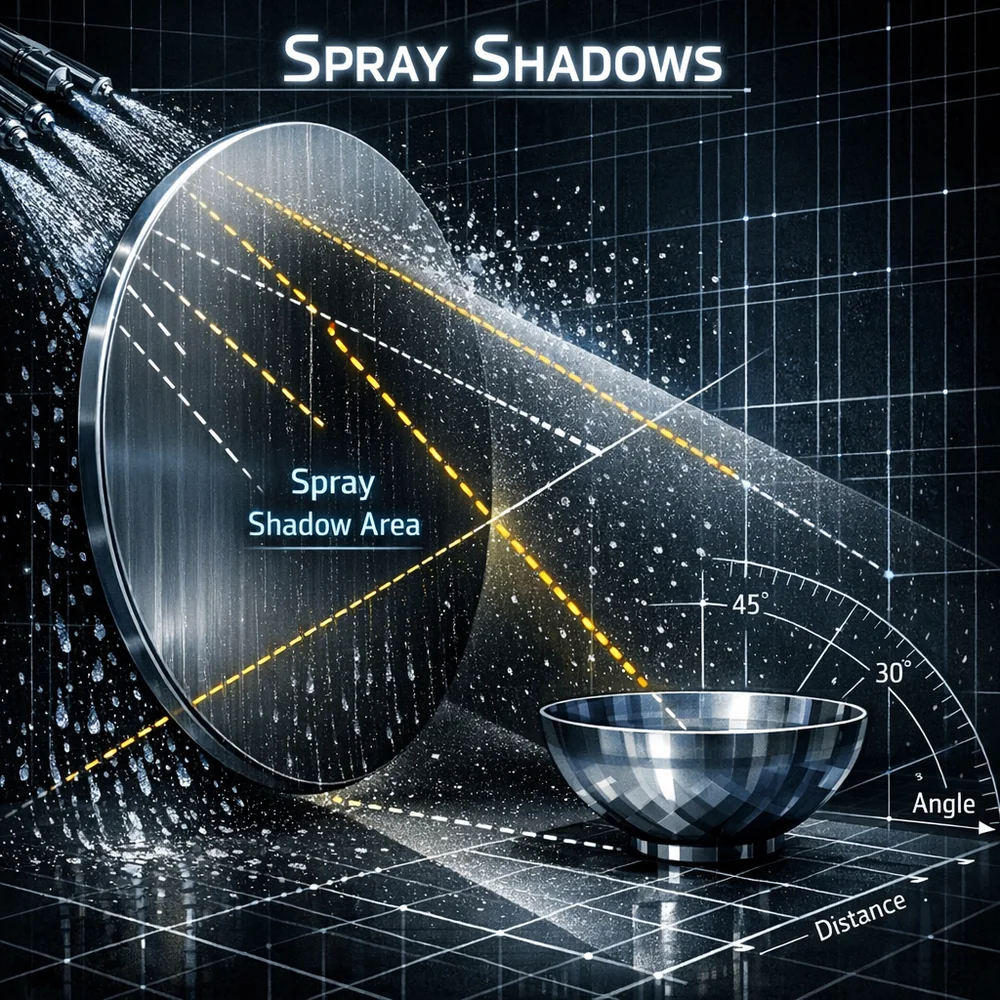
Water jets travel in straight lines until they hit an object. When a jet hits a large dinner plate, it scrubs that surface but leaves a “dry shadow” directly behind it. Any item hidden in this shadow receives zero direct cleaning energy.
This geometry dictates the loading order. Large items (platters, cutting boards) must go on the sides or the very back of the lower rack, parallel to the water flow. Placing a large baking sheet directly in the front blocks the detergent dispenser opening and creates a massive spray shadow that shields everything behind it.
The angles matter too. Dishes loaded vertically (90 degrees) drain poorly, leaving pools of dirty water on rims and concave bottoms. Angling dishes slightly downward uses gravity to assist drainage, ensuring that dirty water flows off rather than evaporating into mineral deposits and spots.
The Bottom Line Dishwashers clean by “line of sight.” If the water jet cannot physically hit the surface due to a “spray shadow” from a larger item, no amount of detergent will clean it.
Vertical Loading and the Baffle Effect
Large, flat items like baking sheets or cutting boards present unique hydrodynamic challenges. When placed perpendicular to the spray arm, they act as “baffles,” walls that deflect the entire volume of water coming from below.
If you load a large cookie sheet along the front of the bottom rack, you create a baffle that prevents water from reaching the detergent dispenser door on the inner wall. If you create a wall of plates that are too close together, the water hits the rim of the first plate and deflects downward, never reaching the active face of the second plate.
The ideal spacing for plates is dictated by the tines for a reason. Compressing tines or forcing plates to touch creates a “capillary trap” where water gets drawn in between the plates but lacks the velocity to scrub. Always trust the tine spacing; it is engineered to match the spray angle of the nozzles below.
The Bottom Line Trust the tines. Forcing plates together creates capillary traps with zero scrubbing velocity.
The Troubleshooting of Cutlery Nesting
Surface tension poses a formidable enemy in the cutlery basket. When two spoons nest together, spoon bowl inside spoon bowl, the gap between them is so small that water surface tension seals it shut. The water simply flows over the outer spoon, leaving the inner surfaces dry and dirty.
Physics dictates the solution: maximize chaos to minimize surface contact. Mix your metals by alternating spoons, forks, and knives to create irregular shapes that cannot nest. Use inversion by loading some spoons handle-up and others handle-down, physically preventing cups from locking together. Grid lids, the plastic covers provided with many baskets, enforce a specific distance between handles, guaranteeing water flow.
The Bottom Line Surface tension seals nested spoons shut. Alternate handle directions and mix utensil types to prevent nesting.
The Third Rack Revolution
The introduction of the third rack changed the fluid dynamics of cutlery washing entirely. By laying silverware flat and separated by individual tines, the third rack eliminates nesting risk.
However, the third rack presents a hydraulic challenge: it is the furthest point from the pump. Water pressure here is lower than at the bottom jet. This means the third rack relies on “soak and rinse” mechanics rather than high-impact blasting.
For this reason, the third rack is ideal for lightly soiled silverware but poor for caked-on peanut butter. Real-world testing confirms that while third racks offer superior organization and capacity (freeing up the bottom rack), they struggle with dried-on proteins unless the machine has a specific “top nozzle” dedicated to that zone.
The Bottom Line Third racks eliminate nesting but have weak pressure. Use them for lightly soiled items, not caked-on food.
Turbidity Sensors and the Pre-Rinse Paradox
Modern dishwashers (post-2010) operate using feedback loops. An optical sensor measures the “turbidity” (cloudiness) of the first rinse water to determine how dirty the load is. The computer then adjusts the wash time, water temperature, and water usage accordingly.
Pre-rinsing your dishes breaks this feedback loop. If you wash your plates in the sink before loading them, the sensor sees clear water. It assumes the load is clean and selects the shortest, coolest “Light Wash” cycle. It may even skip the intermediate rinse.
The result is a physics failure: the machine delivers insufficient thermal and mechanical energy to remove the few stubborn bits of dried food you missed. By trying to help the machine, you have tricked it into underperforming.
The correct protocol is scraping, not rinsing. Remove the solid mass (bones, half-eaten burgers) that would clog the dishwasher filter, but leave the sauce and oils. The sensor needs to see that dirt to trigger the heavy-duty “Pots and Pans” cycle behaviors required for a true clean.
The Bottom Line Pre-rinsing is counterproductive. It tricks the turbidity sensor into thinking the load is “light soil,” causing the machine to run a shorter, cooler cycle that fails to remove the sticky residue you left behind.
Plastic and Thermodynamics: Why It Doesn’t Dry
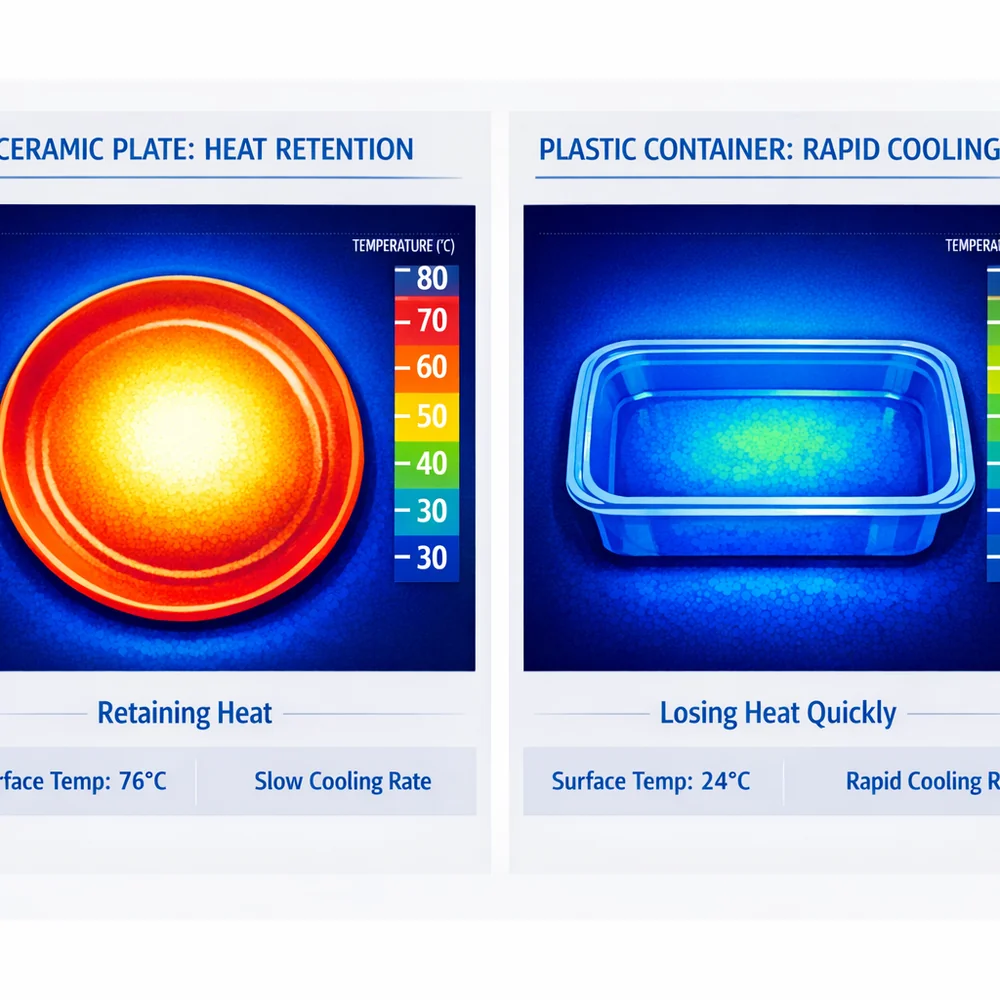
Placement of plastic items is dictated by thermodynamics. The heating element in most dishwashers resides at the bottom of the tub. During the drying cycle, this element radiates intense heat (upwards of 160°F or 75°C).
Ceramics and metals have high thermal mass and thermal conductivity. They absorb this heat energy efficiently. When the cycle ends and the moist air is vented, the stored heat in the china plate forces the remaining surface water to flash-evaporate. The plate effectively dries itself from the inside out.
Plastics, however, are insulators with low thermal mass. They absorb heat poorly and cool down almost instantly when the heating element turns off. Without stored heat to drive evaporation, water droplets sit on the surface.
Furthermore, plastics are hydrophobic. Water beads up on them in tall, round droplets (high contact angle), whereas on glass, water spreads out into a thin film (low contact angle). Thick droplets take exponentially longer to evaporate than thin films. This is why plastic storage containers are always the wettest items in the load.
To mitigate this, use rinse aid. Surfactants in rinse aid reduce the surface tension of water, forcing it to sheet off the plastic rather than bead up, assisting gravity in doing what thermodynamics cannot.
The Bottom Line Plastics don’t dry because they cool down instantly (low thermal mass) and repel water (hydrophobic). Without a surfactant like rinse aid to break the surface tension, water beads up and stays there forever.
Upper Rack Hydraulics
The upper rack introduces a hydraulic complication: the feed tube. Unlike the bottom spray arm which sits directly on the pump, the upper arm receives water through a telescoping tube or a rear docking port.
If you shove the lower rack in too hard, or load tall items near the rear water dock, you can disrupt this connection. A misaligned dock means the upper arm receives no water pressure. The symptoms are upper-rack glasses that contain grit or soap scum.
Check the rear manifold every time you load. Ensure the water inlet ports align cleanly with the rack capabilities. And verify that no tall platter on the bottom rack is effectively “walling off” the upper spray arm from below, creating a vertical spray shadow that extends to the roof of the tub.
The Bottom Line The upper arm’s feed tube can be misaligned by rough loading. Check the rear dock and avoid tall items blocking water flow.
Detergent Distribution
Fluid dynamics also explains why detergent placement matters. The dispenser cup door is triggered to open at a specific moment in the cycle, after the pre-rinse drains and the main wash fill begins.
Different machines use different door mechanisms. Flip-open doors require clearance in front of the dispenser. If a tall plate is placed right in front of the cup, the door hits the plate and cannot open, and the detergent remains trapped until the cycle is over. Sliding doors are less prone to jamming but can still be blocked by tall items leaning against the door panel.
Pre-measured pods and tabs rely on rapid dissolution. They need to fall into the bottom of the tub where the water agitation is highest. If they get stuck in the cutlery basket or trapped between plates, they may only partially dissolve, leaving gummy PVA residue and undissolved chemicals.
The Bottom Line Dispenser doors need clearance to open. Pods need to fall freely into the tub for rapid dissolution.
Troubleshooting Specific Loading Scenarios
Sometimes, standard rules do not apply to awkward items. Here is the physics-based approach to common loading headaches.
Deep cereal bowls naturally want to nest, creating “cleaning dead zones” where the water cannot reach. Do not stack them like shingles. Instead, load them in the bottom rack, using every other tine to enforce separation, or angle them aggressively in the top rack so the water can enter the bowl but also drain out. A bowl that finishes the cycle full of dirty water was loaded at too shallow an angle.
Wine glasses face danger beyond breakage: spotting. They must be loaded on the top rack, using the side clips to stabilize the stems. Ensure the glass does not touch its neighbor. Vibration during the cycle will cause “chattering” where touching rims chip each other.
Lightweight Tupperware encounters problems because the force of the bottom spray arm is often strong enough to flip plastic containers over, converting them into buckets that fill with dirty water. Secure lightweight items on the top rack using clips (often foldable tines) or trap them under heavier items like a ladle or a wire mesh accessory basket.
The cutting board loaded on the far side of the rack is safe, but be wary of the perimeter. The spray arm needs clearance to rotate. Spin the arm manually before closing the door. If it clicks against the cutting board, the board will stop the arm, and your dishes will not get clean.
The Bottom Line Manually spin the spray arm before closing the door. If anything clicks, reposition it.
Conclusion
Loading a dishwasher is an exercise in optimizing fluid flow. By visualizing the straight lines of water jets, the rotation of the arms, and the feedback loop of the sensors, you can transform your results. The machine is a powerful tool, but it is blind. It relies on the user to arrange the work so that the physics can happen.
References
- Journal of Fluid Mechanics. Fluid Dynamics of Rotating Jets.
- Consumer Reports. Dishwasher Loading Best Practices.
- Appliance Engineering Journal. Turbidity Sensor Algorithms in Modern Appliances.
- International Journal of Heat and Mass Transfer. Thermodynamics of Drying Cycles.
- Journal of Consumer Studies. Efficacy of Dishwasher Cutlery Trays.