Preventing Moth Damage to Wool: Complete Protection Strategies
Table of Contents
Things You'll Learn From This Article:
- Holes in wool usually mean larvae have been feeding for a long time, not that adult moths just showed up.
- Clothes moths and carpet beetles both eat wool, but they look and behave differently, so spotting which one you have helps you respond better.
- Freezing wool at 0°F (-18°C) for at least three days kills moths and beetles without using chemicals.
- Sealing clothes in airtight bags before freezing prevents moisture damage when they come back to room temperature.
- Cleaning wool before storage matters because sweat, oils, and food traces attract pests even if you can’t see them.
- Plastic dry-cleaning covers should be removed right away since they trap moisture and can damage fabric over time.
- Cedar and lavender only repel pests; they don’t kill eggs or larvae already on your clothes.
- Cedar blocks and lavender sachets lose strength over time and need refreshing or replacing to stay effective.
- Pheromone traps are mainly an early warning system that lets you catch a problem before holes appear.
- Finding moths in a trap means it’s time to act, not that the trap alone will solve the issue.
- Regular vacuuming removes eggs, larvae, and the lint they feed on, especially in closet corners and cracks.
- Emptying the vacuum after cleaning closets prevents pests from escaping back into your home.
- Airtight plastic bins fully block moths but can trap moisture if clothes aren’t completely dry.
- Breathable garment bags reduce moisture risk but don’t guarantee moths can’t get in.
- Storing valuable wool works best when you combine cleaning, wrapping, barriers, deterrents, and monitoring.
- Heat can kill fabric pests too, but only if the item can safely handle high temperatures.
- Dryers on high heat can treat some items even if they’re already clean and dry.
- Sun-heating in black plastic bags can work in hot weather but isn’t reliable enough on its own.
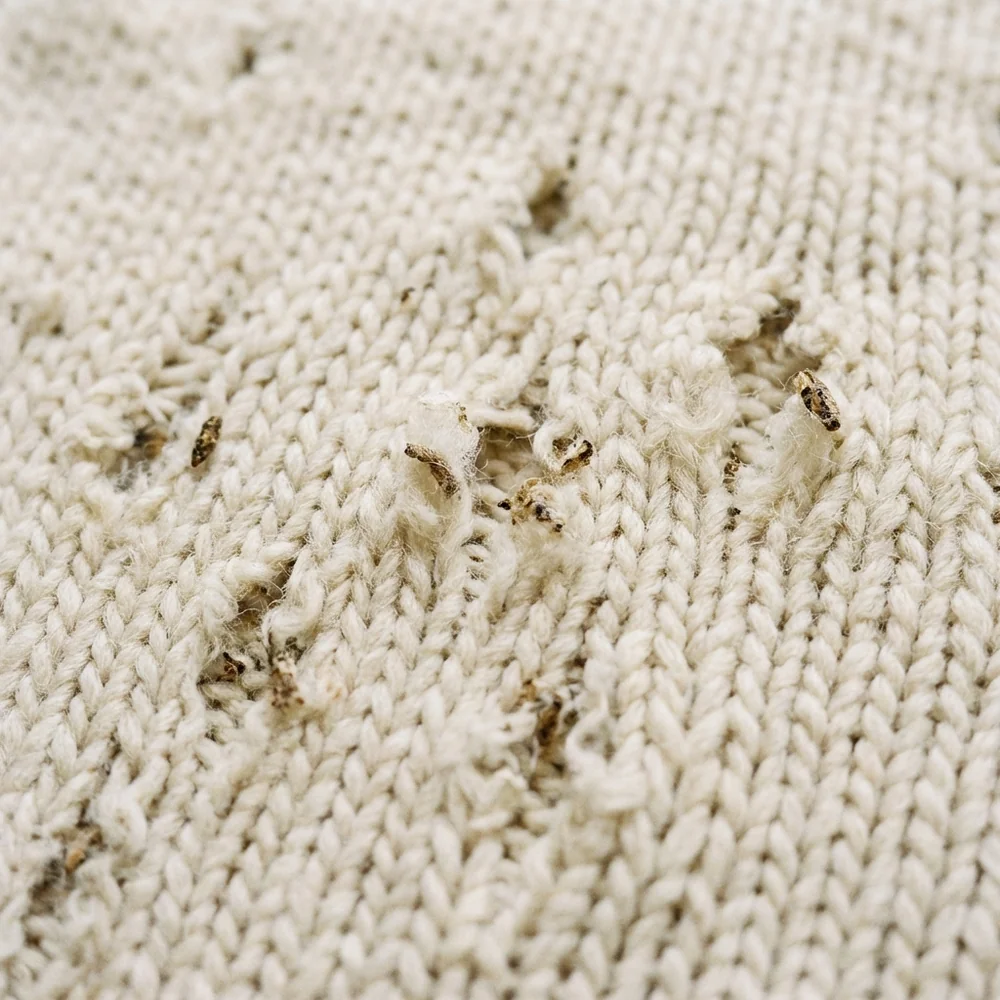
Finding holes in a beloved wool sweater is genuinely heartbreaking. Unlike stains that can be treated or tears that can be mended, moth damage removes the actual fabric, leaving gaps that can’t be filled. The worst part is that by the time you notice the damage, the feeding has already been happening for weeks or months in the dark corners of your closet.
The good news is that prevention works if you understand what you’re dealing with.
Those small tan moths fluttering near your closet aren’t actually doing the damage. It’s their larvae, tiny caterpillars that hide in dark, undisturbed spots and quietly eat your wool for weeks before transforming into the harmless adults you eventually spot. Once you know how these pests operate, protecting your sweaters becomes straightforward.
Clothes Moths Versus Carpet Beetles
Two different types of insects cause most of the damage to stored wool, and knowing which one you’re dealing with helps you target your response. Both feed on keratin, the protein that makes up wool, silk, feathers, and fur. But they look different and behave differently.
Clothes moths are the classic culprits. The adults are small, roughly a quarter inch, with golden or buff-colored wings. They hate light and prefer to run when disturbed rather than fly. Adult moths don’t actually eat anything because their mouthparts don’t work. Their only job is to mate and lay eggs, then die within a few weeks.
The damaging stage is the larva, a small cream-colored caterpillar that hatches from eggs laid directly on or near wool. Depending on conditions, larvae might feed for several weeks to over a year, with warm temperatures speeding things up. According to the University of Kentucky Entomology department, carpet beetles have actually become more common textile pests than clothes moths in many regions.
Carpet beetles are small, oval beetles with mottled black, white, and orange patterns. Unlike moths, the adults can fly and are attracted to light. They often enter homes through open windows. The bristly larvae, sometimes called woolly bears, do the actual damage to textiles.
Key Insight: Larvae, not adult moths, cause the damage by feeding on protein fibers for weeks or months in dark, undisturbed areas.
Freezing Clothes to Kill Larvae

Extreme cold kills fabric pests at all life stages, and freezing provides a completely chemical-free way to treat delicate items that can’t be washed or dry cleaned. The key is reaching low enough temperatures and maintaining them long enough.
Your home chest freezer typically reaches 0°F (-18°C), which is cold enough to kill clothes moths and carpet beetles within 72 hours.
Upright freezers with auto-defrost cycles may not work as well because they warm up periodically during the defrost phase. Before relying on freezing, check that your freezer actually reaches the necessary temperature.
To freeze potentially infested items, seal them in airtight plastic bags with as much air squeezed out as possible. This prevents frost from forming directly on the fibers, which would cause moisture damage when you remove them. Put the bagged items in the coldest part of the freezer (typically the bottom of a chest freezer) and leave them undisturbed for at least 72 hours. Some textile conservators recommend a full week for confidence.
For extra assurance, use the freeze-thaw-freeze method. After the initial 72 hours, remove items and let them reach room temperature over 24 hours while still sealed. Then return them to the freezer for another 72 hours. This kills any eggs that might have survived the first round through a natural cold-resistance mechanism that dissipates during warming.
Key Insight: Freezing at 0°F (-18°C) for 72 hours, ideally with a repeat cycle, kills all life stages of fabric pests without chemicals.
Clean Everything Before Storage
Moths are attracted to soiled areas because body oils, food residues, and perspiration provide extra nutrition that helps larvae grow faster. Cleaning your wool thoroughly before storage removes these attractants and makes your clothes less appealing targets.
Most contamination is invisible. Body oils accumulate in collars, cuffs, and underarm areas even after minimal wear. Perfume, hair products, and skin lotions transfer to any fabric that touches you. These residues are invisible when fresh but oxidize over time into compounds that both attract pests and provide nutrition.
Dry cleaning effectively removes oils and organic contamination that water alone might miss. For items labeled dry clean only, this is the way to go before storage. Let your dry cleaner know the garments will be stored long-term; some offer additional moth-proofing treatments.
Remove plastic dry cleaning covers immediately when you get home. Despite appearing protective, these trap moisture and can cause storage yellowing.
For washable wool, follow care labels carefully. Let items dry completely before storage because moisture encourages mold and creates conditions some pests prefer. The Woolmark Company provides detailed guidance for various wool types.
Key Insight: Moths preferentially target soiled areas containing body oils or food residue, so thorough cleaning before storage is your best prevention.
Cedar and Lavender Have Limits

Cedar and lavender are traditional moth deterrents, and they do work to some degree. But it’s important to understand their limitations so you don’t rely on them more than you should.
Fresh red cedar heartwood contains aromatic compounds that moths find unpleasant and that may inhibit larval development at high concentrations. The key word is fresh.
Those cedar blocks and panels release their volatile compounds over time. After a few years, they may still smell nice to you but provide minimal actual protection. Light sanding exposes fresh wood and releases additional volatiles, or you can refresh aged cedar with cedar oil products.
Lavender works similarly through compounds like linalool that create an environment moths prefer to avoid. Dried lavender sachets gradually lose effectiveness as the oils evaporate, typically needing replacement every few months. Squeezing the sachets periodically releases more fragrance.
The critical thing to understand is that neither cedar nor lavender kills eggs or larvae already present on your clothes. They’re prevention, not treatment. For items with suspected infestation, you need to freeze or heat-treat before relying on deterrents.
Key Insight: Cedar and lavender repel adult moths but don’t kill eggs or larvae already present. They must be refreshed regularly to remain effective.
Use Pheromone Traps for Early Warning
Pheromone traps use synthetic versions of the chemical signals female moths emit to attract males. Male moths fly toward the scent and get stuck on a sticky surface inside the trap. While this does remove some males from the breeding population, the real value is monitoring.
If you find moths in your traps, you know you have a problem before damage becomes visible. Early detection means you can act while populations are still small and damage is limited. Without traps, infestations often develop undetected until you discover holes.
Place traps near closets containing wool or in rooms where vulnerable items might be stored. Follow manufacturer recommendations for height and positioning. Replace traps every 8 to 12 weeks because the pheromone lure degrades over time.
Don’t expect traps alone to eliminate an infestation. Females can mate before males find the traps, and only a fraction of males get caught anyway. Traps alert you to problems; they don’t solve them.
Key Insight: Pheromone traps are primarily an early warning system to detect moth presence, not a method to eliminate an infestation on their own.
Vacuum Your Closets Regularly

Regular vacuuming interrupts pest life cycles by removing eggs, larvae, and the lint and hair fibers they feed on. Fabric pests thrive in undisturbed environments where they can develop for months without interference. Something as simple as routine cleaning eliminates both the pests and the conditions they need.
Closet floors accumulate lint, hair, and fabric fibers that make perfect larvae food. Corners, cracks, and areas behind stored items often escape regular cleaning, becoming safe havens. Vacuum these areas thoroughly, paying special attention to edges and gaps.
Use your vacuum’s hose attachment to get into crevices that a floor head can’t reach. Run it along closet rod ends, shelf supports, and any gaps between built-in components. If your closet has carpet, vacuum it thoroughly and consider lifting edges where possible.
Empty or replace vacuum bags after cleaning areas with suspected moth activity to prevent captured eggs or larvae from escaping back into your home. Quarterly cleaning is a reasonable minimum for most storage areas.
Key Insight: Regular vacuuming of cracks and crevices removes eggs and larvae, interrupting the pest life cycle before damage occurs.
Choosing Between Garment Bags and Plastic Bins
The choice between breathable garment bags and airtight plastic containers involves tradeoffs. Truly airtight containers completely exclude moths but can create moisture problems. Breathable covers allow air circulation but don’t offer absolute protection.
Airtight plastic bins or vacuum-sealed bags create physical barriers that prevent moth access entirely.
Items properly cleaned and sealed remain protected indefinitely regardless of what’s happening in the surrounding environment. However, any moisture present when you seal gets trapped inside, potentially promoting mold growth.
Breathable garment bags made of cotton or muslin allow air circulation that prevents moisture buildup. They can incorporate cedar panels or lavender sachets for added deterrence. But they don’t keep moths out with certainty. Determined moths can find their way through zipper gaps, or they can lay eggs on the outside where hatching larvae work their way in.
For valuable pieces, the layered approach works best: clean items thoroughly, wrap in acid-free tissue, then place in breathable bags with cedar or lavender. Store in closets that get regular vacuuming and monitoring with pheromone traps. The Smithsonian Museum Conservation Institute recommends this combination for valuable textiles.
Key Insight: For valuable items, use a layered approach: clean thoroughly, wrap in acid-free tissue, and store in breathable bags with deterrents.
Heat Treatment as an Alternative
Heat kills fabric pests just as reliably as cold, offering another option when freezing isn’t practical. The same principles apply: you need sufficient temperature for adequate time.
Water temperatures above 120°F (49°C) maintained for 20 to 30 minutes kill all life stages of clothes moths and carpet beetles.
Many wool items tolerate cold or cool washing but not hot temperatures, so this option has limits. Always defer to care labels.
Clothes dryers generate plenty of heat for pest control. Items that tolerate tumble drying can be treated with 30 minutes on high heat, even if they’re already dry. The heat itself does the killing. Items that normally require low-heat drying might tolerate brief high-heat exposure for pest control, though test on something unimportant first.
Summer sun can also be leveraged. Black plastic bags left in full sunlight on hot days can reach internal temperatures above 130°F (54°C). However, this method is unreliable due to weather dependence and uneven heating. Consider it a supplement rather than a primary treatment.
Key Insight: Heat above 120°F (49°C) for 30 minutes kills pests effectively. A high-heat dryer cycle is a convenient method for tolerant items.
Conclusion
Protecting wool from moths doesn’t require elaborate equipment or constant vigilance. Clean items before storage to remove attractants. Use physical barriers and environmental deterrents to make storage areas inhospitable. Monitor with pheromone traps so you catch problems early.
Each layer of protection reinforces the others. The investment of time and attention is modest compared to the value of your woolens, whether that value is measured in money, sentimentality, or simple practicality.
Moths have been eating wool for millennia and they aren’t going to stop. But we can make our closets difficult targets that pests bypass in favor of easier meals elsewhere.
References
University of Kentucky Entomology Department. “Carpet Beetles.” Entomology Extension Publications.
The Woolmark Company. “Wool Care and Storage Guide.” Consumer Resources.
Smithsonian Museum Conservation Institute. “Caring for Textiles.” Preservation Resources.
University of Minnesota Extension. “Clothes Moths.” Pest Management Publications.
North Carolina State University Cooperative Extension. “Managing Stored Product Pests.” Entomology Publications.
American Institute for Conservation. “Protecting Textiles from Insect Damage.” Conservation Resources.