Diagnostic Stain Guide: Classifying Stains by Chemistry for Effective Removal
Table of Contents
Things You'll Learn From This Article:
- Check what kind of stain you have before doing anything, because different stains react very differently to water, heat, and cleaners.
- Use cold water on blood, milk, egg, or baby food, since even warm water can lock these stains in forever.
- Avoid bar soap on coffee, tea, wine, or fruit stains, because it can make the color darker and permanent.
- Treat plant-based drink and food stains with neutral or slightly acidic detergent instead of regular soap.
- For oily or greasy spots, water alone won’t work; you need dish soap or liquid detergent to break up the oil.
- Warm or hot water helps with grease, but only after you’ve added a detergent that can grab the oil.
- Act fast when something spills, because stains sink deeper into fabric the longer they sit.
- Blot fresh spills instead of rubbing, which pushes the stain deeper into the fibers.
- Never put stained clothes in the dryer unless the stain is completely gone, since dryer heat makes most stains permanent.
- Air-dry items you’re unsure about so you can treat the stain again if needed.
- Enzyme detergents work best when matched to the stain, like enzymes for blood or food, not grease.
- Don’t mix chlorine bleach with enzyme cleaners, because bleach destroys the enzymes.
- Use oxygen bleach when color remains after cleaning, especially on colored or delicate fabrics.
- When you don’t know what caused a stain, start with cold water and gentle detergent to avoid making it worse.
Every stain behaves according to its molecular chemistry. The brown ring from your coffee responds completely differently to treatment than the grease spot from dinner. Identifying what you are dealing with is the first and most critical step in removal.
The wrong treatment can transform a temporary spill into permanent damage. Hot water on blood ruins the garment forever. Bar soap on wine dyes the stain darker. Understanding these chemical reactions, and which treatments trigger them, is what separates successful cleaning from permanent staining.
This guide teaches you to diagnose stains by their chemistry so you can apply the right treatment every time.
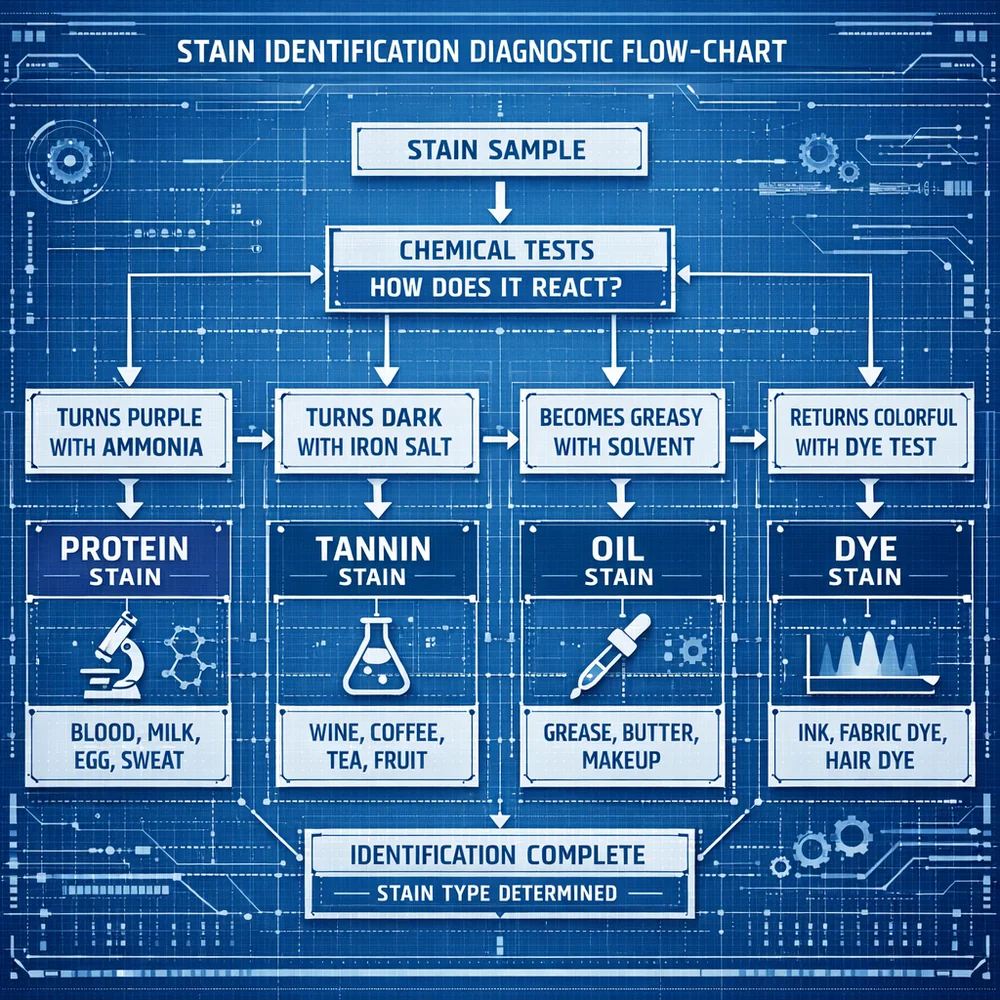
Protein Stains: The Heat Sensitivity Problem
Blood, milk, egg, and meat juices all contain proteins that are extremely sensitive to temperature. When these proteins encounter heat, they undergo denaturation, a structural collapse that exposes reactive sites. These sites then bond permanently with the fabric’s polymers.
Think of what happens when you cook an egg. The clear albumin turns white and solid, and that transformation is irreversible. The same reaction happens when you apply hot water to blood on fabric. The protein fuses to the fiber and no amount of scrubbing will remove it.
The denaturation process begins at surprisingly low temperatures. Blood proteins start to denature around 104°F (40°C). By the time water feels “comfortably warm” to your hand, it is already hot enough to set protein stains permanently.
Always treat protein stains with cold water first. Keep the protein in its soluble state until you can introduce laundry enzymes. Protease enzymes specifically target peptide bonds, performing molecular surgery that cuts the large protein mass into smaller units that rinse away.
Common protein stains include blood, milk, cheese, yogurt, egg, meat juices, and many baby food splatters. When in doubt about whether a stain contains protein, treat it cold.
The Bottom Line Protein stains must never contact heat. Cold water keeps them soluble for enzymatic removal.
Tannin Stains: The Alkalinity Trap

Coffee, tea, wine, and fruit berries contain polyphenolic compounds called tannins. These molecules naturally act as dyes, binding readily to the hydroxyl groups in cotton and other natural fibers.
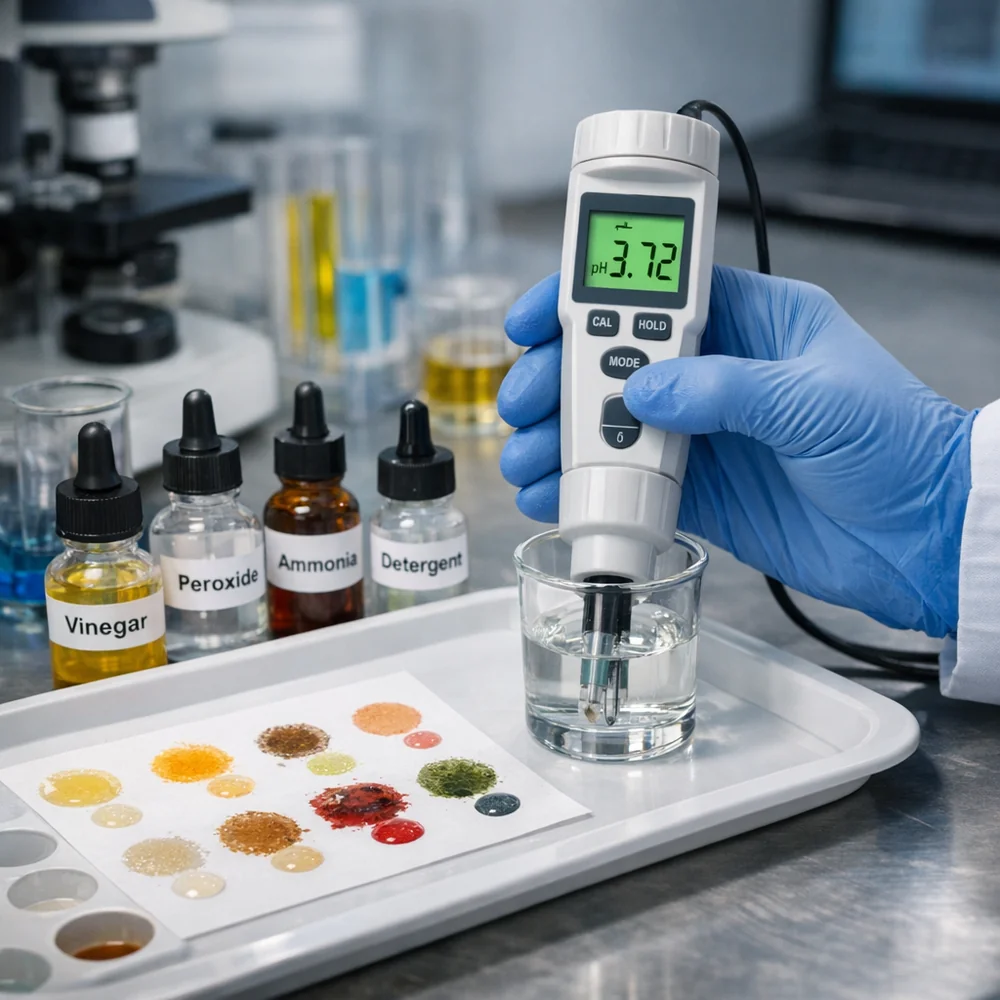
Unlike proteins, tannins do not denature with heat. Their danger is alkalinity. When tannin stains encounter alkaline substances (pH above 7), a chemical reaction darkens and “sets” the color. This is the same mordant reaction used in ancient dyeing to make colors permanent.
The chemistry behind this is fascinating. Alkaline conditions cause tannin molecules to ionize, creating negatively charged phenolate groups. These groups form strong ionic bonds with positively charged sites on fabric fibers. The higher the pH, the more complete this bonding becomes.
Most bar soaps are highly alkaline, often pH 9 or higher. Using soap on a wine or juice stain is essentially dyeing your garment with the spill. Start with pH-neutral detergent or slightly acidic solutions to keep the tannin molecules mobile and removable.
Common tannin stains include coffee, tea, red wine, white wine, beer, fruit juice, berries, soft drinks, and most plant-based foods.
The Bottom Line Alkalinity permanently fixes tannin stains. Use neutral or acidic solutions for coffee, wine, and fruit.
Oil and Grease: The Temperature Contest
Lipids, including cooking oils and animal fats, are hydrophobic and will not dissolve in water regardless of how hard you scrub. Removal requires surfactants that can emulsify the oil, surrounding droplets with water-attracting molecules.
The efficiency of emulsification depends heavily on wash temperature. Higher temperatures reduce the surface tension of oil, allowing it to move more freely out of fiber crevices. Many oil stains fail to release in cool water because the specific fat remains semi-solid.
Different fats have different melting points. Butter solidifies at room temperature but melts easily. Coconut oil stays solid until around 76°F (24°C). Some animal fats require even higher temperatures. This explains why the same wash temperature works perfectly for some grease stains but fails completely on others.
Pre-treat heavy grease with concentrated dish soap or liquid laundry detergent. Let the surfactant molecules embed themselves in the oil layer before washing. Without this intervention, oils eventually oxidize and polymerize into a hard, resin-like varnish that becomes truly permanent.
Common oil stains include cooking oil, butter, margarine, mayonnaise, salad dressing, automotive grease, motor oil, cosmetics, and body oils from skin contact.
The Bottom Line Oil removal requires heat to reduce viscosity and surfactants to emulsify. Cold water fails because the fat stays solid.
The Bar Soap Mistake
This error deserves its own section because it ruins so many garments. Traditional bar soaps are highly alkaline, often pH 9 or 10. When this alkalinity meets a vegetable-based stain, it triggers a mordant reaction that locks the dye to the fiber.
By reaching for soap to clean wine or juice, you are essentially using ancient dyeing chemistry on your clothes. The stain goes from removable to permanent in seconds.
This mistake is especially common because soap seems like a logical first response to any stain. People have been using soap for cleaning for thousands of years. But modern synthetic detergents are formulated differently, often with neutral or slightly acidic pH, specifically to avoid this problem.
If a stain has already been darkened by soap, immediate neutralization with white vinegar can sometimes reverse the reaction. But prevention is far easier than cure. Use pH-neutral products for any unknown or plant-based stain as your default first response.
The Bottom Line Bar soap is alkaline and permanently sets plant-based stains. Keep pH-neutral detergent on hand for emergencies.
Time: Surface to Core Migration
In the first few minutes after a spill, most staining exists as surface adhesion. The substance rests on the outside of yarns and can be blotted away with high success rates. Applying cornstarch or a clean white towel during this window can remove up to 90% of the material.
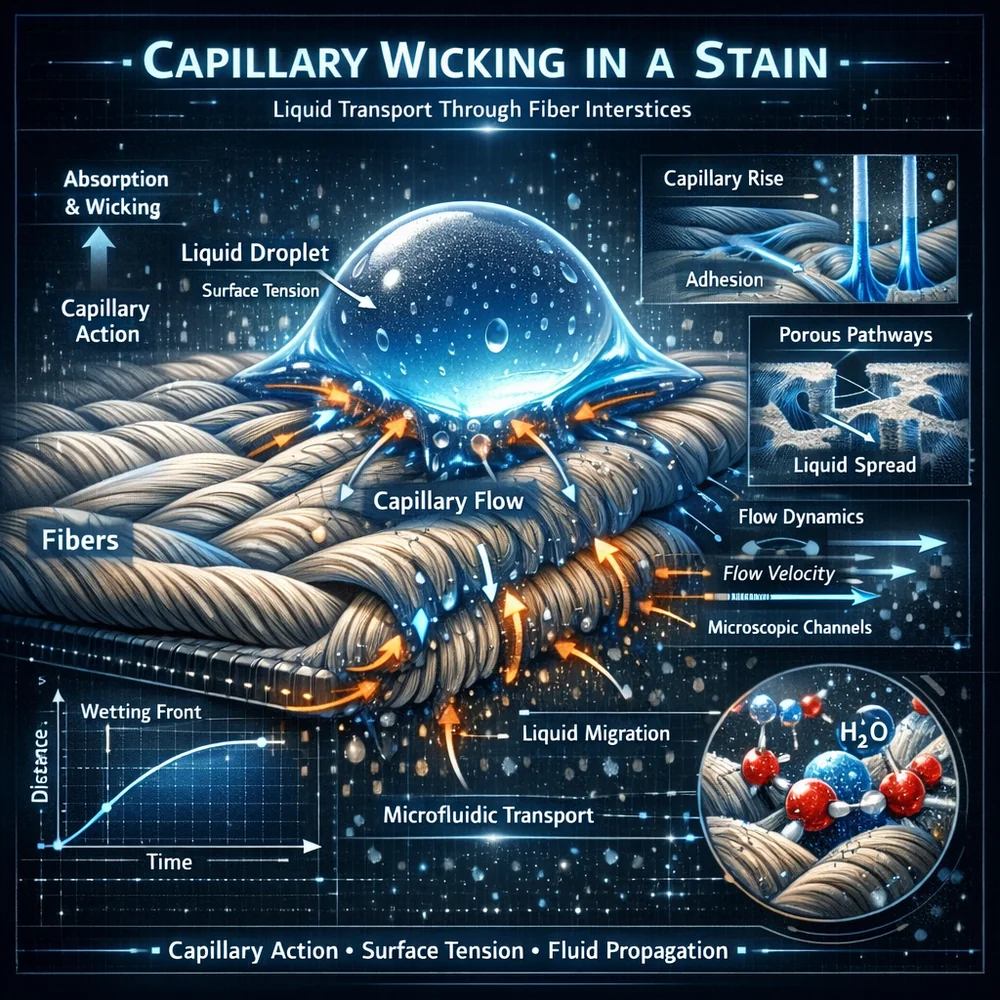
As minutes pass, capillary action draws liquid into the center of fiber twists. Once a stain moves from surface to core, simple blotting stops working. Chemical energy must now be used to dislodge particles from their entrapment.
The physics of capillary action work against you constantly. Surface tension pulls liquid molecules along the microscopic channels between fibers. Gravity plays almost no role at this scale. The liquid simply wicks into every available space until equilibrium is reached.
This transition is why “dwell time” matters for cleaning agents. Older stains need longer soaking because the reagents must migrate into the fiber center to reach the entrapped molecules.
The Bottom Line Fresh stains blot away; set stains require chemical penetration. Act fast with absorption, then give cleaners time to reach the core.
The Dryer: Where Stains Become Permanent
The tumble dryer is the graveyard of stained clothing. High heat provides the activation energy to finalize bonds between stain and fiber that were only weakly held before.
Proteins denature completely at dryer temperatures, becoming insoluble biological plastic. Sugars caramelize through the Maillard reaction, turning yellow forever. Residual oils polymerize into waterproof varnish fused to the fabric.
The temperatures inside a tumble dryer on high heat can exceed 135°F (57°C), which is well above the threshold for setting virtually every type of stain. Even on low heat, prolonged exposure creates cumulative setting effects.
Once a stain survives a full dryer cycle, removal success drops by roughly 95%. The fundamental rule is never subject an item to the dryer until you have verified the stain is completely gone. Air drying allows a second treatment attempt without heat-setting.
The Bottom Line Dryer heat permanently bonds stain molecules to fabric. Always air dry questionable items for inspection first.
Enzyme Specificity in Modern Detergents
Modern laundry enzymes provide surgical precision compared to general surfactants. Each enzyme type targets only specific molecules.
Protease attacks proteins. Lipase breaks down fats and oils. Amylase handles starches from gravies or baby food. Cellulase works on the cotton fiber itself to brighten appearance. This specificity allows powerful cleaning at lower temperatures while preserving fabric integrity.
Enzyme effectiveness depends on matching the right enzyme to the stain family. Using protease on an oil stain wastes time because protease has no effect on lipids. Similarly, lipase does nothing for blood stains.
However, enzymes are proteins themselves and have operating requirements. Most work best in warm (not hot) water and neutral pH. They are destroyed by chlorine bleach. Use enzymes first to digest organic matter, then follow with oxidation if color correction is still needed.
The Bottom Line Match the enzyme to the stain family: protease for protein, lipase for fat, amylase for starch. Let them work before using bleach.
Oxidation: When Color Remains After Matter Leaves
Sometimes the physical substance of a stain is gone but residual color persists. This happens because chromophores, the light-absorbing parts of molecules, can remain even when the bulk material is extracted.
Oxygen bleach (sodium percarbonate) or hydrogen peroxide add oxygen atoms to chromophores, breaking the double bonds that cause them to reflect color. This renders the stain invisible even if molecular fragments remain.
The process is called oxidative bleaching. It works by disrupting the conjugated double bond systems in colored molecules. These systems are what allow molecules to absorb specific wavelengths of light and appear colored. Breaking the bonds removes this absorption capacity.
Start with oxygen-based bleaches because they are safer for colors and fibers. Chlorine bleach should only be used as a last resort on white cotton. It degrades natural fibers over time and reacts poorly with iron, causing yellowing on blood or rust stains.
The Bottom Line Oxidation breaks the light-reflecting bonds in residual color. Use oxygen bleach first; reserve chlorine for white cotton only.
Solvent Techniques for Heavy Grease
Industrial and automotive greases are too heavy for water-based detergents. They require solvents that dissolve hydrocarbon chains directly. Options include isopropyl alcohol, acetone, and mineral spirits, each with varying strength and fabric safety.
Application technique matters as much as chemical choice. Place the garment face-down on an absorbent white towel. Apply solvent to the back of the stain, pushing dissolved grease out of the fabric and into the towel. This “back-spotting” prevents the oil from being forced deeper.
After solvent treatment, rinse with a surfactant-rich solution to remove the dissolved oil entirely. Without this step, the solvent evaporates but leaves the oil behind.
The Bottom Line Heavy grease needs solvent treatment. Apply from the back side to push contamination out, then rinse with detergent.
Diagnosing Unknown Stains
When you do not know what caused a mark, physical and sensory clues help identify the chemistry.
A stain that is stiff or crusty suggests protein or starch. Use cold water and enzymes. A greasy or translucent spot is almost certainly oil or fat. Heat and surfactants are needed. Colored, thin stains are likely tannins or dyes, requiring pH-neutral treatment.
Smell provides additional diagnostic power. A metallic odor indicates iron, pointing to blood or rust. Rancid smells suggest oxidizing oils. Sweet odors point toward sugars and tannins.
When diagnosis is uncertain, default to a cold water soak. Cold minimizes the risk of triggering irreversible chemical setting.
The Bottom Line Use texture and smell to classify unknown stains. When in doubt, cold water is the safest starting point.
Conclusion
Successful stain removal depends on identifying the molecular family of the contamination. Proteins need cold water and enzymes. Tannins need pH neutrality. Oils need heat and surfactants. All stains become permanent after dryer heat.
Start conservative with cold water and neutral detergent. Once you know what you are dealing with, bring in specialized tools: protease enzymes for biological matter, oxygen bleach for residual color, solvents for heavy grease. This systematic approach saves countless garments from the landfill.
The Bottom Line Classify first, treat specifically, verify before drying. Understanding the chemistry transforms guesswork into reliable restoration.
References
- Journal of Surfactants and Detergents. “Mechanisms of Stain Removal in Cellulose Matrices.” Springer Link
- American Cleaning Institute. “Chemical Classification and Reagent Selection.” https://www.cleaninginstitute.org/
- Textile Research Journal. “Enzymatic Hydrolysis on Cotton Fibers.” Sage Journals
- Consumer Reports. “Temperature and Soil Removal Efficiency.” https://www.consumerreports.org/
- Dyes and Pigments. “pH-Dependent Stability of Natural Tannins.” ScienceDirect