Surfactants SLS vs. SLES: The Chemistry of Cleaning Agents
Table of Contents
Things You'll Learn From This Article:
- Water alone can’t remove oily dirt; surfactants are what let water grab grease and wash it away.
- SLS and SLES are common cleaning ingredients that come from similar sources but behave differently in use.
- SLS cleans very aggressively and foams a lot, which can be useful for heavy dirt but rough on skin.
- SLES is modified to be gentler, making it better for sensitive skin, baby clothes, and frequent washing.
- The way a detergent works depends on reaching a certain strength in water; too little surfactant means poor cleaning.
- Hard water can weaken some detergents, especially those with SLS, by turning them into residue instead of cleaners.
- SLES handles hard water better, so it performs more consistently in different homes and locations.
- Big, fast foam doesn’t always mean better cleaning; controlled, creamy foam often works better in modern washing machines.
- Skin dryness or irritation after washing is more likely with SLS because it strips away natural skin oils.
- Detergents often mix multiple surfactants so they clean well while staying gentle on skin and fabrics.
- Trace contaminants like 1,4-dioxane can come from making SLES, which is why manufacturing quality and testing matter.
- Both SLS and SLES break down in wastewater treatment, but they last longer in low-oxygen environments like septic systems.
- Choosing a detergent isn’t just about cleanliness; water hardness, skin sensitivity, and machine type all play a role.
Surfactants are the molecular workhorses that make cleaning possible. Without them, water would simply bead up and roll off oily surfaces without taking any of the grime with it. These surface-active agents are what allow water to penetrate, emulsify, and lift away the oils and soils that make laundry dirty in the first place.
Among the most prevalent surfactants in the global detergent market are Sodium Lauryl Sulfate (SLS) and its ethoxylated relative, Sodium Laureth Sulfate (SLES). While sharing a similar alkyl-sulfate core derived from coconut or palm oil, these two molecules possess distinct chemical behaviors dictated by their molecular architecture. SLS is known for its high-energy foaming and aggressive soil removal, whereas SLES is engineered for mildness and stability in hard water.
Understanding the thermodynamics of micelle formation and the specific irritancy profiles of these compounds is essential for choosing the right detergent for your needs. The choice between SLS and SLES is a decision that balances cleaning potency against biological compatibility, and the differences matter more than most people realize.
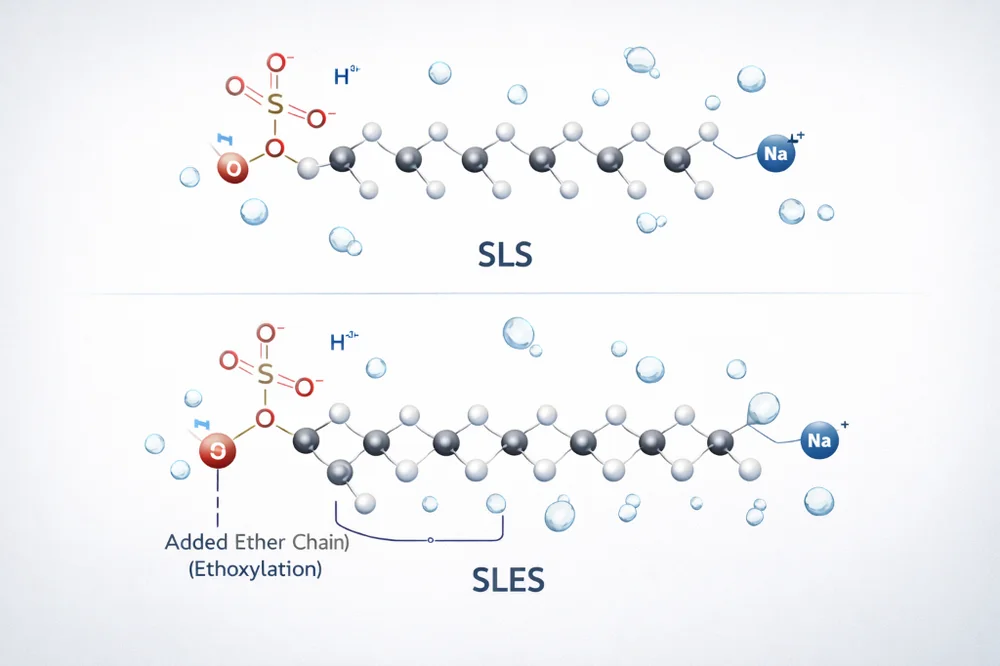
How Ethoxylation Changes the Molecule
The fundamental chemical difference between SLS and SLES is the inclusion of an ethoxy link between the hydrophobic tail and the hydrophilic head.
Sodium Lauryl Sulfate is produced by the direct sulfation of lauryl alcohol. It is a linear molecule with a concentrated negative charge at the sulfate head, making it a high-energy anionic surfactant. Sodium Laureth Sulfate is produced through a process called ethoxylation, where ethylene oxide units (typically 1 to 3) are added to the alcohol before sulfation. This addition increases the molecular bulk and distributes the hydration energy across a larger volume.
The ethoxylation process serves to soften the molecule. By inserting the ethoxy groups, the molecule becomes more hydrophilic and less likely to form the tight, rigid structures associated with high irritancy. However, the process of ethoxylation carries a manufacturing byproduct risk: the formation of 1,4-dioxane. This cyclic ether is a potential carcinogen and must be strictly monitored and removed through vacuum stripping during the terminal stages of the SLES manufacturing cycle.
The Bottom Line Ethoxylation inserts spacer groups that increase molecular size and reduce skin penetration. This makes SLES milder than SLS, but introduces the need for rigorous purification to remove 1,4-dioxane byproduct.
How Micelles Form and Clean

Cleaning occurs when surfactant molecules aggregate into tiny spherical structures called micelles.
In an aqueous solution, the hydrophobic tails of the surfactants retreat from the water, clustering together to form an oil-compatible core, while the hydrophilic heads remain on the outside to interact with the solvent. The concentration at which this occurs is known as the Critical Micelle Concentration (CMC). If the concentration is below the CMC, the surfactant exists as individual molecules and cannot effectively emulsify grease.
SLS has a relatively low CMC, meaning it starts forming micelles and cleaning effectively even at low concentrations. SLES, due to its larger head group and ethoxy chain, has slightly different micellar dynamics. The ethoxylated chains interfere with the packing density of the micelle surface, allowing for more flexible configurations that are better at solubilizing certain types of organic matter. This flexibility also contributes to the creamier and more stable foam produced by SLES-based detergents.
Why SLS Irritates Skin More Than SLES
The most significant practical difference between SLS and SLES is their potential for skin irritation and sensitization.
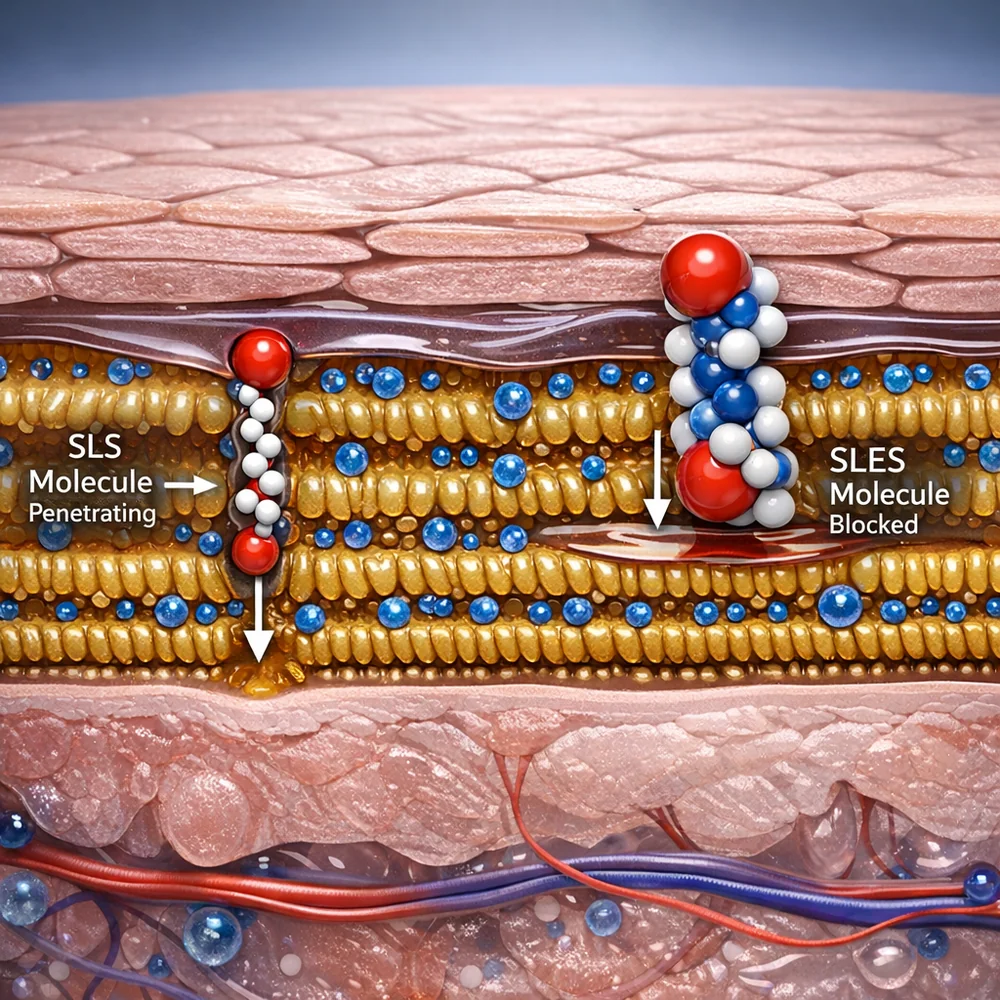
SLS is a known skin irritant and is often used as a positive control in dermatological patch testing. Its small molecular size allows it to penetrate the interstices of the stratum corneum, the skin’s outermost protective layer. Once inside, SLS interacts with the structural proteins and lipids of the skin, stripping away the natural oils (sebum) that maintain the skin’s moisture barrier. This results in dryness, itching, and the tight feeling often associated with harsh soaps.
SLES is significantly milder because the added ethoxy groups increase the molecule’s physical size and change its charge distribution. The larger SLES molecule is physically hindered from penetrating the skin barrier compared to the smaller SLS molecule. This makes SLES the preferred choice for washing newborn clothes and for users with eczema. It provides effective soil removal without the biological cost of total lipid extraction from the epidermis.
The Bottom Line SLS is small enough to penetrate skin and strip natural oils. SLES’s larger molecular footprint cannot penetrate as deeply, making it significantly gentler while still cleaning effectively.
Performance in Hard Water
Water hardness, referring to the concentration of calcium and magnesium ions, significantly impacts surfactant performance.
Anionic surfactants like SLS are susceptible to precipitation in the presence of divalent cations. The calcium ions form ionic bonds with the sulfate heads of the SLS molecules, creating insoluble calcium lauryl sulfate, commonly known as soap scum. This neutralizes the surfactant and removes it from the cleaning equation. Without the addition of chelating agents like borax, SLS-based cleaners lose a significant portion of their potency in hard water zones.
SLES handles hard water more gracefully. The ethoxy chains provide a steric barrier that inhibits the approach of calcium ions to the sulfate head. Furthermore, the ethoxy groups themselves can weakly coordinate with the metal ions, keeping them in solution rather than allowing them to form a precipitate. This built-in tolerance makes SLES a more robust and predictable performer in varied water qualities, ensuring that the detergent remains active throughout the entire wash cycle.
Foam Density and Consumer Perception
The foaming properties of a surfactant are often equated with cleaning power by consumers, despite only a loose correlation between the two.
SLS produces a voluminous, high-energy foam with a large flash lather potential. The bubbles are typically larger and more fragile, providing a visual cue of intense cleaning action. This makes SLS popular in shampoos and high-foaming hand-wash detergents. However, in modern high-efficiency (HE) washing machines, excessive foam can be a liability, as it can cushion the mechanical fall of the clothes and interfere with the sensors.
SLES produces a denser, smaller-bubble foam that is perceived as creamier and more luxurious. This foam is more resistant to collapsing, providing more consistent lubricity during the wash. For HE washer mechanics, the controlled sudsing of SLES-based blends is often easier to manage through the addition of anti-foaming agents. The foam of SLES is also less likely to transport soil back onto the fabric surface, a phenomenon known as redeposition.
The Bottom Line SLS creates voluminous but fragile foam that consumers associate with power. SLES creates stable, creamy foam that performs better in HE machines and prevents soil redeposition.
Environmental Biodegradability
The environmental fate of SLS and SLES is a critical component of their overall chemical lifecycle assessment.
Both SLS and SLES are considered readily biodegradable under aerobic conditions. In a typical municipal wastewater treatment plant, bacteria can break down the hydrocarbon tails and the sulfate heads into carbon dioxide, water, and inorganic sulfate. The linear alkyl chain of both molecules provides an easy target for beta-oxidation by microbial enzymes. This sets them apart from the older, branched alkylbenzene sulfonates used in the mid-20th century, which were notoriously resistant to biodegradation and led to persistent foam in rivers and streams.
However, the anaerobic biodegradability (in the absence of oxygen) of these surfactants is more restricted. In the oxygen-depleted environments of septic tanks or deep river sediments, the biodegradation process is significantly slower. This is a primary driver behind the search for next-generation surfactants like alkyl polyglucosides (APGs), which degrade effectively in both aerobic and anaerobic conditions.
Historical Development of Synthetic Surfactants
The rise of SLS and SLES as dominant cleaning agents is a testament to the mid-century industrialization of the surfactant market.
Prior to the 1930s, most laundry was performed using traditional soap, the salt of a fatty acid produced from animal fats or vegetable oils. While natural, these soaps were highly inefficient in hard water and required intensive manual labor to rinse. The development of synthetic alcohol sulfates provided a consistent, high-performance alternative that was independent of the food supply of animal fats. Sodium Lauryl Sulfate was one of the first synthetic surfactants to be commercialized on a massive scale, revolutionizing everything from laundry to industrial degreasing.
As the industry matured, the need for milder alternatives led to the widespread adoption of SLES in the 1960s and 70s. The ethoxylation process allowed manufacturers to keep the powerful soil removal of the alkyl-sulfate core while softening the impact on the consumer’s skin. This evolution mirrored the broader gentrification of the personal care and laundry markets, where users began to value the physical experience of the wash just as much as the final cleanliness of the garment.
The Bottom Line The shift from SLS to SLES reflects industry evolution from raw cleaning power toward skin-compatible formulations. Modern detergents balance performance with user comfort.
Managing 1,4-Dioxane Contamination

The safety profile of SLES is inextricably linked to the purity of the manufacturing process regarding 1,4-dioxane.
As a cyclic ether byproduct of ethoxylation, 1,4-dioxane is not intentionally added to detergents but can remain as a trace contaminant. Because it is highly soluble in water and resistant to biodegradation, it has become a focus of environmental and health regulators. Modern industrial standards require that 1,4-dioxane levels in consumer products be kept below 10 parts per million (ppm), with some eco-labels demanding even lower thresholds.
Manufacturers achieve this through the use of vacuum stripping technology at the end of the SLES synthesis. By exposing the surfactant to high vacuum and heat, the more volatile 1,4-dioxane is boiled off and recovered, leaving behind a clean SLES grade. Consumers concerned about this contaminant often look for certifications from third parties or choose SLS-based products, though the latter must be balanced against the increased risk of skin irritation.
How Surfactants Work Together
In modern laundry formulations, SLS and SLES are rarely used in isolation. They are blended with co-surfactants to optimize performance.
To further mitigate the irritancy of SLS or SLES, formulators often add amphoteric surfactants like Cocamidopropyl Betaine. These secondary agents interact with the primary anionic surfactant to form mixed micelles. These hybrid structures are even larger and more stable than single-surfactant micelles, providing better soil suspension and even lower skin penetration. This synergy is the foundation of tear-free and sensitive-skin detergents.
Furthermore, non-ionic surfactants are often added to SLES blends to improve grease removal. While SLES is excellent at removing particulate soil and general grime, non-ionic surfactants are more effective at emulsifying heavy oils and synthetic resins. This multi-surfactant approach ensures that the detergent can handle a varied load of activewear and everyday cottons with a single, balanced formula.
Conclusion
The science of surfactants is a study in molecular optimization, where small changes in atomic arrangement lead to vast differences in performance and safety.
Sodium Lauryl Sulfate remains a powerful, high-foaming cleanser for heavy-duty applications, while Sodium Laureth Sulfate provides the mildness and hard-water stability required for modern, skin-sensitive laundry routines. The decision to use one over the other, or a blend of both, rests on the specific cleaning objective and the intended user. While the process of ethoxylation introduces the challenge of trace contaminant management, it also provides the structural bulk necessary to protect the skin barrier.
Ultimately, the mastery of cleaning science requires an appreciation for these microscopic cleaning machines. By selecting detergents that utilize the appropriate surfactant for the water quality and fabric type, you can achieve high-performance results without compromising biological health. As the industry moves toward bio-based ethoxylation and more advanced purification, the gap between effective and gentle continues to close, promising a future of sustainable and safe textile hygiene.
References
- Journal of Surfactants and Detergents. “Comparative Study of SLS and SLES Irritancy on Reconstructed Human Epidermis.” Springer
- Environmental Science & Technology. “Global Mapping of 1,4-Dioxane Trace Contamination in Consumer Laundry Products.” ACS Publications
- Textile Research Journal. “Effect of Ethoxylation on the Hard Water Tolerance of Anionic Surfactants.” Sage Journals
- Dermatitis. “Sodium Lauryl Sulfate: The Gold Standard for Skin Irritation Testing and its Alternatives.” PubMed
- Industrial & Engineering Chemistry Research. “Micelle Dynamics and Soil Solubilization Kinetics in SLS/SLES Blends.” ACS Publications