Hydrogen Peroxide Laundry Guide: The Science of Oxygen Bleach
Table of Contents
Things You'll Learn From This Article:
- That brown bottle of hydrogen peroxide isn’t just for cuts—it can safely brighten whites and remove stains in your laundry.
- It works by releasing oxygen that breaks stains apart, then turns into plain water, so it’s gentler on fabric than chlorine bleach.
- Regular 3% hydrogen peroxide is the right strength for home laundry; stronger versions are unsafe to handle.
- You can boost white loads by adding about 1 cup of 3% peroxide to the wash to reduce yellowing and dinginess.
- Fresh blood stains come out best when you pour peroxide directly on them, let it foam, then blot and repeat.
- Yellow armpit stains respond well to a mix of peroxide, baking soda, and water to break down sweat and deodorant buildup.
- Smelly gym clothes and towels can be soaked in peroxide before washing to kill odor-causing bacteria without damaging elastic.
- “Oxi” laundry powders are basically peroxide in dry form, so liquid peroxide can do the same job.
- Light breaks peroxide down, so storing it in a dark, cool place keeps it effective longer.
- If it no longer fizzes slightly when poured down the drain, it has lost its strength and should be replaced.
- Peroxide can still bleach color, so testing a hidden seam first helps avoid ruining dyed fabrics.
- Most modern synthetic fabrics and colorfast cottons handle 3% peroxide without problems.
- Never mix peroxide with vinegar, since that creates a harsh acid that can irritate skin and lungs.
- Never mix peroxide with chlorine bleach, because the reaction can release dangerous gases.
It is the brown bottle in every medicine cabinet, usually reserved for scraped knees. But hydrogen peroxide ($H_2O_2$) is also the most versatile, safe, and scientifically sound chemical in your laundry arsenal.
Unlike chlorine bleach, which works by aggressively stripping electrons from everything it touches (including the fabric itself), hydrogen peroxide is an oxidative bleach. It breaks down pigments and organic molecular structures through the release of oxygen, leaving behind nothing but water.
This guide explores the chemistry of peroxide, how to use it safely on different fabrics, and why it is the active engine behind every “Oxi” product on the market.

The Chemistry: Water with an Extra Oxygen
Water is $H_2O$: two hydrogen atoms bonded to one oxygen atom. This is an incredibly stable molecule.
Hydrogen Peroxide is $H_2O_2$: two hydrogen atoms bonded to two oxygen atoms. That extra oxygen bond is weak and unstable. The molecule effectively “wants” to get rid of it to return to being stable water.
When peroxide encounters an organic molecule (like a wine stain, blood, or bacteria), it breaks apart.
- Reaction: $2H_2O_2 \rightarrow 2H_2O + O_2$
- The Result: It releases a free oxygen radical. This radical is highly reactive. It attacks the double bonds in chromophores (color molecules), breaking them apart and rendering the stain colorless. It also ruptures the cell walls of bacteria, killing them instantly.
This is why peroxide bubbles when you pour it on a cut (or a blood stain). The enzyme catalase in blood accelerates this decomposition, creating a rapid foaming release of oxygen gas.
Key Insight: Hydrogen peroxide is simply water with an extra, unstable oxygen atom. When it cleans, it releases that oxygen and turns back into pure water. No toxic residues, no fumes.
Uses in the Laundry Room
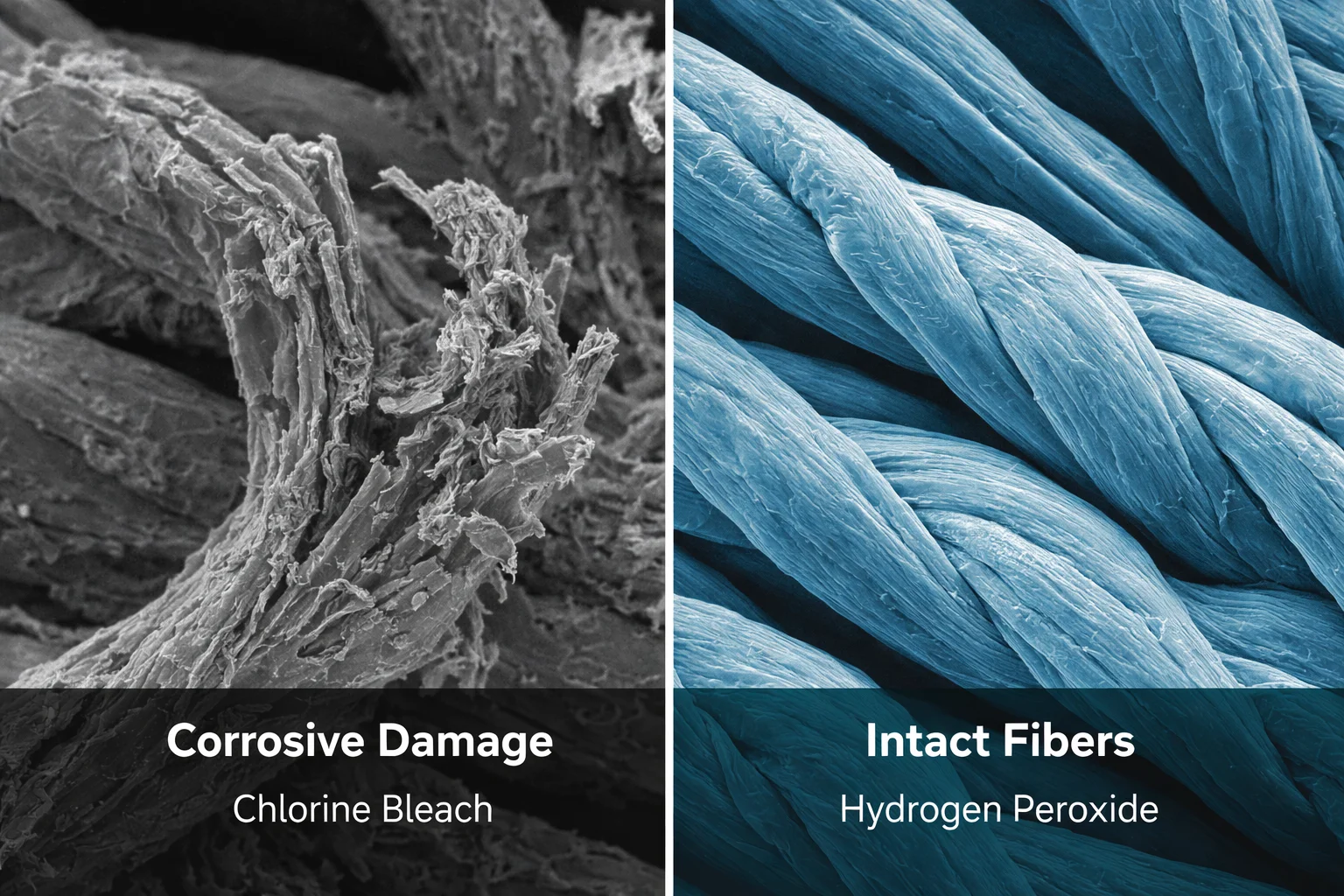
Peroxide is a “surgical” tool. It is less powerful than chlorine bleach but far more precise and less damaging to fibers.
1. The “Oxi” Booster for Whites
Commercial “Oxi-Clean” powders are just sodium percarbonate—a dry form of hydrogen peroxide mixed with washing soda. When dissolved in water, it releases liquid peroxide. You can skip the powder and add liquid peroxide directly to your wash.
- Protocol: Add 1 cup of 3% hydrogen peroxide to the bleach dispenser (or directly to the drum) for white loads.
- Benefit: It brightens yellowing linen and graying cotton by oxidizing the trace organic oils that trap dingy soil.
2. Biological Stain Removal (Blood, Sweat, Berries)
Peroxide is the gold standard for biological stains because it targets protein and plant-based pigments specifically.
- Blood: Apply straight 3% peroxide to fresh blood. Wait for the foaming to stop, then blot. Repeat until gone. (See our Blood Stain Guide).
- Yellow Armpit Stains: Use a 1:1:1 mix of peroxide, baking soda, and water. The baking soda provides the abrasion, while the peroxide breaks down the yellow protein/salt complex. (See Armpit Stain Removal).
3. Disinfection Without Damage
Chlorine bleach disinfects but shreds elastic and eats wool. Peroxide disinfects gently. It is EPA-registered as a sanitizer, effective against Staph, Salmonella, and viruses.
- Protocol: Soak smelly gym clothes or towels in a sink with 1 cup of peroxide for 30 minutes before washing. This kills the bacteria causing the “permastink” without destroying the spandex in your yoga pants.
Concentration Matters: 3% vs. 12% vs. 35%
Not all peroxide is created equal. The concentration dictates safety and usage.
| Concentration | Use Case | Safety |
|---|---|---|
| 3% (Pharmaceutical) | The brown bottle. First aid and standard laundry stain removal. | Safe for skin contact. |
| 6-10% (Hair/Beauty) | “Developer” for hair dye. Stronger bleaching action. | Caution: Can irritate skin and whiten fingers. |
| 12% (Food Grade) | Used for industrial disinfection. | Warning: Corrosive. Must be diluted. |
| 35% (Technical) | Industrial textile bleaching. | Danger: Causes chemical burns instantly. |
For home laundry, always use standard 3% solution. It provides enough oxidative power to clean fabric without burning your skin or degrading the textile rapidly.
The Bottom Line Use only 3% hydrogen peroxide for laundry. Higher concentrations (like food grade or hair developer) can damage fabrics and cause chemical burns.
Safety and Stability

Peroxide has an Achilles heel: Light.
Photons of light provide enough energy to break that weak oxygen bond, causing the peroxide to decompose into water right inside the bottle. This is why it is always sold in opaque brown bottles.
- Storage: Keep it in a cool, dark cabinet.
- Shelf Life: Unopened, it lasts a year. Opened, it starts losing potency after 6 months.
- The “Fizz Test”: If you pour it down the sink drains and it doesn’t fizz slightly, it has turned into expensive water. Buy a new bottle.
The Colorfastness Test
While gentler than chlorine, peroxide is still a bleach. It can alter colors, especially on natural dyes or vintage organic prints.
- The Swap Test: Apply a drop to a hidden inside seam. Wait 5 minutes. Blot with a white paper towel. If color transfers to the towel, do not use it on that item.
- Generally Safe: Most modern synthetic dyes (polyester, nylon, acrylic) and colorfast cottons are immune to 3% peroxide damage.
Never Mix With Vinegar or Chlorine
Chemistry requires respect. Just because two cleaners are “safe” alone doesn’t mean they are safe together.
1. Peroxide + Vinegar = Peracetic Acid While some eco-blogs suggest this, mixing Hydrogen Peroxide and Vinegar creates Peracetic Acid. This is a corrosive acid that can irritate the skin, eyes, and respiratory system. It is effective sanitizer, but too aggressive for casual home use.
2. Peroxide + Chlorine Bleach = Violent Oxygen Release Mixing an oxidizer (peroxide) with a stronger oxidizer (chlorine bleach) creates a violent reaction that releases oxygen gas rapidly (boom) and potentially hazardous chlorine gas. Never mix them.
The Bottom Line Never mix hydrogen peroxide with vinegar or chlorine bleach. Interaction creates corrosive acids or dangerous gas. Used alone, it dissolves into water and oxygen.
Conclusion
Hydrogen Peroxide is the bridge between gentle natural cleaning and harsh industrial chemistry. It harnesses the fundamental power of oxygen to disassemble stains at a molecular level.
Whether you are trying to rescue a white linen shirt from yellowing or sanitize a musty towel, that brown bottle is the most underrated tool in the laundry room. It is science, simplified.
References
- Journal of Surfactants and Detergents. “Oxidative Bleaching Mechanisms of Hydrogen Peroxide.” Springer Link
- Textile Research Journal. “Comparative Degradation of Cotton Fibers by Chlorine vs. Peroxide Bleaching.” Sage Journals
- American Journal of Infection Control. “Virucidal Efficacy of Hydrogen Peroxide.” ScienceDirect
- CDC. “Chemical Disinfectants: Hydrogen Peroxide.” https://www.cdc.gov/