Greenwashing in Cleaning Products: Decoding Labels and Unregulated Terms
Table of Contents
Things You'll Learn From This Article:
- Those green leaves and earthy colors on bottles are often marketing, not proof of safety or sustainability.
- Words like “non-toxic,” “eco-friendly,” and “green” usually have no legal definition and don’t guarantee a product is safe.
- If a claim is vague and sweeping, it’s likely meaningless; specific claims with numbers or test names are more trustworthy.
- “Chemical-free” is a red flag, since everything, including water, is made of chemicals.
- “Natural” ingredients can still irritate skin, trigger allergies, or harm the environment.
- “Plant-based” doesn’t mean unprocessed or harmless; many plant-based cleaners are still heavily modified.
- “Biodegradable” only matters if a timeframe is given, like breaking down within 28 days.
- Certifications matter more than slogans, especially third-party ones like EPA Safer Choice or Green Seal.
- Ingredient lists tell you more than front-label claims; missing or vague ingredients should make you cautious.
- Terms like “fragrance” or “proprietary blend” often hide dozens of undisclosed chemicals.
- State laws, especially in California, have made full ingredient disclosure more common and easier to find.
- A product can be labeled “recyclable” even if it’s unlikely to ever be recycled in real life.
- Packaging with recycled content or refill options usually does more good than “recyclable” claims alone.
- Fake or self-made certification logos are a common greenwashing trick.
- Quick checks—specific claims, real certifications, clear ingredients—can help you avoid being misled at the store.
The cleaning products aisle is drowning in green leaves, earth tones, and reassuring words like “natural,” “non-toxic,” and “eco-friendly.” For anyone trying to find genuinely safer and more sustainable products, this marketing landscape is a minefield of deception called greenwashing.
Unlike food labeling, which is strictly regulated by the FDA, cleaning product labeling in the United States faces much looser oversight. Manufacturers are not federally required to list all ingredients on the label, though regulations are tightening in states like California and New York. This opacity creates fertile ground for vague claims that imply safety without any legal definition.
This guide decodes the most common marketing terms used on all-purpose cleaners, dish soaps, and disinfectants, separating legally meaningful certifications from empty marketing fluff.
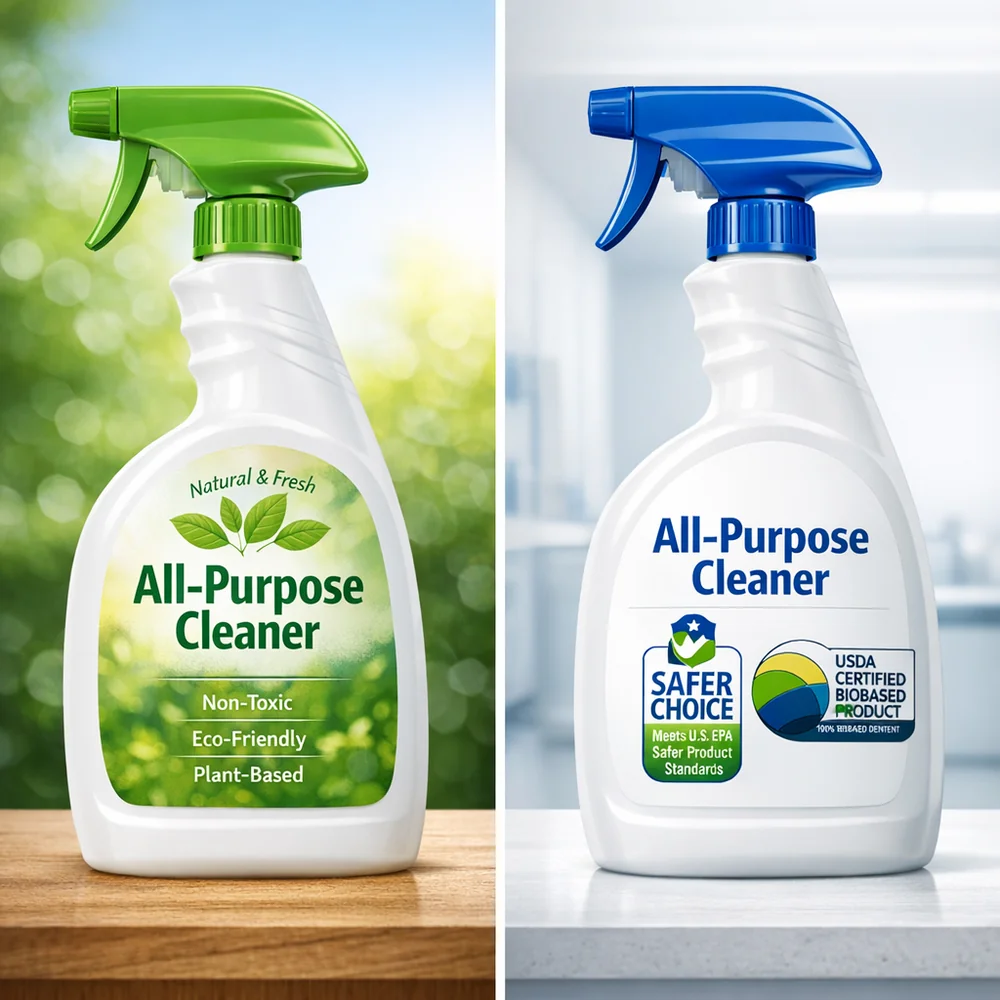
The “Non-Toxic” Lie
“Non-toxic” is perhaps the most persuasive and least regulated term in the cleaning aisle. To a consumer, it implies “safe for humans and pets in all quantities.” To a regulator, it has no specific standard definition unless a particular test is referenced.
From a toxicology perspective, toxicity is always about dose. Even water is toxic in sufficient quantities. A product can be labeled “non-toxic” while containing ingredients that are skin irritants, allergens, or harmful if swallowed.
The Federal Trade Commission “Green Guides” advise marketers that an unqualified “non-toxic” claim conveys that the product is non-toxic to humans and the environment. However, enforcement is reactive. Unless a company is sued or investigated, they can largely use the term as they see fit.
Key Insight: “Non-toxic” is not a government certification. It effectively means “immediate death is unlikely,” not “safe for long-term health.”
Unqualified vs Qualified Claims
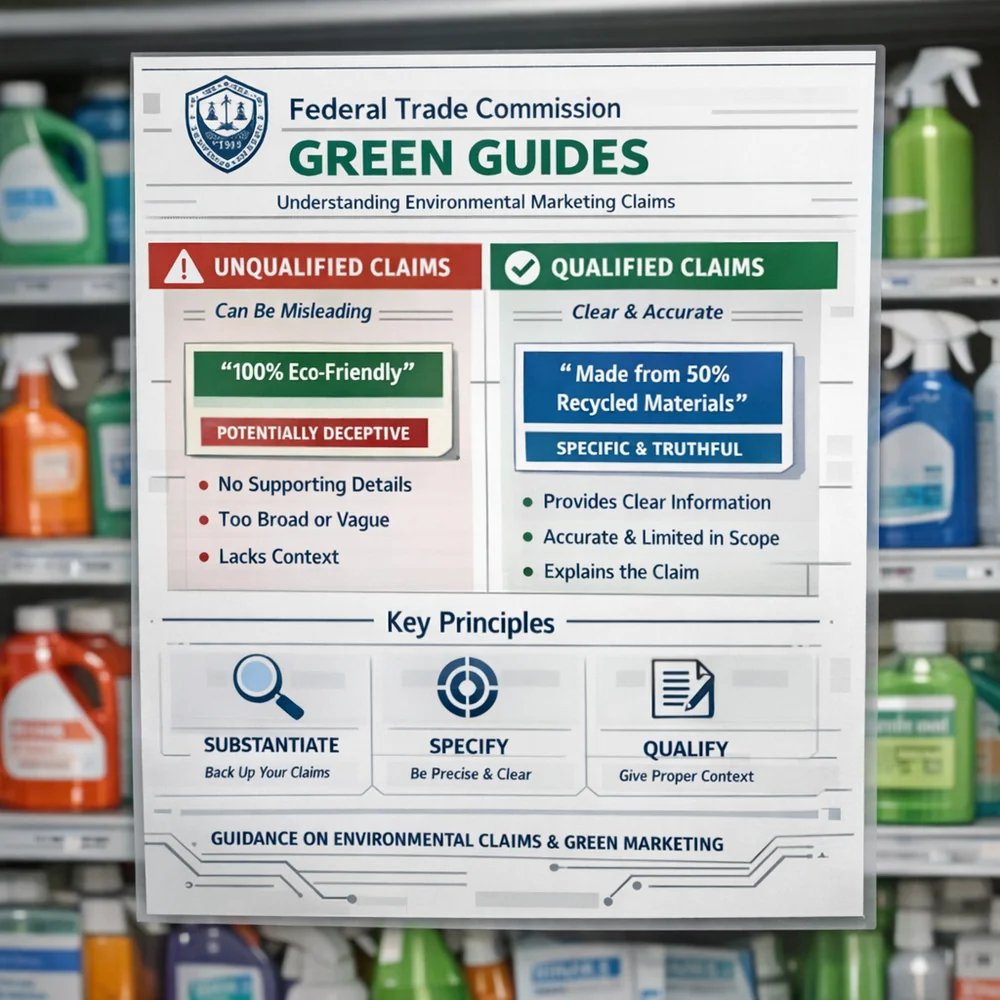
The US Federal Trade Commission provides a framework called the “Green Guides” to prevent deceptive environmental marketing. The core distinction is between unqualified and qualified claims.
Unqualified claims are broad, general statements like “eco-friendly,” “green,” or “better for the planet.” The FTC considers these inherently deceptive because they are impossible to substantiate across a product’s entire lifecycle. A “green” cleaner might have safe ingredients but be manufactured in a coal-powered factory and shipped in non-recyclable plastic.
Qualified claims are specific and limited. For example, “Made with 50% post-consumer recycled plastic” or “Biodegradable in 28 days.” Legitimate brands avoid generalities and use qualified claims backed by laboratory data.
Marketers must ensure claims are prominent and understandable. If a brand claims a product is “recyclable” but the bottle only recycles if you remove a specific non-recyclable sleeve, that qualification must be clearly visible, not hidden in fine print.
Key Insight: Vague claims like “eco-friendly” are legally deceptive because no product can prove it is green across its entire lifecycle.
”Chemical-Free” Is Impossible
Marketing a cleaning product as “chemical-free” is scientific nonsense. Water is a chemical. Vinegar is a chemical. Baking soda is a chemical. Every physical substance in the universe is composed of chemicals.
When a brand uses “chemical-free,” they are counting on consumer fear of synthetic or harmful chemicals. However, using a scientifically impossible term signals a marketing-first approach that prioritizes fear over transparency.
A product claiming to be “chemical-free” is by definition misleading. Legitimate eco-friendly brands use precise language like “free from synthetic solvents” or “no added fragrances” rather than impossible blanket statements.
Key Insight: “Chemical-free” is scientifically false. Legitimate brands say “free from synthetic solvents” or “no added fragrances” instead of making impossible claims.
Natural vs Bio-Based
“Natural” is another vaguely defined term. In cleaning products, it usually implies ingredients from plants or minerals rather than petroleum. But “natural” does not mean safe. Arsenic, lead, and poisonous mushrooms are all natural.
A “natural” all-purpose cleaner might contain d-limonene from citrus oil. That is indeed natural, but it is also a potent skin sensitizer and aquatic toxin. Learn more in our citrus solvent science guide.
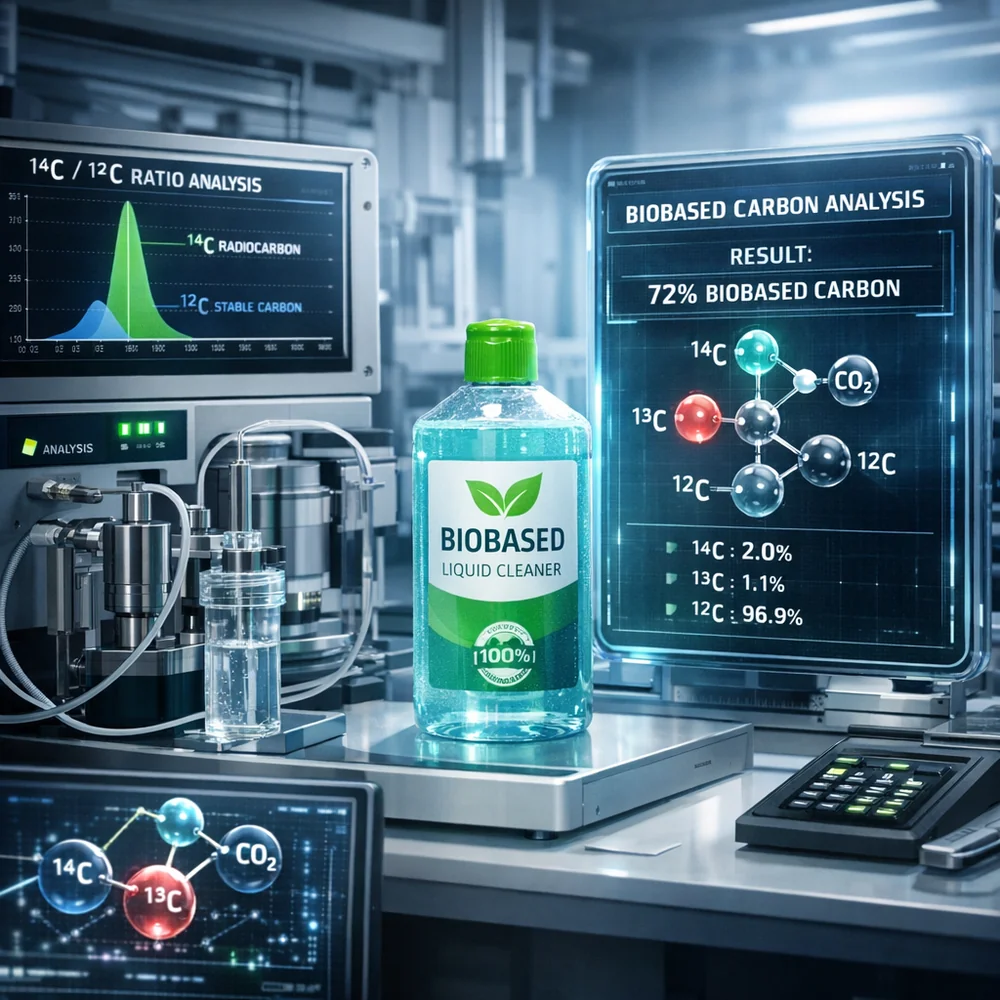
“Bio-based” is the preferred technical term, often backed by the USDA BioPreferred program. This certification measures the actual percentage of carbon in the product that comes from renewable biological sources versus fossil fuels. A product certified as “95% Biobased” has undergone radiocarbon dating analysis to prove its origin.
Key Insight: Ignore “Natural.” Look for the USDA Certified Biobased Product label, which verifies actual plant content through radiocarbon testing.
Biodegradable Without a Timeframe Is Meaningless
The word “biodegradable” implies a product will disappear harmlessly into the environment. Without a timeframe, the claim means nothing. Everything, including plastic, is technically biodegradable if you wait ten thousand years.
The industry standard for “Ready Biodegradability” is the OECD 301 test series. To make a legitimate claim, a surfactant should disappear by at least 60 to 70 percent within a 28-day window in an aerobic environment.
Ready biodegradability means the material breaks down quickly in standard wastewater treatment conditions. That is what you want in a dish soap or laundry detergent. Inherent biodegradability means the material can break down but might take much longer or require rare conditions.
Many “natural” brands use ingredients that are merely inherently biodegradable, meaning they persist in waterways for months, potentially harming fish before they finally decompose.
Key Insight: “Biodegradable” without a timeframe is meaningless. Look for “Ready Biodegradability OECD 301” which means 60-70% breakdown in 28 days.
Plant-Based Does Not Mean What You Think
Consumers often assume “plant-based” means the ingredient was simply squeezed out of a coconut. In reality, modern surfactants are highly processed.
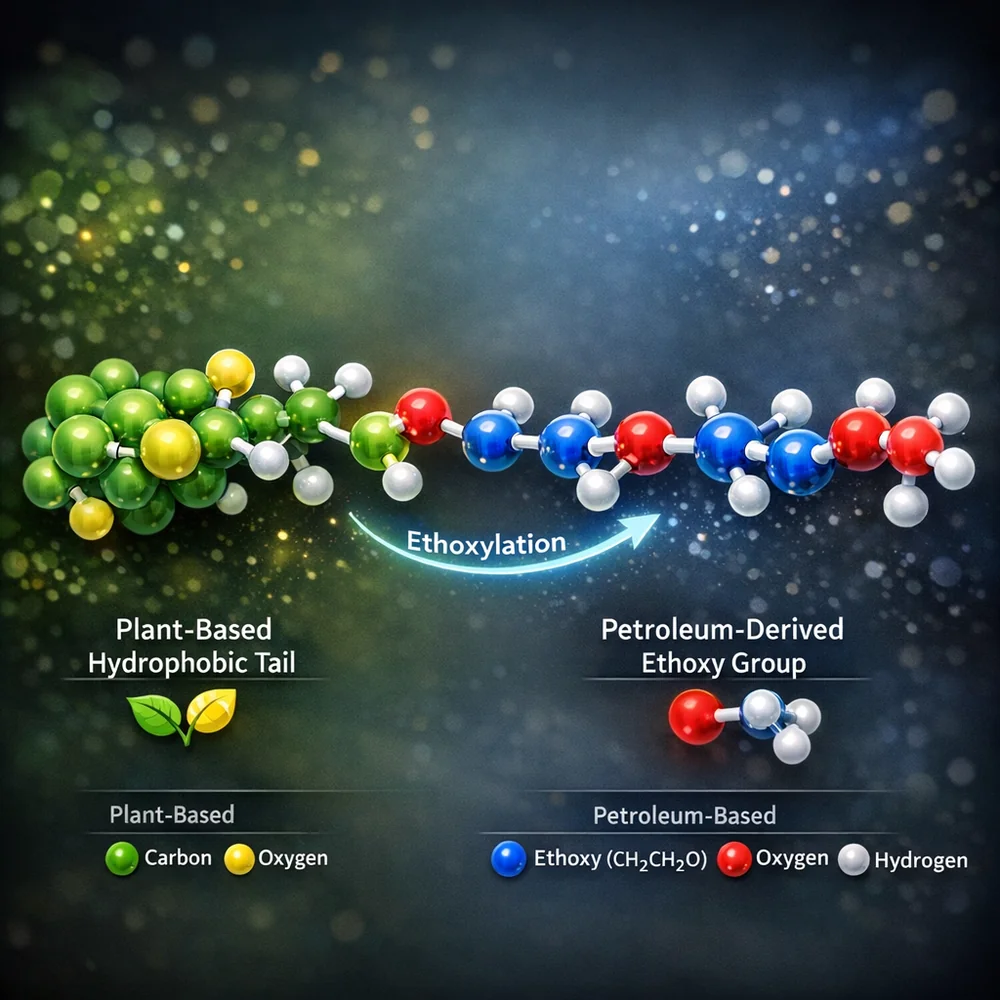
Oleochemicals are surfactants derived from plant oils like palm, coconut, or soy. Petrochemicals are surfactants derived from crude oil. A “90% plant-based” detergent may still have undergone ethoxylation, a process where ethylene oxide, a petroleum derivative, is added to a plant oil to make it a better cleaner.
While the starting material was a plant, the finished chemical is a semi-synthetic hybrid. If the manufacturer does not strip away residual 1,4-dioxane, a byproduct of ethoxylation, even a “plant-based” cleaner can contain a known carcinogen.
Key Insight: “Plant-based” surfactants often undergo ethoxylation using petroleum derivatives. The finished chemical is a semi-synthetic hybrid, not pure plant.
Certifications That Actually Mean Something
Amidst all the noise, several third-party certifications provide genuine verification of safety and environmental standards. These logos represent audits, ingredient reviews, and performance testing.
EPA Safer Choice is the gold standard for US cleaning products. This EPA program reviews every single ingredient against strict master criteria for human health and environmental safety. It puts products in the “safest in class” category and specifically restricts carcinogens, reproductive toxins, and persistent environmental pollutants.
Green Seal is a non-profit certification evaluating products through rigorous lifecycle assessment including raw materials, manufacturing, performance, and packaging. Green Seal standards are often used for institutional cleaning in schools and offices.
EWG Verified, issued by the Environmental Working Group, indicates the product avoids EWG’s chemicals of concern and meets full ingredient disclosure standards. EWG scrutiny focuses heavily on human health safety.
Cradle to Cradle assesses products across five categories: material health, material reutilization, renewable energy, water stewardship, and social fairness. Certifications range from Bronze to Platinum.
Key Insight: EPA Safer Choice is the gold standard. Every ingredient is reviewed by EPA toxicologists against strict safety criteria.
State Laws Are Forcing Transparency
While federal law is lax, state laws are driving change. The California Cleaning Product Right to Know Act of 2017 requires manufacturers to disclose ingredients on product labels and websites for products sold in California.
Because managing different labels for different states is expensive, many national brands have adopted these disclosure standards nationwide. If a “natural” cleaner does not list full ingredients on the bottle or provide a QR code link to the list, treat it with suspicion.
Watch out for “Proprietary Blend” or generic terms like “Surfactant” or “Fragrance” in ingredient lists. These terms hide specific chemical identities. “Fragrance” alone can represent dozens of undisclosed chemicals including phthalates.
Key Insight: California law requires ingredient disclosure for cleaning products. If a brand does not list ingredients, they are hiding something.
Companies That Got Caught
The FTC and other regulators have cracked down on high-profile greenwashing cases that serve as warnings for consumers.
Moonlight Slumber in 2017 claimed its baby mattresses were “organic” and “plant-based.” The mattresses were mostly conventional polyurethane plastic with only a tiny fraction of soybean oil. They also invented their own “Green Safety Shield” logo to look like third-party certification.
LEI Electronics in 2016 marketed alkaline batteries as “80% recycled.” Investigation found that while the box might have used recycled paper, the batteries themselves contained zero recycled material. This is classic bait and switch greenwashing.
Kauai Coffee in 2017 marketed coffee pods as “100% compostable.” The FTC found this deceptive because pods only composted in industrial facilities unavailable to most consumers. For a “compostable” claim to be unqualified, it must work in a standard backyard compost pile.
How EPA Safer Choice Actually Works
The EPA Safer Choice program uses rigorous Master Criteria for different functional classes of chemicals rather than just giving pass/fail grades.
Green Circle means the chemical has been verified as among the safest in its functional class. Yellow Triangle means the chemical is generally safe but has some data gaps or minor concerns keeping it from the top tier. Grey Square means the chemical has not yet been fully evaluated.
When you see the Safer Choice logo, an EPA toxicologist has reviewed the surfactant’s aquatic toxicity, the solvent’s volatility, and the fragrance’s allergen potential. This is far more reliable than a hand-drawn leaf.
Key Insight: Safer Choice uses colored ratings. Green Circle is safest in class. Yellow Triangle has minor concerns. Grey Square is not yet evaluated.
The Recyclable Trap
Greenwashing extends to packaging. A bottle claiming to be “100% Recyclable” refers only to the potential recyclability of the material, not whether it will actually be recycled.
Plastic recycling rates in the US are often below 9 percent. A product in a plastic bottle is likely destined for landfill regardless of theoretical recyclability. See our guide on soap nuts for completely plastic-free alternatives.
Genuine sustainability leaders focus on post-consumer recycled content, meaning plastic that has already been recycled, which creates market demand for recycled materials. They also use plastic-free formats like glass, aluminum, or paper. Refill systems eliminate bottles entirely for subsequent purchases, as seen in many refillable cleaning systems.
Key Insight: “Recyclable” means it could theoretically be recycled, not that it will be. US plastic recycling rates are under 9%.
Quick Audit Before You Buy
When evaluating a new “green” cleaning product, run this five-second audit.
Look for specifics. Does it say “Eco-Friendly” which is vague, or “Biodegradable in 28 Days OECD 301D” which is specific?
Check the logos. Are the green marks generic leaves designed by marketing, or legitimate third-party certifications like EPA Safer Choice?
Find the ingredients. Are they listed clearly with chemical names like Sodium Lauryl Sulfate, or vague descriptions like “Coconut Cleaning Agent”? Transparency usually correlates with safer formulations.
Ignore “Chemical-Free.” Disqualify any brand using this term as scientifically illiterate.
Verify scents. Does it use “Fragrance” which hides chemicals, or “Essential Oils of Lemon and Thyme” which is specific disclosure?
Greenwashing is a mechanism to charge premium prices for standard products by exploiting consumer good intentions. The antidote is literacy. By ignoring front-of-bottle slogans and flipping to the back to read ingredients and verify certifications, consumers can fund genuine innovation rather than marketing departments.
Select products that disclose their chemistry, engage with rigorous third-party certifiers especially EPA Safer Choice, and define their claims with specific technical standards.
Key Insight: Look for specific claims with test standards, third-party logos, full ingredient lists, and detailed fragrance disclosure. Reject vague marketing.
The Bottom Line
References
- FTC Green Guides. “Guides for the Use of Environmental Marketing Claims.”
- EPA Safer Choice. “Identifying Greener Cleaning Products.”
- USDA BioPreferred. “Biobased Product Certification and Labeling.”
- UL Solutions. “Sins of Greenwashing: Environmental Claims Validation.”
- Green Seal. “Ecological Standards for Cleaning Products.”