Washing Neoprene Wetsuits: Preventing Dry Rot & Bacterial Growth
Table of Contents
Things You'll Learn From This Article:
- Rinse your wetsuit thoroughly with fresh water after every ocean session, flexing the material to flush out salt crystals that slowly cut the rubber from the inside.
- Avoid regular laundry detergent, bleach, and washing machines, since they strip out the oils that keep neoprene soft and cause it to stiffen and crack over time.
- Use wetsuit shampoo or mild baby shampoo to clean smells without damaging the rubber, and rely on wetsuit-specific products if you’re in the water often.
- Treat urine and strong odors with enzyme cleaners, which break down the source of smells and protect seam glue from ammonia damage.
- Wash and soak in lukewarm water only, because hot water speeds up rubber aging and makes enzyme cleaners ineffective.
- Dry your wetsuit in the shade, not in direct sun, by hanging it inside out first and then flipping it once the inside is dry.
- Keep your wetsuit away from heat, sunlight, and ozone sources like garages with motors or appliances, since all three accelerate dry rot.
- Never use dryers, heaters, or radiators to speed up drying, as heat drives out the flexibility that keeps neoprene from cracking.
- Rinse and lubricate zippers regularly with wax-based zipper lube to prevent salt buildup and seizing.
- Store your wetsuit hanging on a wide hanger or padded support to avoid shoulder damage and permanent creases that create cold spots.
- Don’t fold or pile wetsuits under heavy gear, because crushed areas lose insulation and never fully recover.
- Dry booties aggressively by stuffing them with newspaper or using no-heat boot dryers to prevent fungus and persistent odors.
- Let antimicrobial or enzyme residues remain after cleaning when recommended, since they continue working between sessions.
- A wetsuit that stays flexible stays warmer, so a few minutes of proper rinsing, drying, and storage directly translates into more comfortable time in cold water.
A quality wetsuit is a serious investment in cold water freedom—the essential barrier that lets surfers paddle out in January swells and divers explore frigid depths. But neoprene is way more delicate than its rugged appearance suggests. This synthetic rubber (technically polychloroprene) is a petroleum-derived foam sandwiched between layers of nylon or polyester jersey.
And it needs almost ritualistic care to keep its flexibility and thermal properties over time. Ocean environments subject wetsuits to relentless assault: salt water, biological contamination from urine and skin bacteria, UV radiation, and atmospheric ozone attacking the rubber’s molecular structure.
The eventual fate of every neglected suit? “Dry rot”—a condition where neoprene becomes stiff, brittle, and prone to cracking at stress points.
Proper maintenance can double or even triple the effective lifespan of quality neoprene. This isn’t just about rinsing away smells after each session. The real work involves managing plasticizer retention, preventing oxidative degradation, and controlling microbial colonization.
The Physics of Neoprene Insulation
A wetsuit’s thermal performance depends entirely on the closed-cell foam structure of neoprene. Within the rubber matrix are millions of microscopic bubbles filled with nitrogen gas instead of air. Nitrogen was chosen during manufacturing because it conducts heat worse than oxygen-rich air, providing superior insulation per millimeter of thickness.
These gas-filled cells create a thermal barrier trapping body heat against your skin. The thickness spec of any wetsuit—whether 3mm for warm water or 5mm for winter—refers to the total volume of this nitrogen gas layer. Thicker suits = more insulating gas = warmer in colder water.
The critical vulnerability: the fragility of these microscopic bubbles. When neoprene dries out, loses plasticizers, or suffers physical damage, cell walls collapse and nitrogen escapes. A suit that’s lost significant cell integrity feels noticeably colder in water even without visible cracks or tears.
You might notice an aging wetsuit just doesn’t keep you as warm as before, even without any obvious degradation. This invisible insulation loss precedes the eventual visible cracking signaling the end of useful life.
Fresh Water Flushing Salt Crystals
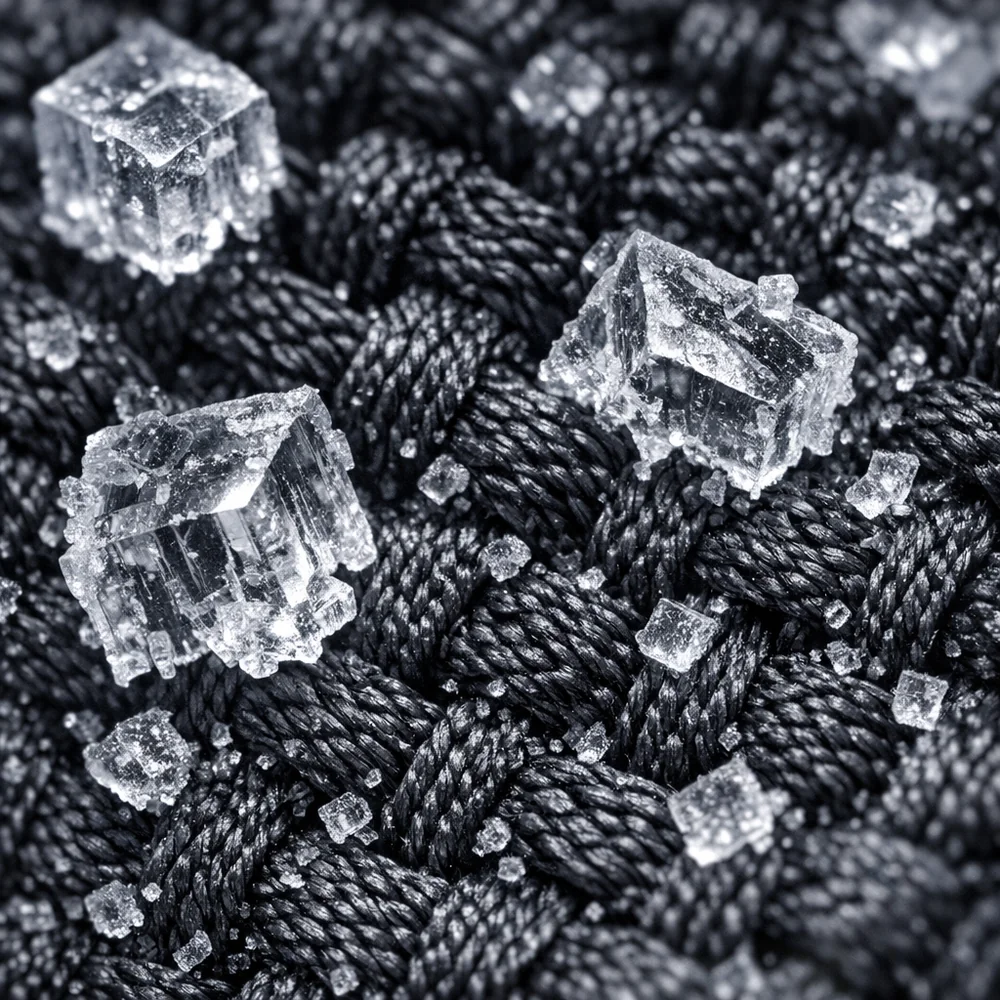
Salt water is the primary threat to neoprene longevity, though the damage mechanism isn’t obvious. When seawater dries on or inside wetsuit fabric, water evaporates but dissolved sodium chloride remains. These salt deposits crystallize into jagged, microscopic crystals lodged in the porous jersey weave and on rubber surfaces.
These crystals function like microscopic razor blades embedded throughout the material. Every time you stretch the suit putting it on, paddle a stroke, or twist during a duck dive—these sharp crystals grind against delicate bubble walls and abrade nylon fibers. Damage compounds with every session as more crystals accumulate and existing ones cut deeper.
A simple bucket dunk is insufficient. Salt crystals already formed need physical flushing to dislodge and remove. The proper protocol: run fresh water through the fabric using a hose or shower head while actively flexing and manipulating the material to open pores and release trapped brine. Both interior and exterior need thorough flushing.
This single habit—performed consistently after every ocean session—is the largest factor in preventing the stiff, crusty deterioration of a poorly maintained suit. Research in Corrosion Science has documented how salt crystallization generates surprisingly powerful mechanical forces as crystals grow within porous materials.
The bottom line: Salt crystals act as microscopic razor blades inside the neoprene; deep flushing is required to dislodge them and prevent internal abrasion.
Why Standard Detergent Destroys Neoprene
The temptation to wash a wetsuit with regular laundry detergent is understandable but chemically misguided. Standard detergents like Tide or Ariel are formulated specifically to attack and solubilize oils and greases. Since neoprene is itself a petroleum-derived product, these aggressive surfactants view the rubber as contamination to strip away.
The primary damage: extraction of plasticizers—chemical additives manufacturers incorporate to maintain softness and flexibility. Plasticizers work by embedding between polymer chains, lowering the glass transition temperature and allowing material to flex without cracking.
According to polymer chemistry research, plasticizer molecules aren’t chemically bonded to the rubber—just trapped within the matrix, making them vulnerable to extraction by solvents and aggressive detergents.
When harsh products leach out plasticizers, neoprene undergoes “work hardening.” The suit becomes progressively stiffer, loses elastic recovery, and eventually cracks at high-flex points like knees, elbows, and shoulders where repeated bending concentrates stress. Products containing chlorine bleach further accelerate degradation by attacking carbon double bonds in polymer chains.
The fundamental rule for wetsuit care: strict pH neutrality in any cleaning product. Never use conventional washing machines for neoprene—mechanical agitation subjects heavy rubber to forces that damage seams and accelerate plasticizer loss through repeated compression and extension.
The bottom line: Standard detergents strip plasticizers from neoprene, initiating “work hardening” that leads to stiffness and permanent cracking at stress points.
Wetsuit Shampoo Ingredients
Specialized wetsuit shampoos aren’t entirely marketing hype. These products are formulated with mild surfactants—typically coco-betaine or similar amphoteric compounds—providing cleaning action without aggressive degreasing properties.
More importantly, quality wetsuit shampoos contain emollients that replenish volatile oils and plasticizers lost through normal use and aging. These conditioning agents maintain rubber suppleness, extending the period before permanent stiffening. Many formulations also include antimicrobial compounds targeting bacteria and fungi colonizing the warm, moist wetsuit interior.
Baby shampoo offers a budget alternative satisfying pH neutrality requirements—many experienced surfers use it successfully. However, baby shampoo lacks conditioning agents found in dedicated products. It cleans effectively but does nothing to slow gradual plasticizer loss. For casual recreational users, baby shampoo may suffice; serious surfers logging significant water time benefit from specialized formulations.
Some products now incorporate biodegradable surfactants suitable for environmentally sensitive marine areas.
The Urine Problem and Seam Integrity
Let’s be real—urinating in wetsuits during cold water sessions is an unspoken reality, though few discuss the chemical consequences. Urine contains urea that bacteria convert to ammonia over time. This ammonia is corrosive not primarily to neoprene itself, but to the adhesives bonding seams together.
Neoprene cement and seam tape rely on chemical bonds that ammonia attacks progressively. Chronic contamination slowly dissolves adhesives, eventually causing seam failures manifesting as leaks at shoulders, underarms, and crotch where urine contact concentrates most.
Simple fresh water rinsing doesn’t neutralize the threat—ammonia has already formed and continues corrosive work while the suit dries. Addressing this requires either avoiding the behavior entirely or implementing chemical neutralization after sessions where it occurs. Enzyme cleaners designed for wetsuits contain urease and protease enzymes breaking down urea and protein residues before bacterial conversion to ammonia occurs.
The bottom line: Urine converts to ammonia, which chemically dissolves seam adhesives. Enzyme cleaners are required to neutralize this threat before it destroys the suit’s integrity.
Enzyme Cleaners for Urine Odors in Wetsuits

The characteristic “wetsuit funk” in heavily used neoprene represents a complex biological ecosystem—mildew, bacteria feeding on urine and skin cells, and algae spores colonizing the damp interior. Enzyme cleaners are gold standard because they digest organic materials rather than merely masking odors or sterilizing with harsh chemicals.
Just as with enzyme detergents for sweat in athletic apparel, wetsuit enzyme treatments use specific biological catalysts breaking down problem compounds. Protease enzymes target protein residues from skin cells and body oils. Urease enzymes specifically attack urea before it converts to ammonia. Lipase enzymes break down oily residues standard soaps leave behind.
Proper application: fill a bathtub or large basin with lukewarm water—never hot, as high temps denature enzymes (making them useless) while accelerating plasticizer loss. Add enzyme cleaner per product directions, submerge suit completely, and knead gently to work solution throughout fabric. Soak at least 30 minutes for enzymatic reactions to proceed.
Counterintuitive but important: unlike conventional cleaning, enzyme cleaners benefit from leaving a microscopic residual film. This residual continues digesting bacterial colonies and organic contamination as the suit dries and between sessions, providing ongoing odor control.
Preventing Dry Rot and Cracking
Dry rot represents oxidative degradation of polymer chains—accelerated by heat, UV light, and atmospheric ozone. Understanding these three factors lets you implement storage and handling practices dramatically slowing the aging process.
Heat increases molecular mobility within the polymer, accelerating all degradation reactions while driving volatile plasticizers out of the rubber matrix. Research shows storage temperatures above 30°C significantly accelerate deterioration compared to cool storage. Leaving a wetsuit in a hot car trunk on a summer day causes more damage than months of proper storage.
UV radiation cleaves carbon-carbon bonds in the polymer backbone—visibly manifesting as black rubber turning gray and developing chalky surface texture. UV-damaged neoprene loses all elasticity and tears with minimal force, often failing catastrophically during normal use after significant sun exposure.
Ozone is a less recognized but equally destructive threat. This highly reactive oxygen species attacks carbon double bonds, completely destroying rubber’s molecular integrity. Electric motors, gas furnaces, and certain air purifiers generate ozone as a byproduct.
Storing wetsuits in garages near workbenches or near laundry areas with running appliances exposes them to elevated ozone. This accelerates degradation even without visible UV or heat damage.
Drying Away from Direct Sunlight
Drying represents a critical phase where improper handling undoes all washing benefits. UV radiation during drying causes significant damage even over short exposure on sunny days.
The optimal protocol: turn the suit inside out immediately after final rinse. This exposes the smooth nylon/polyester lining to air—it dries faster than the textured exterior jersey. More importantly, if UV does reach the suit during drying, it contacts the replaceable lining rather than the critical smooth-skin rubber exterior where flexibility is essential.
Hang the inverted suit in shaded, well-ventilated area away from direct sunlight. A covered porch, garage interior away from ozone sources, or indoor clothesline all work.
Once interior has dried completely, turn right-side out to let exterior finish drying. This two-stage approach minimizes UV damage while ensuring complete moisture removal to prevent mold.
Never use mechanical dryers, radiators, or heat sources to accelerate drying. Temperatures involved drive plasticizer loss far faster than natural air drying while risking thermal damage to seams and stretch panels.
The bottom line: Turn wetsuits inside out immediately. UV damage to the lining is cosmetic, but UV damage to the exterior rubber is catastrophic.
Lubricating Zippers
Zippers are a common and expensive failure point—particularly the main back entry zipper bearing significant stress during donning and doffing. Salt corrosion attacks metal slider components, producing greenish verdigris increasing friction and eventually seizing the mechanism. Salt crystals accumulate between plastic teeth, creating binding that forces damaging force levels.
Prevention: include the zipper track in your fresh water rinse routine, running water along teeth while working the slider back and forth to flush accumulated salt. After drying, periodic wax-based zipper lubricant application reduces friction and provides a protective barrier.
Avoid petroleum-based lubricants like WD-40 or Vaseline—they dissolve neoprene cement around zipper tracks, eventually causing the zipper to pull free from the suit body. Wax-based products designed for outdoor gear (Zip Tech, etc.) provide necessary lubrication without attacking surrounding rubber.
Never force a seized zipper. Resulting damage typically tears neoprene around the track, requiring professional repair or complete zipper replacement. Gentle working back and forth while applying fresh lubricant usually frees minor corrosion binding.
Storage on Wide Hangers to Prevent Creasing
Neoprene exhibits significant shape memory—persistent deformation eventually becomes permanent. Folding a wetsuit and storing under a pile of gear creates creases where nitrogen bubbles become permanently crushed, producing cold spots that will never properly insulate again.
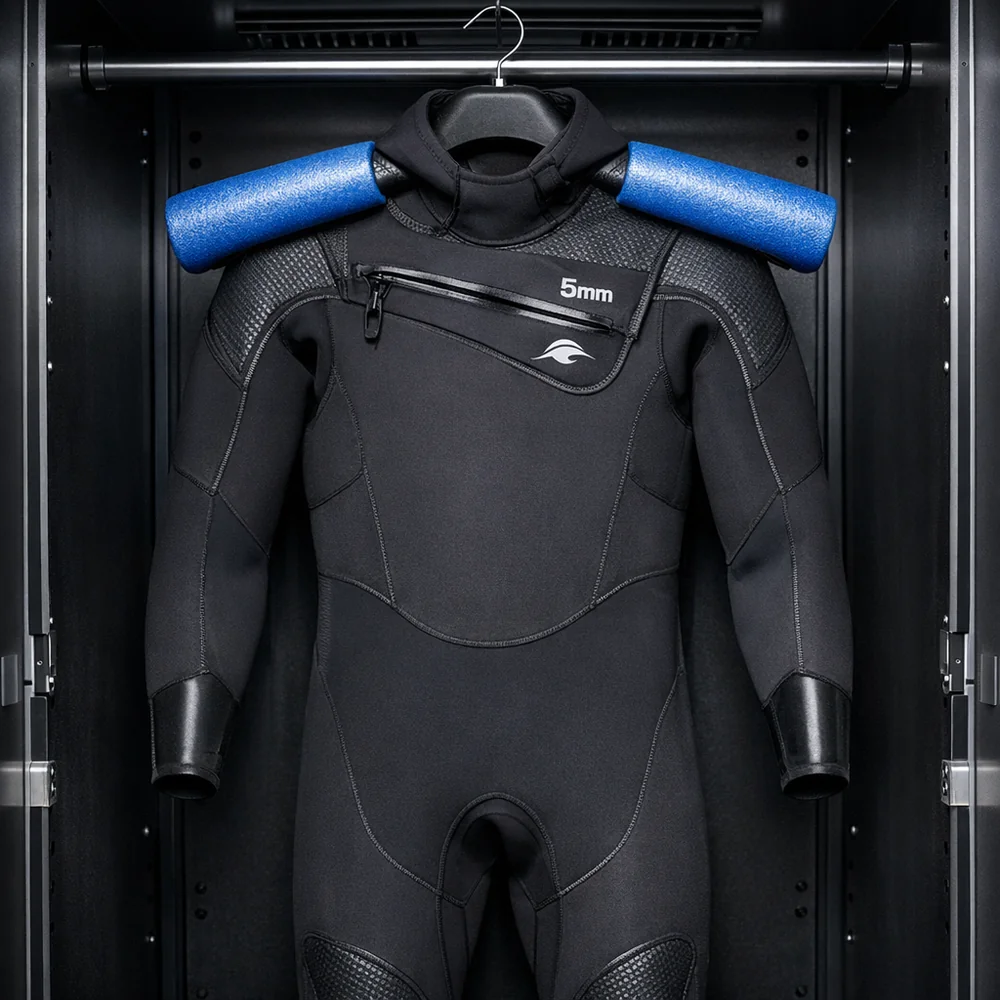
Proper storage requires hanging, but standard thin wire hangers create their own problems. The weight of even a dry 5mm suit concentrated on thin metal edges acts like a cheese wire, slowly cutting into shoulder areas and creating premature failure points.
Wide shoulder hangers designed for wetsuits distribute weight across larger surface area, eliminating cutting action. An inexpensive alternative: slip a pool noodle over a standard hanger for a cushioned surface. Hang by the waist rather than shoulders when possible, further reducing stress on shoulder seams that commonly fail first.
Storage location matters as much as method. Cool, dark closets away from ozone sources, exhaust fumes, and UV through windows provide ideal environments. Suits stored in garages, sheds, or car trunks deteriorate far faster than those in climate-controlled spaces.
The bottom line: Use wide shoulder hangers or a pool noodle to distribute weight; thin hangers act like cheese wire, cutting into the neoprene shoulders over time.
Fungal Prevention Inside Boots
Clean laboratory aesthetic, sharp focus, 8k.” loading=“lazy” />
Neoprene booties present unique challenges because their enclosed design creates ideal fungal colonization conditions. Warmth, darkness, and persistent moisture inside footwear create perfect incubators for athlete’s foot fungi and molds producing the characteristic “cheese smell” of poorly maintained neoprene boots.
Aggressive drying is primary prevention. After rinsing, stuff booties with newspaper to wick moisture from interior surfaces where air circulation is minimal. Replace paper as it saturates until interior is completely dry.
Forced-air boot dryers set to no-heat or low-heat provide faster moisture removal for frequent users needing boots dry for consecutive day sessions.
Periodic dilute antimicrobial solution cleaning helps control existing fungal populations. Pour solution into boots, shake vigorously to contact all interior surfaces, and drain. Don’t rinse—allow residual antimicrobial activity to continue between sessions.
Specialized antimicrobial neoprene fabric now exists with fungal and bacterial inhibitors incorporated directly into the material. Booties from these materials provide inherent resistance, though they still require proper drying.
According to dermatological research, athlete’s foot thrives in exactly the warm, moist conditions neoprene booties provide. Users prone to fungal foot infections should implement particularly rigorous drying and antimicrobial protocols.
Conclusion
Your wetsuit functions as a second skin permitting comfortable existence in otherwise dangerously cold environments. The closed-cell neoprene foam making this possible requires informed care to maintain flexibility, thermal performance, and structural integrity.
Fresh water flushing after every session removes salt crystals that would shred material from within. pH-neutral cleaning products preserve plasticizers keeping rubber soft. Storage away from UV, heat, and ozone prevents oxidative degradation leading to dry rot. Proper hanging avoids permanent creasing crushing insulating gas cells.
A flexible suit is a warm suit—and a warm suit is the difference between cutting a session short and staying out for one more wave in challenging conditions. The few minutes invested in proper care after each session pay dividends in extended lifespan and maintained thermal performance.
References
- Journal of Applied Polymer Science. (2018).
Ozone cracking and oxidative degradation in synthetic rubber. Wiley Online Library. https://onlinelibrary.wiley.com/journal/10974628 2.
Corrosion Science. (2012). Mechanisms of salt crystallization damage in porous materials.
ScienceDirect. https://www.sciencedirect.com/journal/corrosion-science 3. DuPont Performance Elastomers.
Neoprene polychloroprene technical guide and chemical resistance. https://www.dupont.com 4. Surfers Medical Association.
(2015). Dermatological issues in cold water surfers: Wetsuit hygiene. 5.
Wikipedia. Plasticizer chemistry and migration. https://en.wikipedia.org/wiki/Plasticizer 6.
NeilPryde Wetsuit Care Guide. Preventing UV and environmental damage. https://www.neilpryde.com