Ultrasonic Stain Removal Tools: The Physics of Cavitation
Table of Contents
Things You'll Learn From This Article:
- Scrubbing works on tough fabrics but can permanently damage delicate ones like silk and wool.
- Ultrasonic stain removers clean without rubbing, so the fabric surface stays smooth instead of getting fuzzy or worn.
- These tools only work when there’s liquid present; water is not optional.
- Touching the wand to dry fabric can burn a hole because the energy turns into heat instead of cleaning.
- The cleaning comes from tiny bubbles in the water collapsing and blasting dirt loose, not from visible shaking.
- Higher frequencies (around 40–50 kHz) are gentler and safer for delicate fabrics than lower ones.
- Lower frequencies make bigger, harsher bubbles that can damage fine fibers.
- Pressing harder doesn’t clean better; it actually weakens the effect and increases the risk of heat damage.
- Keeping the wand moving prevents hot spots and protects the fabric.
- A towel under the stain helps pull dirty water away so loosened grime doesn’t settle back in.
- Mild, low-foam detergents work best because they help bubbles form and carry energy properly.
- Bleach and strong solvents can cause rapid color damage because ultrasonics speed up chemical reactions.
- Protein stains like blood can get permanently set if heat builds up, so cold water and enzymes are critical first.
- Holding the wand in one spot too long can overheat water, even to the point of boiling.
- The metal tip wears down over time, and a rough tip can snag fabric, so regular inspection matters.
For decades, the standard advice for dealing with a stain was to scrub it. Rub, scrub, or blot. Whether you were using a toothbrush or just your knuckles, the idea was the same: apply friction to the fabric and hope the dirt comes loose.
This works fine for sturdy materials, but it’s a disaster for delicate fabrics. Rubbing wet silk causes fibrillation, which is a permanent fuzzing of the fiber that looks like a faded spot. Scrubbing wool felts the scales together, leaving you with a hard patch.
Enter ultrasonic technology. Borrowed from industrial precision cleaning, where it’s used on everything from surgical instruments to jet engine parts, these tools have been miniaturized for home use. They don’t scrub.
They don’t even move in a way your eye can see. Instead, they use sound waves to create microscopic explosions that blast stains off the fiber without ever touching it.

Acoustic Cavitation: The Mechanism of Action
To really understand how these tools work, you’ve got to get past the idea of simple “vibration.” When people hear a device vibrates, they picture the shaking of an electric toothbrush. Ultrasonic tools operate on a totally different level, using something called acoustic cavitation.
Here’s what’s happening: sound waves traveling through liquid create alternating high and low pressure cycles. During the low-pressure phase, tiny vacuum bubbles form. Then, during the high-pressure phase, those bubbles violently collapse. This implosion releases a localized shockwave of heat and pressure that physically blasts contaminants off the fiber.
These bubbles only exist for microseconds. Their collapse is violent on a molecular scale, generating temperatures near the surface of the sun and pressures of thousands of atmospheres, but all contained in a space smaller than a red blood cell.
When one of these collapsed bubbles happens near a dirt particle stuck to a fiber, the shockwave acts like a tiny crowbar, prying the dirt loose. And because these bubbles can form inside the weave of the fabric, they reach places no brush bristle could ever touch.
The bottom line: Acoustic cavitation creates vacuum bubbles that implode like microscopic crowbars, blasting dirt off fibers without touching them.
The Piezoelectric Wand: Bringing Thunder to Handhelds
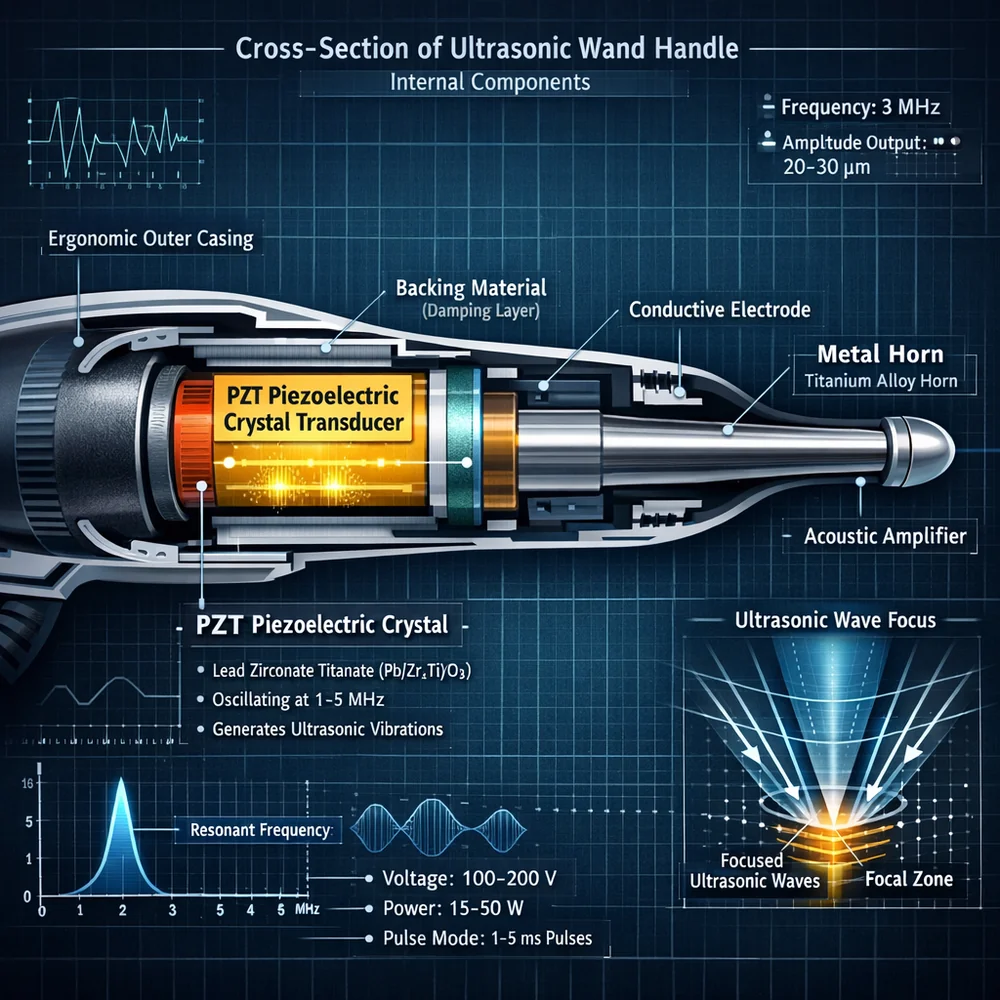
The device that delivers all this energy is the ultrasonic wand. At its core is a piezoelectric transducer, which is a crystal (usually made of lead zirconate titanate, or PZT) that has a special property: it changes shape when electricity runs through it. Feed it a high-frequency electrical signal, and it expands and contracts tens of thousands of times per second.
The energy gets delivered through a metal tip or “wand,” usually titanium or stainless steel. Inside the handle, the piezoelectric transducer converts electricity into mechanical vibration, oscillating the tip at frequencies between 30kHz and 50kHz. This movement is invisible to the naked eye, but you’ll hear a “sizzling” sound.
The tip acts like a hammer. But unlike a regular hammer hitting something, this one hits the water on your shirt 50,000 times a second (at 50kHz). This massive acceleration is what creates the pressure waves needed for cavitation.
How well the wand works depends a lot on the quality of the transducer. Cheaper generic units often struggle to maintain frequency under load, which weakens their cleaning power when you press them against thicker fabric.
The bottom line: Piezoelectric crystals vibrate 50,000 times a second. This “hammering” creates the pressure waves needed for cleaning.
Fabric Safety and Frequency Response
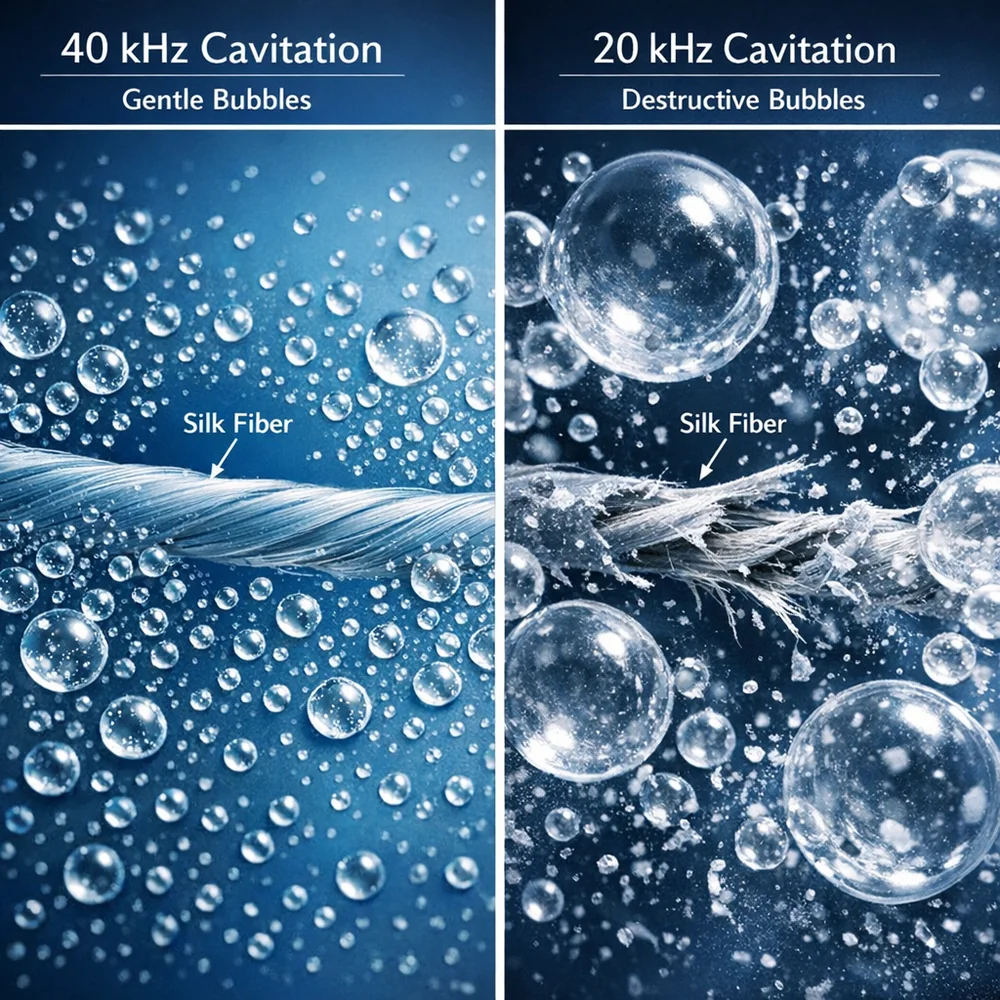
One of the most dangerous misconceptions about ultrasonic cleaners is that they’re safe for all fabrics. That’s not true. The intensity of the cavitation bubbles is inversely related to the frequency.
Lower frequencies create larger, more destructive bubbles. Higher frequencies create smaller, gentler bubbles.
Not all fabrics handle this the same way. Natural fibers like wool and silk have a scale structure that can be damaged by intense cavitation. A frequency of 40kHz is generally safe, but lower frequencies (around 20kHz) produce larger bubbles with more destructive force, which can cause “fibrillation” or fuzzing on delicate silks.
For heavy-duty industrial cleaning, 20kHz is standard. But for a silk blouse, that would likely cause fiber damage. Most consumer stain removal wands run in the 40kHz to 50kHz range, which hits a nice balance between cleaning power and fabric safety. Still, it’s always smart to test on a hidden spot first.
For Gore-Tex and other membrane fabrics, you’ll need to be extra careful. The shockwaves can potentially delaminate the waterproof membrane from the outer fabric if you hold the wand in one spot too long.
The Coupling Medium: Why Water is Mandatory
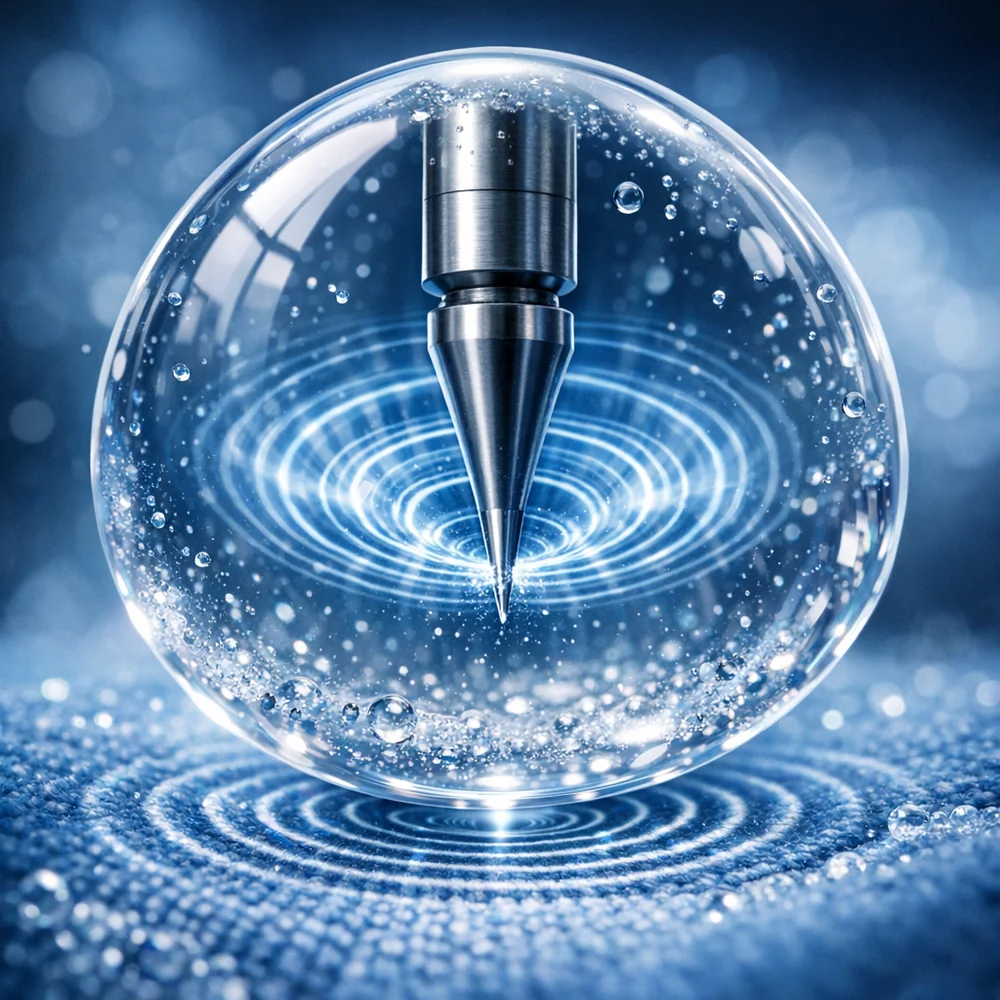
A really common mistake is touching the vibrating wand directly to a dry stain. This does absolutely nothing except ruin your garment. Ultrasound moves poorly through air; it needs liquid to travel effectively.
Without water, the mechanical energy from the tip has nowhere to go. It turns straight into friction heat.
The ultrasound can’t travel through air; it needs a liquid bridge. This is called the “coupling medium.” You’ve got to apply a generous drop of water and detergent between the wand and the stain.
If the wand touches dry fabric, the energy has nowhere to go and creates friction heat, instantly burning a hole in the cloth.
The coupling medium does two jobs. First, it bridges the gap so sound waves can travel from the metal tip into the fabric. Second, it provides the liquid needed for cavitation bubbles to actually form.
No liquid means no bubbles, which means no cleaning. We recommend using warm water mixed with a low-foaming detergent. High-foaming detergents can actually absorb the ultrasonic energy since the air in the bubbles blocks the sound waves instead of carrying them.
The bottom line: Ultrasound cannot travel through air. You must use a liquid “coupling medium” (water) or the friction will burn a hole in the fabric.
Detergent Selection and Surface Tension
Choosing the right detergent matters more with ultrasonics than regular washing. To get maximum cavitation, you want to lower the water’s surface tension. High surface tension makes it harder for bubbles to form. Adding a surfactant (detergent) relaxes the water, letting bubbles form more easily and in greater numbers.
But you’ve got to avoid heavy solvents and bleaches. Cavitation speeds up chemical reactions. A bleach solution that might be safe for a 30-minute soak can strip color in seconds under ultrasonic agitation because the shockwaves are driving the chemicals deep into the dye sites.
Stick to pH-neutral, surfactant-heavy formulas designed for enzymatic cleaning. These work together with the physical action of the bubbles.
Comparison to Traditional Scrubbing
The main advantage of ultrasonic cleaning is that there’s no mechanical abrasion. When you scrub a wine stain with a cloth, you’re relying on shear force. You’re dragging fibers against each other. This often causes “pilling,” where fiber ends break and tangle into small balls.
Ultrasonic cleaning applies force perpendicular to the fiber, not parallel. The shockwaves hit the dirt from all angles, lifting it straight up and out of the weave. This keeps the surface texture of the fabric intact.
For satin, velvet, and high-twist wools, this is really the only way to spot-clean without leaving a visible mark where the texture has been changed.
The bottom line: Scrubbing shears fibers, causing pilling. Ultrasonics lift dirt “up and out,” preserving the texture of satin and velvet.
Protocol for Safe Use
Using these tools requires a shift in how you think. Patience is key. You can’t speed things up by pressing harder.
Pressing the wand firmly against the fabric dampens the tip’s vibration and stops the cleaning action. You need to “float” the tip just above the fabric surface, keeping a constant liquid bridge.
Put an absorbent towel underneath the stain. This “receiver cloth” is really important. As the shockwaves blast dirt out of the garment, it needs somewhere to go.
The towel wicks away the dirty water, stopping it from just settling back onto the fabric. Work in small circular motions, keeping the tip moving so you don’t create hot spots. Add more water/detergent often; the area should never dry out.
Industrial vs Consumer Power Density
New users often get frustrated by the difference between industrial ultrasonic baths and handheld wands. An industrial tank might pump 1000 watts of energy into a 10-gallon bath, achieving a power density of about 25 watts per liter.
A handheld piezo wand, though, concentrates roughly 5 to 10 watts into a droplet of water the size of a pea. This creates a massive local power density, often over 1000 watts per liter in that tiny zone.
This extreme concentration is what lets the wand do “instant” stain removal that a bath would need minutes to achieve. But it also explains why the wand creates heat. The energy density is so high that water in the coupling droplet can literally boil in seconds if you hold the wand still.
The bottom line: Handheld wands have massive power density (1000 watts/liter). They boil water in seconds if held still; keep the wand moving!
The Chemistry of Protein Coagulation
There’s one scenario that needs a special warning: protein stains like blood or egg. Ultrasonic cavitation creates localized heat. While the fabric might feel warm overall, the microscopic cavitation points can reach temperatures that cook protein instantly.
If you use an ultrasonic wand on fresh blood without a cold-water enzymatic detergent, you risk “setting” the stain forever. The heat denatures the protein, making it coagulate and bond permanently to the fiber.
For protein stains, you need to use way more liquid (to act as a heat sink) and keep the wand moving fast to spread out the thermal energy. We recommend pre-treating these spots with a cold protease enzyme soak for at least ten minutes before going in with the ultrasonic.
The bottom line: Cavitation heat cooks protein. Never use ultrasonics on fresh blood or egg without a cold enzymatic pre-soak.
Maintenance of the Wand Tip
The metal tip of the wand takes the same punishment as the stain: thousands of implosions per second. Over time, this causes “cavitation erosion.” The smooth stainless steel surface will start to pit, developing a frosted look.
This pitting isn’t just cosmetic. A rough tip acts like sandpaper, physically scraping delicate fabrics. You should inspect your wand tip monthly under magnification.
If the surface feels rough when you run a fingernail over it, it’s time to either polish the tip with fine jeweler’s rouge or replace the unit. Keep using a pitted wand on silk and you’ll get snagging and fiber pulls, completely defeating the purpose of the non-contact technology.
The Future of Sonic Laundry: Integrated Systems
While handheld wands are the standard for consumers right now, the future is all about integration. Several high-end appliance makers are already experimenting with ultrasonic modules built right into washing machine drums.
Picture a specialized “Stain Cycle” where, instead of the usual tumbling, the drum fills with water and a large high-frequency transducer plate activates.
This would bring the benefits of cavitation cleaning to an entire load at once, effectively pulling sweat salts out of gym clothes or allergens out of bedding without the abrasion of regular agitation. Until these hybrid machines become affordable, the handheld wand is the bridge, letting us bring laboratory-grade physics into our laundry rooms one stain at a time.
Conclusion
Ultrasonic stain removal tools are a real leap forward in garment care, moving from mechanical abrasion to acoustic physics. They let us save delicate items that would’ve been ruined by the scrubbing needed to remove a tough stain. By understanding how cavitation works and respecting the need for a liquid coupling medium, you’re adding a powerful, non-destructive weapon to your laundry toolkit.
References
-
Ultrasonics Sonochemistry. (2019). Mechanisms of acoustic cavitation in textile cleaning.
-
Journal of Cleaner Production. (2020). Efficiency of ultrasonic washing for wool and silk fabrics.
-
Textile Research Journal. (2018). Effect of ultrasonic frequency on tensile strength of natural fibers.
-
Applied Acoustics. (2021). Piezoelectric transducer performance in consumer cleaning devices.
-
Coloration Technology. (2017). Influence of cavitation on dye fastness and fiber surface morphology.