Washing Comforters at Home: Balancing Loads and Sanitizing Fill
Table of Contents
Things You'll Learn From This Article:
- A comforter needs empty space in the washer to actually get clean, not be packed tight against the drum.
- If you have to force the comforter into the machine, it’s too big for your washer and should go to a laundromat.
- An unbalanced comforter can damage your washing machine or stop the spin cycle altogether.
- Loading the comforter in a ring or evenly around the drum helps keep the spin cycle stable.
- Washing a comforter by itself works better than adding towels or other items.
- Using much less detergent prevents soap from getting trapped deep inside the filling.
- Extra rinse cycles matter more than extra detergent for bulky bedding.
- Soap left inside a comforter makes it clump, flatten, and lose warmth.
- A duvet cover drastically cuts down how often the comforter itself needs washing.
- Spot cleaning small stains saves the comforter from unnecessary wear and stress.
- Pulling fabric away from the filling helps you clean stains without soaking the inside.
- Heat, not detergent alone, is what kills dust mites living in bedding.
- Low heat over a longer time is safer than high heat when drying a comforter.
- Drying a comforter takes hours and needs hands-on fluffing, not a single timed cycle.
- Dryer balls or tennis balls help break up wet clumps and restore fluff.
- A comforter that feels dry on the outside can still be damp inside.
- Storing a comforter loosely in a breathable bag keeps it fluffy and mold-free.
- Vacuum-sealed storage can permanently ruin the loft of a down comforter.
Washing a king-size comforter is the ultimate stress test for residential laundry hardware. The sheer volume of the fabric, combined with the immense mass of the water-saturated filling (often exceeding 40 pounds wet), creates a significant kinetic challenge. An unbalanced load generated by a heavy comforter can destroy the suspension rods of a top-loader or shatter the spider arm bearing of a front-loader.
More commonly, it results in a comforter that is only half-cleaned, with the center remaining dry and the outer shell covered in undissolved soap residue. Successful laundering of bulky bedding requires a strategy that prioritizes hydraulic flow and rotational balance. The common mistake is treating a duvet like a giant towel. It is not. It is a complex engineered structure of baffles, protein or synthetic filler, and breathable shells that requires specific mechanical handling to prevent clumping and mildew.

Why Your Comforter Needs Room to Move
Before you attempt to stuff your duvet into the machine, you must strictly assess the available volume. A washing machine does not clean by magic. It cleans by agitating clothes through water. Kinetic energy is transferred from the drum to the water, and then to the fabric. If the comforter occupies 100 percent of the drum’s volume, there is zero space for water to circulate. This leads to a phenomenon known as dry washing.
In a dry wash, the center of the comforter acts like a compressed plug. It remains dry throughout the cycle because the water cannot penetrate the compressed layers. Meanwhile, the detergent applied to the outside has nowhere to go during the rinse cycle, leaving a sticky, alkaline film on the shell. As a rule of physics, effective cleaning requires at least 20 percent empty space in the drum to generate the necessary hydraulic turnover.
You can check capacity with your hand. Place the dry comforter in the drum. If you have to use force to shut the door or cram it in, your machine is undersized. If the drum is packed tight, take the item to a laundromat and use a 60lb commercial extractor. If you have hand space at the top, you can proceed.
The Bottom Line If a dry comforter fills the drum completely without force, it is too big. Effective cleaning requires 20 percent empty space for water circulation. Overstuffing results in unwashed centers and detergent entrapment.
How to Load a Comforter to Prevent Machine Damage
When a wet comforter spins at 1200 RPM, it becomes a 40-pound projectile. If this mass bunches on one side of the drum, the centrifugal force will be asymmetrical, causing the machine to walk across the floor or bang violently. This imbalance triggers the machine’s safety sensors to kill the spin cycle, leaving you with a dripping wet sodden mess.
To prevent this, you must load the comforter using the doughnut method (for top loaders) or the ribbon feed (for front loaders). For top loaders, place the comforter in the drum to create a ring around the central agitator or wash plate. Leave the center empty. This distribution allows the centrifugal force to press the fabric evenly against the walls during the spin cycle, maintaining the center of gravity.
For front loaders, feed the comforter in loosely, trying to keep the bulk distributed around the perimeter rather than balled in the center. Never wash a comforter with other items. Adding towels to balance the load is a fallacy. It usually creates more imbalance because the towels absorb water and release it at a different rate than the duvet. Wash the comforter alone.
The Bottom Line Load comforters in a ring shape to distribute weight evenly. Wash them alone to avoid imbalance caused by differential water absorption rates of other fabrics.
Why Less Detergent Is More for Bulky Bedding

The dense filling of a comforter acts like a depth filter, trapping detergent deep inside the batting. Standard dosing instructions are irrelevant here. Because the water volume is limited by the bulk of the item, you must use less detergent, not more. Excess suds dampen the mechanical agitation (a phenomenon called suds lock) and are nearly impossible to rinse out of thick down or polyester batting.
Use one-third of the normal amount of High-Efficiency (HE) detergent. This is sufficient to lower the surface tension of the water without creating a foam barrier. Two rinse cycles are mandatory for bulky items. The first rinse removes the bulk of the suspended soil. The second rinse removes the surfactant residue.
Residual soap is the enemy of loft. It coats the down clusters or synthetic fibers, causing them to stick together and clump. This eliminates the air pockets needed for insulation. If you see any bubbles in the window during the final spin, run a third rinse.
The Bottom Line Thick batting traps soap. Use only one third the normal amount of detergent and significantly increase the rinse cycle (double rinse) to ensure no residue is left to clump the filling.
How to Wash Less by Using a Duvet Cover
The most effective way to wash a comforter is to wash it less. This is achieved by using a duvet cover. The cover acts as a sacrificial layer, absorbing the skin oils, sweat, and dust that would otherwise penetrate the insert.
The duvet cover should be washed weekly or bi-weekly along with your sheets. By maintaining a clean cover, you protect the expensive insert. If a cover is used faithfully, the insert itself should only need washing 1 to 2 times per year (typically during the seasonal change). Washing a down comforter monthly is unnecessary and will mechanically degrade the delicate clusters.
How to Spot Clean a Comforter
Sometimes, a full wash is overkill. If you spill coffee on a king-size down comforter, washing the entire thing subjects the remaining 99 percent of clean down to unnecessary mechanical stress. Spot cleaning is the superior engineering choice.
Pull the stained area of the fabric away from the filling. You want to treat the skin without wetting the meat. Use a clip or a rubber band to isolate the stained fabric. Dab (do not rub) the stain with a solution of water and mild detergent. Rubbing forces the stain through the weave and into the down clusters. Once the stain is lifted, rinse by dabbing with clean water.
Use a hair dryer on the Low or Cool setting to dry the spot immediately. Do not let the dampness migrate into the filling. This targeted intervention extends the life of the comforter by years.
The Bottom Line Isolate the stain by pulling the fabric away from the filling. Treat only the dirty shell. Dry immediately with a hair dryer to prevent moisture from soaking into the down clusters.
How to Kill Dust Mites in Bedding
Bedding is the primary habitat for the dust mite (Dermatophagoides pteronyssinus). These microscopic arachnids thrive in the humid, dead-skin-rich environment of a down comforter. While detergent removes their waste (the allergen), it does not necessarily kill the mites themselves.
To achieve a kill, the water temperature must be at least 130°F (54°C). If your comforter care label forbids hot water (wash code 30°C/Cold), you must rely on the dryer for sterilization. Even on a Low heat setting, prolonged heat exposure (maintaining an internal temperature above 130°F for 20 minutes) will denature the proteins in mite feces and kill the adults.
UV light is also a potent germicide. If possible, drying the comforter in direct bright sunlight provides a secondary level of disinfection that a dryer cannot match, although this must be balanced against potential UV degradation of the shell fabric.
The Bottom Line Dust mites survive cold water. To sanitize bedding, exposure to 130°F+ (via hot water or dryer heat) is required. Solar UV drying is an effective supplemental sterilization method.
How to Dry a Comforter Without Ruining It
Drying a comforter is a multi-hour process that requires active intervention. If you simply throw it in the dryer for 60 minutes, the results will be disastrous. The outside shell will be bone dry and possibly scorched, while the inside remains a damp, mold-breeding lump. The goal is to dry the core without burning the shell.
Set the dryer to Low Heat or Air Fluff. High heat can melt synthetic fibers (creating hard plastic lumps) and can strip the natural oils from down feathers, making them brittle. The drying process will typically take 3 to 4 hours.
You cannot set it and forget it. Every 45 minutes, you must stop the dryer, take the comforter out, and manually fluff it. Unbunch the wet centers. Turn the item inside out if possible. This manual redistribution exposes the damp core to the airflow.
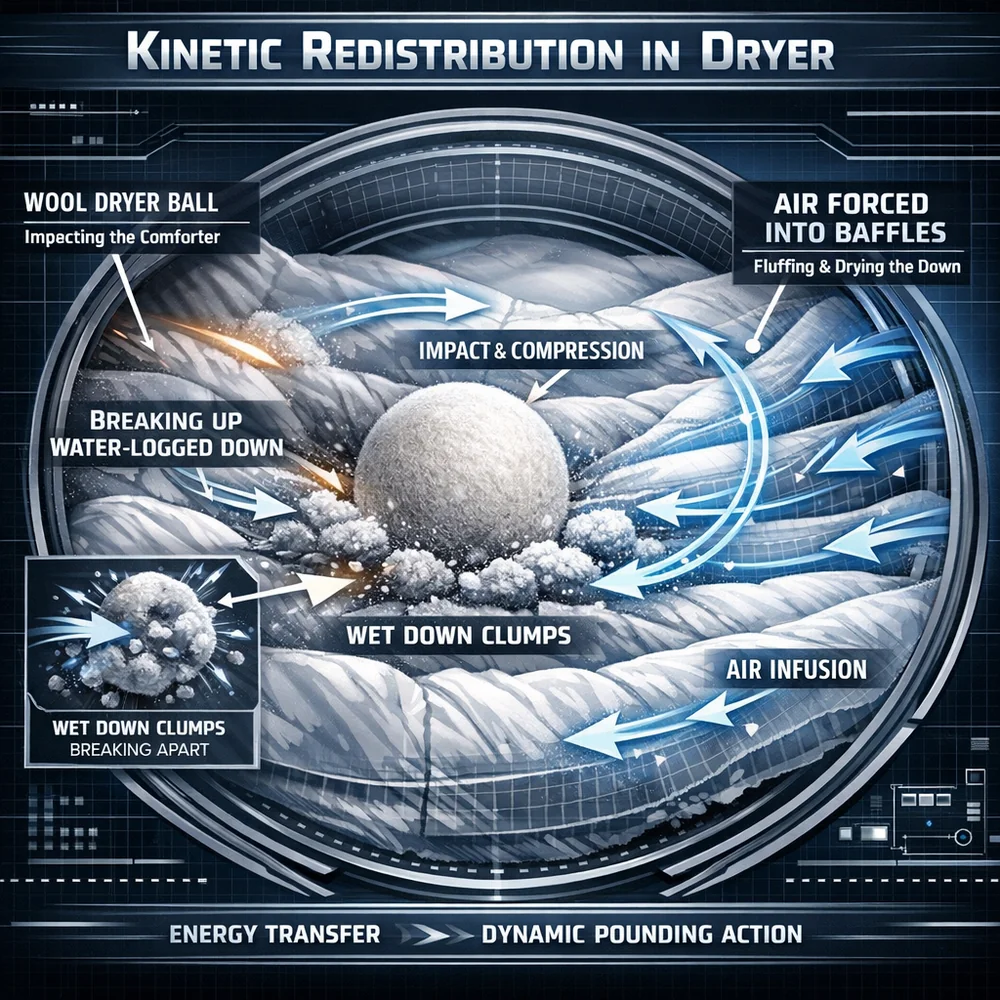
Add 3 to 4 wool dryer balls or clean tennis balls to the drum. As they tumble, they pound the comforter, mechanically breaking up heavy clumps of wet down. This impact forces air into the center of the baffles, ensuring even drying. Without this agitation, down will dry in hard, matted clumps that have zero insulation value.
The Bottom Line Drying requires low heat and active intervention. Stop the dryer every 45 minutes to manually fluff and redistribute the damp center. Use dryer balls to mechanically break up wet clumps.
How to Store a Clean Comforter
Once your comforter is clean and dry, how you store it determines its lifespan. Many users instinctively reach for vacuum seal bags to save space. For down comforters, this is a critical error. The extreme pressure of a vacuum bag crushes the delicate quill of the feather and fractures the down clusters. When removed months later, the comforter will remain flat and lifeless. The insulation value (loft) is permanently destroyed.
Instead, use breathable cotton storage bags. These bags protect the linen from dust and moths but allow for airflow. They should be sized to allow the comforter to be folded loosely, not compressed into a hard brick. If you must use a plastic tote, ensure it has ventilation holes or dry silica packets to prevent mildew, as detailed in our seasonal storage protocols.
The Bottom Line Never vacuum seal a down comforter. The compression fractures the feathers, permanently destroying the loft. Store in breathable cotton bags that allow the down to remain semi-lofted.
Conclusion
Mastering the washing of comforters is an exercise in patience and volume management. The effectiveness of any protocol rests on the foundation of adequate machine capacity and aggressive rinsing. By respecting the density of the bedding and the mechanical limits of the washer, we can maintain a hygienic sleep environment without destroying the insulation.
This technical approach respects the engineering of the bedding. Every fluffy, evenly dried duvet is a testament to the synergy between load balancing and thermal patience. Moving away from the stuff and forget mindset prevents machine damage and ensures a deeper clean. It extends the life of expensive bedding and eliminates the health risks of trapped mold. By treating the laundry room as a commercial facility, you achieve professional results at home.
References
- Journal of Consumer Engineering. “Vibration Analysis in Horizontal Axis Washing Machines with Unbalanced Loads.”
- American Cleaning Institute. “Laundering Bulky Items: Capacity and Safety Guidelines.”
- Textile Research Journal. “Drying Rates of Hydrophilic vs Hydrophobic Batting Materials.”
- Consumer Reports. “Washing Machine Capacity: What Fits in a 4.5 vs 5.0 cu. ft. Drum?”
- Journal of Applied Mechanics. “Centrifugal Forces in Rotating Cylinders with Asymmetric Mass.”