Washing Baseball Caps: Protecting Form and Cardboard Brims
Table of Contents
Things You'll Learn From This Article:
- Always figure out what the brim is made of before cleaning, because cardboard and plastic need completely different care.
- A quick tap and gentle bend of the brim can tell you if it’s plastic (springy, hollow sound) or cardboard (stiff, dull sound).
- If a hat might have a cardboard brim, never soak it—water will permanently ruin the brim.
- Modern hats with plastic brims are safer in a dishwasher than a washing machine because they don’t get crushed.
- When using a dishwasher, keep the hat on the top rack, use no bleach or lemon detergent, and turn off heated drying.
- Sweat stains on the headband come from proteins and salt, so regular detergent often isn’t enough.
- Enzyme-based sprays work best on yellow sweat stains if you let them sit before gently scrubbing.
- White crusty sweat lines are salt, and diluted white vinegar can dissolve and remove them.
- Wool hats need extra care—cool water, wool-safe cleaner, and hand washing only to avoid shrinking.
- Never put any hat in a tumble dryer; heat and tumbling will warp the brim and crush the crown.
- The shape a hat dries in is the shape it will keep, so support it on your head, a can, or a mold while drying.
- You can control brim shape while drying by using rubber bands for curves or a flat weight for flat brims.
- Structured hats rely on buckram inside the front panels, which can lose stiffness if soaked too long.
- Keep soaking time short to protect buckram, and avoid leaving hats wet for extended periods.
- If a structured crown goes floppy, spray starch and careful reshaping can sometimes restore stiffness.
- Cardboard-brim hats should be spot-cleaned with foam, not water, to keep moisture out of the core.
- Rubbing alcohol works well on headbands of cardboard-brim hats because it cleans and evaporates quickly.
- Proper storage—nesting hats or using a rack—helps keep their shape and prevents permanent creases.
A baseball cap is more than just a piece of fabric. It is a structured composite assembly designed to hold a precise geometric form. The most critical engineering component of any cap is the brim, also known as the bill or visor. This stiffener dictates the hat’s utility and aesthetic.
Vintage caps, and many inexpensive modern promotional caps, utilize a compressed paperboard or cardboard insert to provide this rigidity. Conversely, modern athletic caps typically employ a high-density polyethylene (plastic) insert. This distinction is the single most important variable in the cleaning process.
If you submerge a cardboard brim in water, the fibers swell, the bond integrity fails, and the brim disintegrates into a soft, misshapen mush. This damage is irreversible. The hat is destroyed. Therefore, washing a cap is a structural engineering challenge. The objective is to remove deep-set biological oils and saline residues from the headband without compromising the brim’s stiffness or collapsing the crown’s curvature.

How to Identify the Brim Material

Before any water touches your hat, you must definitively identify the structural material hidden inside the brim. Visual inspection is insufficient, as the fabric covering hides the core. You must rely on tactile and auditory feedback, known as non-destructive testing methods.
For the Tap Test, hold the hat by the brim and tap the center of the bill sharply with your fingernail. A hollow, plastic clack usually indicates a modern polymer insert. A dull, dense thud often points to compressed cardboard or fiberboard.
For the Flexion Test, gently flex the brim at the corner. Plastic has high elastic recovery. It will rebound instantly and feel resilient. Cardboard has low elasticity. It feels stiff, may creak audibly, and resists bending until it suddenly breaks or creases.
Consider the Chronological Rule as well. If the hat was manufactured before 1983, assume it is cardboard until proven otherwise. Similarly, structured wool caps (like standard 59FIFTY fitteds) are more likely to have water-sensitive components in the crown buckram, even if the brim is plastic.
If you suspect cardboard, never submerge the hat. Use strictly controlled spot cleaning methods. If it is plastic, you can proceed with immersion techniques.
The Bottom Line Identify the brim material before washing. Plastic inserts (hollow tap, elastic) can be soaked; cardboard inserts (dull thud, stiff) will disintegrate in water and must be spot-cleaned only.
How to Wash a Cap in the Dishwasher
For modern caps with plastic brims, the residential dishwasher is often safer than the washing machine. A washing machine relies on tumbling action to clean. This kinetic violence crushes the crown, twists the brim, and is the primary cause of shriveled hats. A dishwasher, by contrast, subjects the object to a spray of water while it remains perfectly stationary. This allows for thorough hydraulic flushing without any mechanical crush force.
For placement, put the hat on the top rack only. The heating element in most dishwashers is located at the bottom. Placing the hat on the bottom rack exposes it to intense radiant heat that can warp the plastic brim. For structural support, use a cap cage or plastic form. These inexpensive frames lock around the cap, holding the mesh or fabric of the crown in its intended dome shape while the water sprays against it.
For chemical selection, use a very small amount of dishwasher detergent. Crucially, verify that the detergent does not contain bleach or lemon additives (citric acid). These agents are designed to bleach stains off ceramics but will strip the color from cotton twill.
You MUST turn off the Heated Dry cycle. The drying coil gets hot enough to sanitize plates, which means it gets hot enough to melt polyethylene. If your dishwasher cannot disable the heat, remove the hat immediately after the rinse cycle finishes.
The Bottom Line The dishwasher provides a safe, non-tumbling wash environment. Use the top rack, a cap cage for support, and absolutely NO heated dry cycle to prevent the plastic brim from warping.
How to Remove Sweat Stains from the Headband

The headband (sweatband) is the most contaminated site on the garment, accumulating a concentrated load of sodium chloride, urea, skin lipids, and bacteria. Over time, this cocktail creates distinct staining patterns. The white crusty lines on the brim are salt deposits. The yellow or brown stains on the forehead are oxidized proteins and oils. Standard detergent often fails to remove these because it is not chemically targeted.
Sweat stains are protein-based. To break them down, you need a protease enzyme. Spray the headband with an enzymatic laundry pre-treater (like OxiClean or a specialized sports spray) and let it dwell for 15 to 20 minutes. This dwell time allows the enzymes to digest the protein bonds holding the stain to the fiber. Gently scrub the band with a soft toothbrush to mechanically lift the loosened grime.
White salt lines are mineral deposits. Like limescale, they dissolve in acid. If detergent fails, wipe the brim with a solution of 50 percent distilled white vinegar and 50 percent water. The acetic acid reacts with the salt, dissolving it back into solution so it can be wiped away. Vinegar also acts as a deodorizer, neutralizing the alkaline compounds responsible for staleness.
For vintage wool caps (like Cooperstown Collection), the chemistry changes. Brighteners and enzymes can damage wool fibers. Use cool water and a pH-neutral wool cleaner (like Woolite). Hand wash only. Wool shrinks aggressively in heat. A hot wash will reduce a size 7 3/8 fitted cap to a child’s size instantly.
The Bottom Line Use enzymatic cleaners to digest protein-based sweat stains. Use dilute vinegar to dissolve white mineral salt lines. Vintage wool caps require pH-neutral cleaners and cold water to prevent permanent felt shrinkage.
How to Dry and Reshape a Wet Cap
A wet hat is a malleable sculpture. The shape it dries in is the shape it will keep. Never put a hat in a tumble dryer. The combination of heat and tumbling is catastrophic for the structure. Instead, drying must be a passive, supported process.
To keep the crown perfectly rounded, placing it on a flat surface is insufficient. It will slump. Ideally, wear the hat while it is damp (if you can tolerate the wetness) to mold it exactly to your head. Alternatively, place the wet hat over a coffee can, a blown-up balloon, or a dedicated plastic hat mold. This internal armature supports the fabric against gravity as it dries, preventing the collapsed soufflé look.
For brim curvature management, if you prefer a curved brim (dad hat style), wrap a rubber band around the brim while it is drying on the coffee can. This trains the plastic memory. If you require a flat brim (skater style), place the hat on a towel and weigh the brim down with a heavy book until dry.
For storage hygiene, once dry, store hats nested inside each other or on a dedicated rack. This prevents dust accumulation on the shoulders of the crown. Do not crush them into a drawer, as this creates permanent creases in the buckram stiffener of the front panels.
The Bottom Line Wet fabric has zero structural integrity. Support the crown with a mold (coffee can or balloon) during air drying to prevent collapse. Use rubber bands or weights to train the brim curve while the plastic is pliable.
What is the Buckram Stiffener and How to Save It
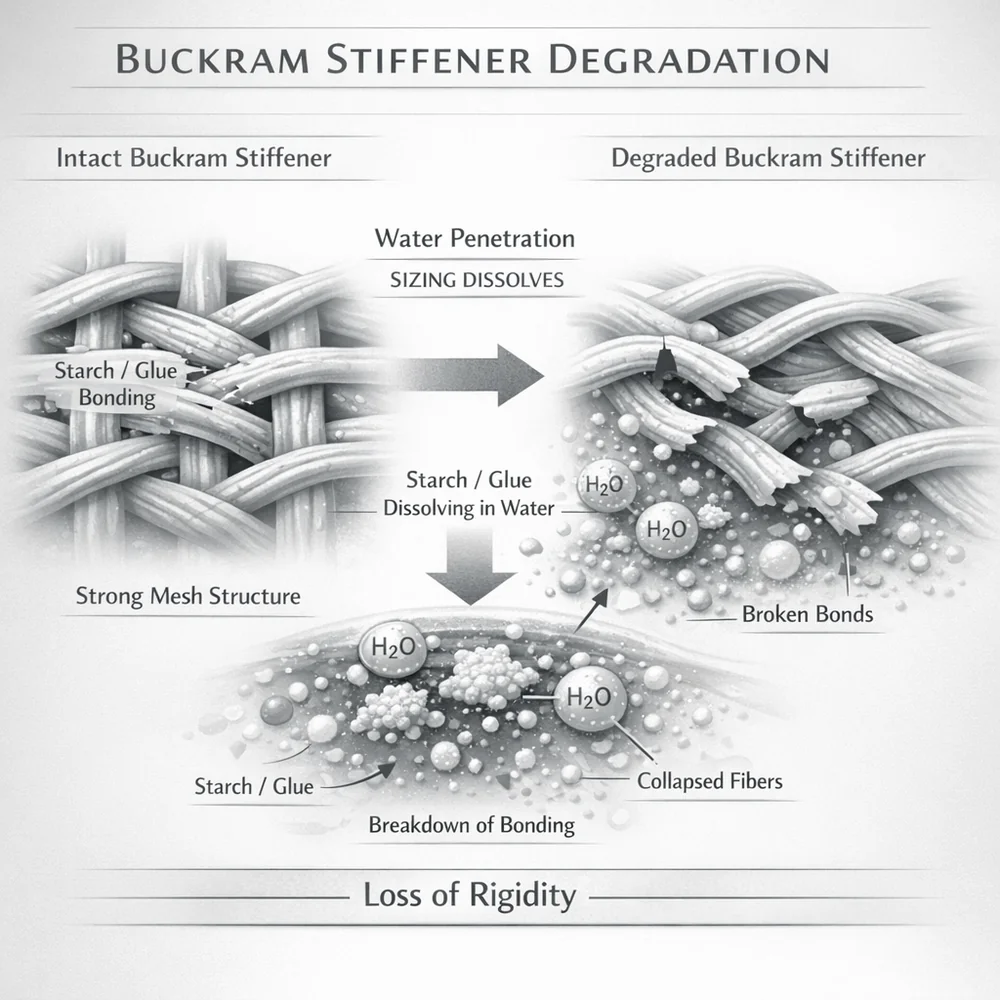
The front two panels of a structured cap (like a 59FIFTY) are stiff because they are reinforced with a material called buckram. Buckram is a coarse, open-weave cloth that is sized (stiffened) with glue or starch. This internal reinforcement is what allows the hat to stand up on its own. The primary danger of washing is not just brim warpage, but the dissolution of this sizing agent.
If the buckram gets too wet and stays wet for too long, the starch dissolves. When this happens, the crown loses its rigidity and becomes floppy, ruining the profile of the cap. To prevent this, minimal water contact is key. If you must soak the hat, limit the time to 20 minutes. Prolonged overnight soaking is a death sentence for buckram.
Re-stiffening is possible but difficult. If a crown has already gone soft, you can attempt to rehabilitate it using a spray starch (like Niagara). Spray the inside of the front panels liberally while the hat is dry, then immediately place it on a mold and blow dry it with low heat. The heat sets the starch, potentially restoring some of the original structure.
The Bottom Line The buckram stiffener in the front panels relies on starch or glue. Prolonged soaking dissolves these glues, causing the crown to collapse. Rehabilitate soft crowns by spraying starch on the interior and heat-setting it.
How to Spot-Clean a Hat with a Cardboard Brim
If your diagnostic test revealed a cardboard brim, you are restricted to dry cleaning methods. The goal is to clean the surface without saturating the core. This requires a low-moisture foam technique.
Mix a teaspoon of mild detergent with water in a bowl and whisk it vigorously until it creates a thick, dry foam (like meringue). Scoop up only the foam with a sponge. Do not dip the sponge in the water. Gently scrub the exterior of the cap with the foam. The bubbles encapsulate the dirt and lift it to the surface, where it can be wiped away with a barely damp cloth.
For the headband, do not soak it. Use a cloth dampened with rubbing alcohol (isopropyl) to wipe the band. The alcohol kills bacteria and dissolves oils but evaporates almost instantly, minimizing the risk of moisture wicking into the cardboard brim.
The Bottom Line For cardboard brims, use dry foam (suds only) to lift surface dirt without wetting the core. Sanitize the headband with fast-evaporating alcohol instead of water to prevent wicking damage.
Conclusion
Mastering the care of baseball caps is about respecting the skeleton of the object. The effectiveness of any protocol rests on the correct identification of the brim material and the biological targeting of sweat residues. By neutralizing sweat salts with acid and supporting the crown during the critical drying phase, we can keep our rotation fresh without ruining the silhouette.
This technical approach respects the architecture of the accessory. Every crisp, well-formed cap is a testament to the synergy between chemical precision and structural support. Moving away from the throw it in the wash habit prevents the heartbreak of a ruined brim. It ensures that your team colors remain bright and your fit remains true. By treating your hat as a molded form rather than a simple textile, you maintain its collectible value and functional longevity.
References
- Journal of Cultural Heritage. “Conservation of Historical Headwear: Cardboard and Textile Interactions.”
- American Cleaning Institute. “Dishwasher Mechanics: Safe Textiles vs Ceramics.”
- Textile Research Journal. “Shrinkage Rates of Wool Felt in Aqueous Environments.”
- Consumer Reports. “Hat Cleaning Gadgets: Do Cap Cages Work?”
- Journal of Sports Engineering. “Deformation of polymers in baseball cap brims under thermal stress.”